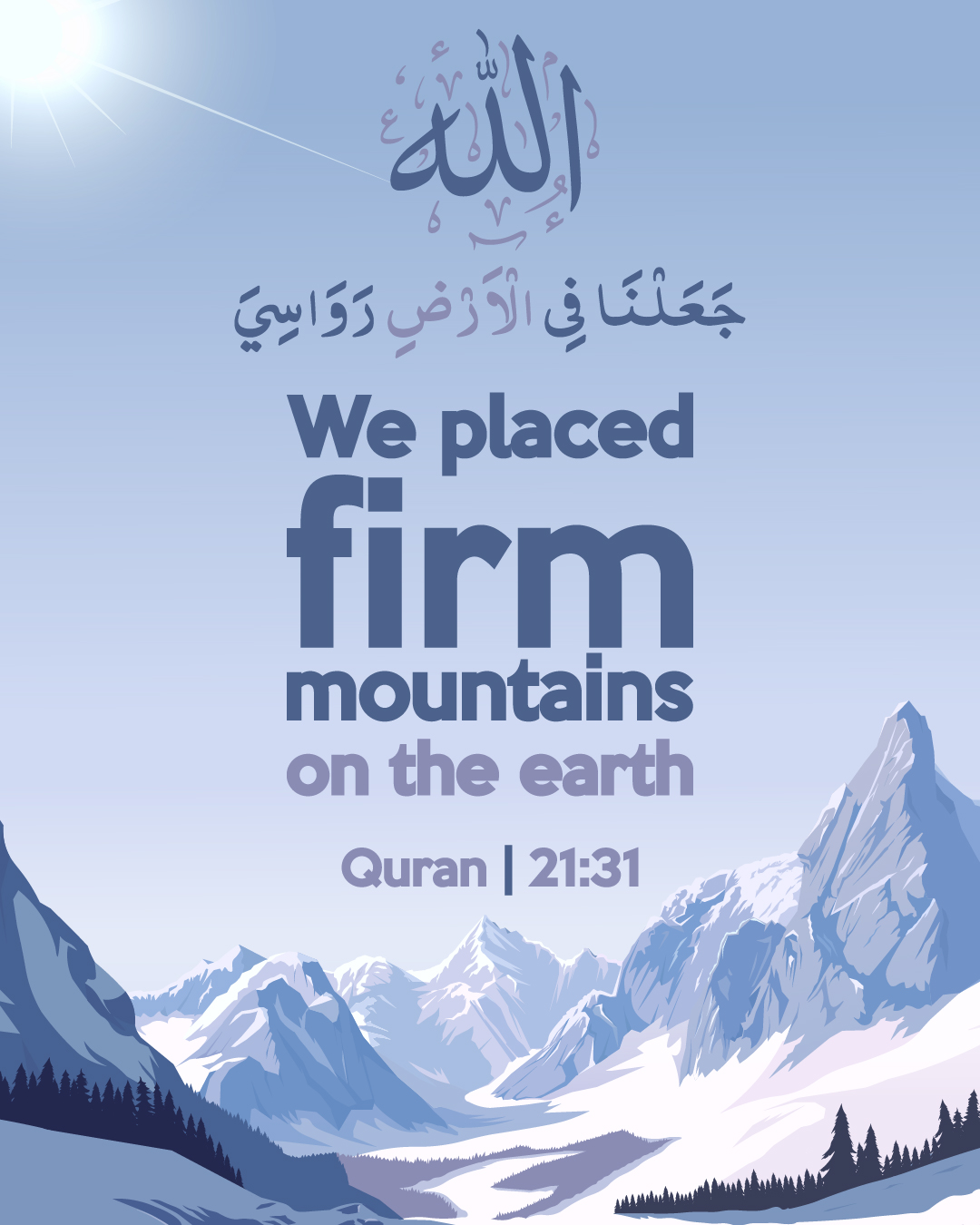
The Quran describes mountains as firm anchors (rawasiya) placed on the earth to prevent it from shaking (Quran 21:31) and as pegs (awtad) driven into the ground (Quran 78:6-7). These descriptions align with the modern geological understanding that mountains have deep roots stabilising tectonic plates.
While the Quran does not use the term ‘plate tectonics,’ it describes mountains as stabilisers that prevent the earth from shaking — a function that modern geology attributes to mountain roots anchoring tectonic plates. This description was made over 1,400 years before the theory was developed.
The Arabic word ‘awtad’ means pegs or stakes. Just as a peg is driven into the ground with most of its structure hidden below the surface, mountains have deep roots extending far into the earth’s crust — a fact confirmed by modern geology.




Allah Says About Mountains in the Quran
وَجَعَلۡنَا فِی الۡاَرۡضِ رَوَاسِیَ اَنۡ تَمِیۡدَ بِہِمۡ ۪ وَجَعَلۡنَا فِیۡہَا فِجَاجًا سُبُلًا لَّعَلَّہُمۡ یَہۡتَدُوۡنَ ﴿۳۱﴾
“We placed firm mountains on the earth so it would not shake with them, and We made in it broad roads as pathways so that they might be guided.”
This verse from Surah Al-Anbiya describes two functions of the earth’s landscape: mountains that stabilise the surface and pathways that allow movement. The description of mountains in the Quran as anchors that prevent the earth from shaking is a statement that modern geology has remarkably confirmed.
How the Quran Describes the Function of Mountains
Allah says He placed firm mountains — “rawasiya” — on the earth so it would not shake. The Arabic word carries the meaning of deep, anchored pegs, not just elevated rock formations. Modern geology has confirmed that mountains have deep roots extending into the earth’s crust, functioning as stabilisers for tectonic plates. This description was made in the Quran over 1,400 years before the theory of plate tectonics was developed. The precision of this language is one of the reasons mountains in the Quran are frequently cited in discussions about the compatibility of science and faith.
The verse then adds a second function: broad roads as pathways. Allah did not only stabilise the earth — He made it navigable. Mountain passes, valleys between ranges, and natural corridors have guided human travel and trade routes for millennia. As Al-Hakeem, the All-Wise, Allah designed the earth’s geography not just for structural integrity but for human benefit. Every mountain and every valley serves a purpose in a system engineered by the Creator.
“And the mountains as pegs? Have We not made the earth a resting place and the mountains as stakes?”
This verse from Surah An-Naba uses the word “awtad,” meaning pegs or stakes driven into the ground. This imagery perfectly mirrors the geological reality that mountains are not simply sitting on the surface — they have deep roots that anchor the earth’s crust. The Quran’s consistent use of this language across multiple surahs reinforces that it is not metaphor but a deliberate description of how mountains function. As Al-Khaliq, the Creator, Allah designed these structures with engineering that humanity would take centuries to understand.
What Mountains in the Quran Teach About Allah’s Design
Mountains in the Quran are never mentioned as random geographical features. They are always presented as signs of Allah’s power and as evidence of intentional design. The earth needed to be stable for life to flourish, and Allah placed mountains to achieve that stability. The earth needed to be traversable for civilisation to develop, and Allah carved pathways through the mountains to make that possible. Every feature of the landscape serves a function, and recognising that function is an act of faith.
For the believer, looking at a mountain is not just an aesthetic experience — it is a moment of reflection. The Quran invites Muslims to see every mountain range as a reminder that the earth was designed, not accidental. Mountains in the Quran point to a Creator who stabilised the ground beneath our feet so that we could build, travel, and worship in safety. This awareness transforms geography into gratitude.
Follow our YouTube, X and Pinterest for more Islamic Quotes and reflections on the signs of Allah in creation.
Mountains serve two purposes in the Quran: stabilising the earth so it does not shake, and providing pathways for human travel and guidance. Both functions point to Allah’s wisdom in designing the earth for life.
Yes. Modern geology confirms that mountains have deep roots extending into the earth’s crust, sometimes reaching depths several times their visible height. The Quran described this function using the word ‘pegs’ long before science confirmed it.
Muslims should see mountains as signs of Allah’s power, wisdom, and design. The Quran invites believers to reflect on creation and recognise that every feature of the earth serves a purpose set by Al-Khaliq (The Creator).