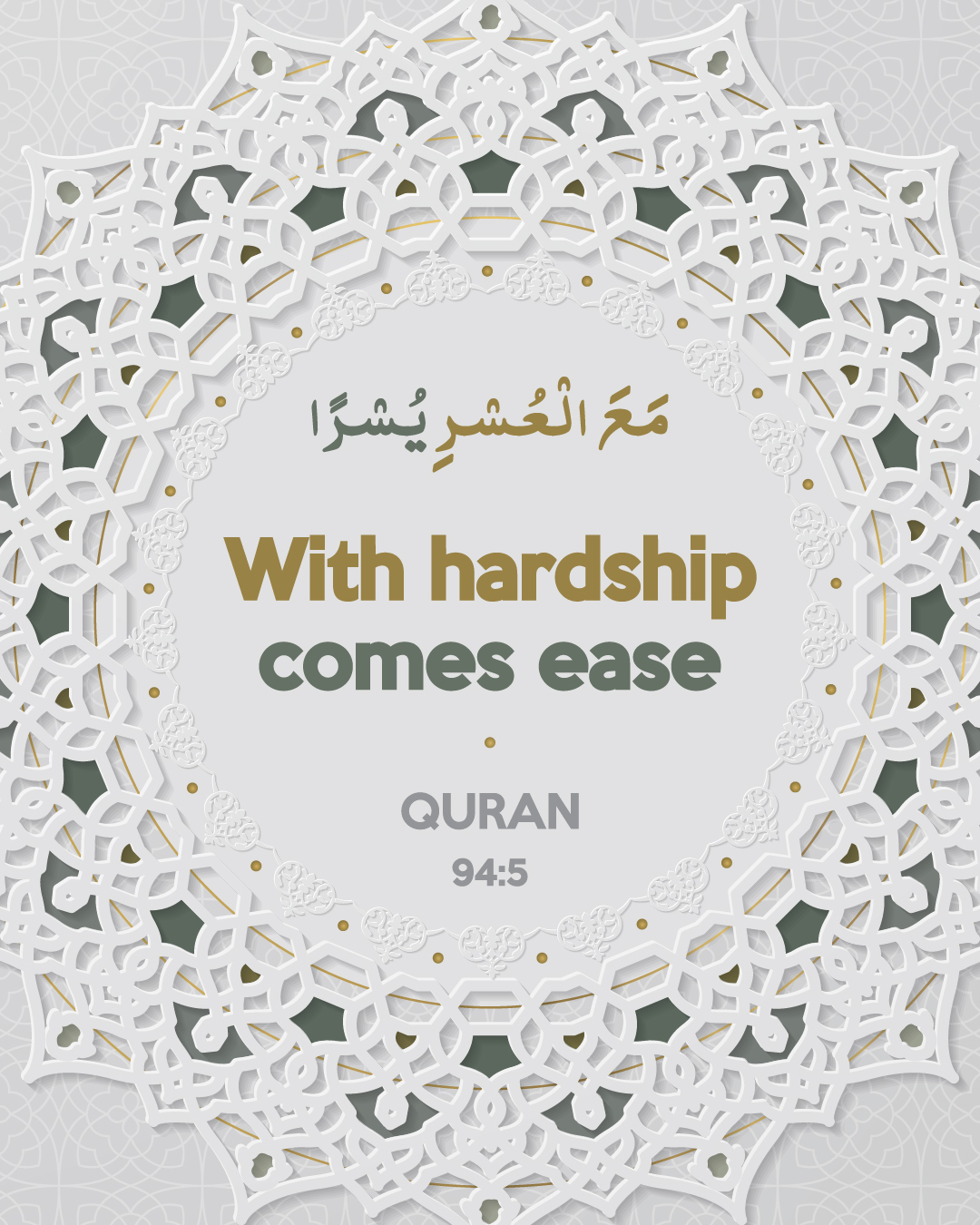
Allah uses the Arabic word ‘ma’a’ (with), meaning ease exists alongside hardship — not after it. The relief is embedded within the trial itself. This teaching on hardship and ease in Islam means that a believer is never without Allah’s mercy, even during the most difficult moments.
Scholars explain that the repetition in Quran 94:5-6 indicates that a single hardship is accompanied by two forms of ease. The definite article on hardship (al-‘usr) refers to one hardship, while the indefinite ease (yusra) refers to multiple eases.
Yes. Allah tests believers to strengthen their faith, purify their sins, and elevate their rank. He guarantees in Quran 2:286 that He never burdens a soul beyond what it can bear. The balance of hardship and ease in Islam ensures no test is without mercy.

The Quran Says About Hardship and Ease in Islam
فَاِنَّ مَعَ الۡعُسۡرِ یُسۡرًا ۙ﴿۵
“Indeed, with hardship comes ease.”
This verse from Surah Ash-Sharh is one of the most repeated, most shared, and most needed statements in the entire Quran. Allah does not say after hardship comes ease — He says with it. Understanding hardship and ease in Islam begins with this single word that changes everything about how a believer experiences difficulty.
Why Allah Says With — Not After
The Arabic word “ma’a” means with, alongside, at the same time. This is not a promise that ease will arrive later, once the trial has ended. It is a declaration that ease already exists inside the hardship itself. A person going through financial difficulty may not see it, but the patience they are developing, the dua they are making, and the reliance on Allah they are building — these are the ease. The relief is not waiting at the end of a tunnel; it is woven into the fabric of the test. This is the unique way hardship and ease in Islam are understood — not as opposites that take turns, but as companions that arrive together.
Allah then repeats the statement: “Indeed, with hardship comes ease” — twice in consecutive verses. Scholars have noted that in Arabic, when a definite noun (al-‘usr, the hardship) is repeated, it refers to the same hardship. But when an indefinite noun (yusra, ease) is repeated, it refers to two different forms of ease. This means one hardship is accompanied by not one but two eases. As Al-Lateef, the Subtly Kind, Allah embeds His mercy into difficulty in ways the human eye often cannot see until the trial has passed.
“Allah does not burden a soul beyond that it can bear. It will have the reward of what good it has earned, and it will bear the consequence of what evil it has committed.”
This verse from Surah Al-Baqarah provides the second essential truth about hardship and ease in Islam: Allah never sends a trial that exceeds a person’s capacity. Every difficulty a Muslim faces is calibrated to what they can endure. This is not a vague comfort — it is a divine guarantee. If a person is going through it, it means Allah knows they can handle it. As Al-Fattah, the Opener, Allah opens doors of relief at the exact moment they are most needed, and He never allows a believer to break under a weight He placed on them.
How Hardship and Ease in Islam Shape the Believer
The verses that follow in Surah Ash-Sharh complete the picture: “So when you have finished, then strive in devotion. And to your Lord alone turn in hope.” Allah does not tell the believer to sit and wait for ease — He tells them to keep working and keep worshipping. The response to hardship in Islam is not passivity; it is active devotion. A Muslim endures difficulty by turning to prayer, by making dua, by giving charity, and by trusting that the One who sent the test also sent the strength to pass it. The relationship between hardship and ease in Islam is a cycle that builds character, deepens faith, and draws the believer closer to Allah with every turn.
For the Muslim going through a trial — whether personal, financial, emotional, or spiritual — this verse is a direct message from Allah: you are not alone, the ease is already with you, and this hardship will not last forever. Hardship and ease in Islam are never separated. The pain is real, but so is the mercy hidden within it. Allah repeated this promise twice in two verses because He wanted no believer to forget it. Hold on to it, and hold on to Him.
Follow our YouTube, Threads and LinkedIn for more Muslim Quotes and reflections on hardship and ease in Islam.
Through patience, prayer, dua, charity, and trust in Allah’s plan. Surah Ash-Sharh instructs believers to strive in devotion and turn to Allah alone with hope when they are finished with their tasks.
Not necessarily. Hardship can be a test, a purification of sins, or a means to elevate a believer’s rank. The Prophet (pbuh) said that no fatigue, illness, or grief befalls a Muslim except that Allah expiates some of their sins through it.
Quran 94:5-6 states: Indeed, with hardship comes ease — repeated twice for emphasis. It is one of the most quoted and most comforting verses about hardship and ease in Islam.
No. Allah explicitly says in Quran 2:286 that He does not burden a soul beyond what it can bear. Every trial is calibrated to what the person can endure.