Allah describes in Quran 24:43 how He drives clouds, joins them, and piles them into towering formations from which rain and hail descend. This description aligns with modern understanding of cumulonimbus cloud formation.
Yes. The Quran describes winds carrying clouds, rain descending from the sky, water settling in the earth (Quran 23:18), and rivers flowing as a result — all core elements of the water cycle.
Modern meteorology confirms the Quran’s three-stage description of cloud formation: smaller clouds are pushed by winds, merge together, and stack vertically into cumulonimbus formations that produce rain and hail.








The Quran Says About Clouds
اَلَمۡ تَرَ اَنَّ اللّٰہَ یُزۡجِیۡ سَحَابًا ثُمَّ یُؤَلِّفُ بَیۡنَہٗ ثُمَّ یَجۡعَلُہٗ رُکَامًا فَتَرَی الۡوَدۡقَ یَخۡرُجُ مِنۡ خِلٰلِہٖ ۚ وَیُنَزِّلُ مِنَ السَّمَآءِ مِنۡ جِبَالٍ فِیۡہَا مِنۡۢ بَرَدٍ فَیُصِیۡبُ بِہٖ مَنۡ یَّشَآءُ وَیَصۡرِفُہٗ عَنۡ مَّنۡ یَّشَآءُ ؕ یَکَادُ سَنَا بَرۡقِہٖ یَذۡہَبُ بِالۡاَبۡصَارِ ﴿ؕ۴۳﴾
“Hast thou not seen that Allah drives the clouds, then joins them together, then piles them up so that thou seest rain issue forth from the midst thereof? And He sends down from the sky clouds like mountains wherein is hail, and He smites therewith whom He pleases, and turns it away from whom He pleases. The flash of its lightning may well-nigh take away the sight.”
This verse from Surah An-Nur describes the formation of rain clouds with a level of detail that modern meteorology would take centuries to confirm. Allah explains how He drives, joins, and piles clouds before rain falls — a description of clouds in the Quran that continues to astonish scientists and scholars alike.
How the Quran Describes Cloud Formation
Allah describes a three-stage process: clouds are driven by wind, then joined together, then piled into towering formations from which rain falls. This matches the scientific process of cumulonimbus cloud formation — where smaller clouds merge and stack vertically before producing heavy precipitation. The verse also mentions hail descending from cloud mountains, another accurate observation. The fact that the Quran described this process in the seventh century, long before satellite imagery or atmospheric science, is a powerful sign of its divine origin.
The verse continues with the flash of lightning that “may well-nigh take away the sight.” This vivid description captures the overwhelming power of storms — a power that belongs entirely to Allah. He decides where rain falls and where it is withheld. He decides who is struck by lightning and who is spared. As Al-Muqtadir, the All-Powerful, Allah controls every element of the weather with absolute precision, reminding humanity that they are not masters of the sky.
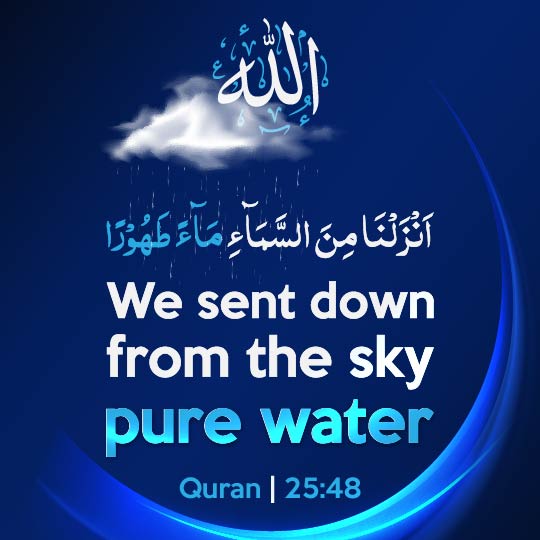
“And We send down from the sky water in a measured amount, and We settle it in the earth, and indeed, We are able to take it away.”
This verse from Surah Al-Mu’minun emphasises that rain is sent in a measured amount — not random, not excessive, but precisely what the earth needs. Allah also reminds humanity that He has the power to remove water entirely. Understanding clouds in the Quran means understanding that every drop of rain is a deliberate act of mercy. As Ar-Razzaq, the Provider, Allah sustains life through systems He designed and controls.
What Clouds and Rain Teach a Believer
For the Muslim, clouds in the Quran are not just atmospheric phenomena — they are signs of Allah’s creative power. Every time a believer looks at the sky and sees clouds gathering, they are witnessing a process that Allah described with stunning accuracy fourteen centuries ago. The Prophet (pbuh) would make dua when clouds appeared, recognising them as carriers of both mercy and potential warning.
This verse invites every Muslim to look at the natural world with the eyes of faith. Clouds are not random formations — they are driven, joined, and piled by the command of Allah. Rain does not fall by accident — it is sent in measured amounts by the One who sustains all life. Recognising this transforms weather from a background event into a daily reminder of the Creator’s power, mercy, and precision.
Follow our YouTube, Instagram and LinkedIn for more Islamic Quotes and reflections on the signs of Allah in creation.
The Quran describes rain as a mercy from Allah, sent down in measured amounts from clouds He drives, joins, and piles. Rain is presented as a sign of Allah’s power and provision throughout multiple surahs.
Lightning in Quran 24:43 is described as almost blinding, reflecting the overwhelming power of storms. It serves as a reminder of Allah’s control over every element of the natural world.
The Prophet (pbuh) would say: ‘Allahumma sayyiban naafi’an’ — O Allah, let it be a beneficial rain. He recognised rain as a moment of divine mercy.
Yes. Allah says in Quran 23:18 that He sends water in measured amounts and is fully able to take it away — a reminder to be grateful for every blessing.