The Muslim ummah is the global community of believers united by faith in Allah and the message of the Prophet (pbuh). The Quran declares it one ummah in Quran 21:92, and the Prophet (pbuh) described it as a single body where the pain of one is felt by all.
To illustrate that believers are not a loose collection of individuals but an interconnected community where the suffering of one part triggers a response from every other part — just as a body responds to pain with fever and sleeplessness.
Muslims are responsible for caring for one another — feeding the hungry, visiting the sick, supporting the oppressed, and feeling the pain of fellow believers. The ummah functions like a body: no part can be ignored without the whole system suffering.

The Prophet Said About the Muslim Ummah
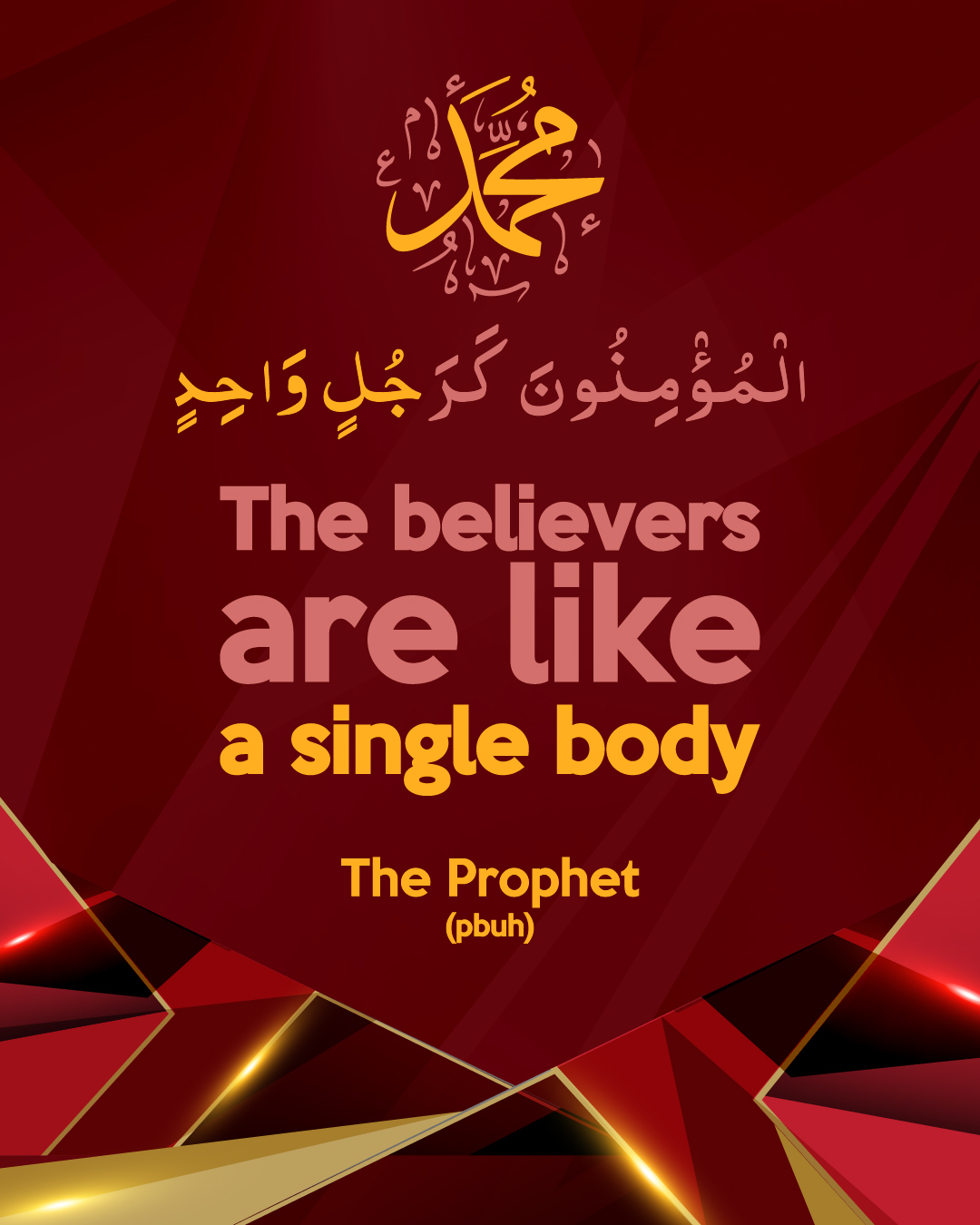
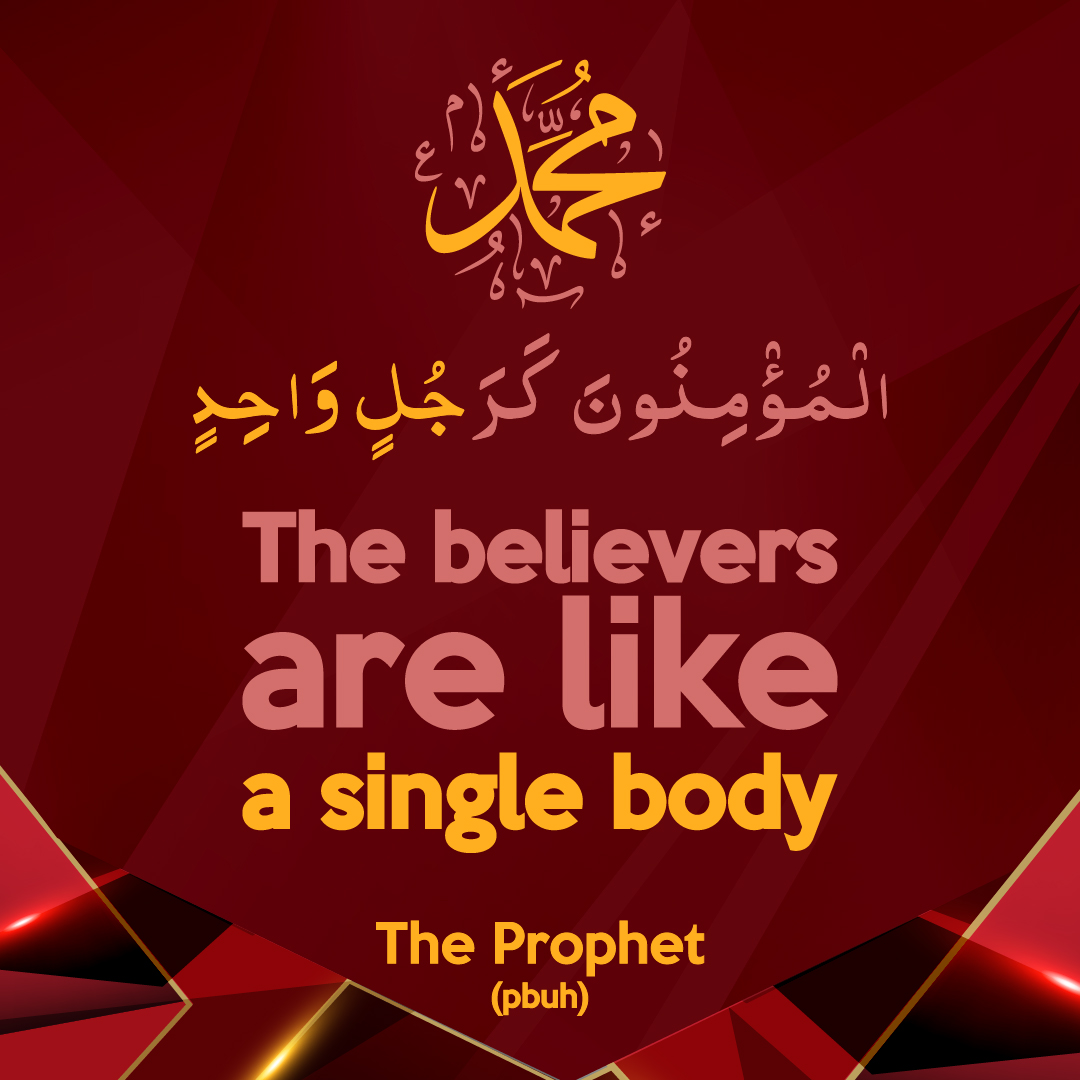
الْمُؤْمِنُونَ كَرَجُلٍ وَاحِدٍ إِنِ اشْتَكَى رَأْسُهُ تَدَاعَى لَهُ سَائِرُ الْجَسَدِ بِالْحُمَّى وَالسَّهَرِ
“The believers are like a single body; if the head aches, the whole body responds with fever and sleeplessness.”
This hadith contains one of the most vivid and powerful images the Prophet (pbuh) ever used to describe the believers. He compared the entire Muslim ummah to a single human body — where the pain of one part is felt by every other part. It is a teaching that defines what it means to belong to this community.
What the One-Body Metaphor Reveals About Believers
The Prophet (pbuh) did not say the believers are like a group or a team or an organisation. He said they are like one body. A group can have members who are disconnected. A team can have players who only care about their own performance. But a body cannot ignore its own parts. When the head aches, the entire body responds — not by choice, but by nature. The fever rises. Sleep becomes impossible. The whole system mobilises to address the pain. This is the standard the Prophet (pbuh) set for the Muslim ummah: a community where the suffering of one is instinctively felt by all.
This metaphor also carries an important truth about interconnection. In a body, no part functions alone. The hand cannot say to the foot, “Your pain is not my concern.” The heart cannot ignore the lungs. Every organ depends on every other organ. The ummah is designed to function the same way — a network of believers who are bound together not by geography or ethnicity, but by shared faith. As Al-Jami, the Gatherer, Allah created this community to be united, and the Prophet (pbuh) described exactly what that unity should look like.
“Indeed, this ummah of yours is one ummah, and I am your Lord, so worship Me.”
This verse from Surah Al-Anbiya declares what the Prophet (pbuh) illustrated through his metaphor: the Muslim ummah is one. Not many communities, not scattered groups, but a single ummah united under one Lord. Allah Himself claims this community and connects its unity to the worship of Him alone. When believers worship the same God, follow the same Prophet, and read the same Quran, they share a bond that transcends borders, languages, and cultures. As Al-Waliy, the Protecting Friend, Allah watches over this ummah and calls every member to protect one another the way a body protects itself.
What the Muslim Ummah Owes to Its Members
If the ummah is one body, then every believer has a responsibility toward every other believer. When a Muslim somewhere in the world is hungry, the body should feel that hunger. When a community is displaced, the rest of the body should lose sleep over it — just as the Prophet (pbuh) described. This is not poetic language; it is a moral obligation. The Muslim ummah is not a passive identity that a person carries on paper. It is an active, living commitment to care for every part of the body, especially the parts that are suffering most.
For the believer, this hadith asks a direct question: do you feel the pain of your ummah? When you hear about a community in crisis, does it move you to act — to donate, to pray, to speak up, to help? The Prophet (pbuh) described a body that responds with fever and sleeplessness — not with indifference. The Muslim ummah is only as strong as the compassion of its members. And that compassion is not a feeling that comes and goes; it is a duty that defines what it means to be a believer.
Follow our YouTube, X and Pinterest for more Muslim Quotes and reminders on the unity of the Muslim ummah.
Yes. Allah says in Quran 21:92: ‘Indeed, this ummah of yours is one ummah, and I am your Lord, so worship Me.’ The Quran also calls believers the best nation produced for mankind in Quran 3:110.
Through charity, dua, volunteering, spreading awareness about struggling communities, supporting Muslim businesses, and simply caring about the welfare of believers beyond your immediate circle. Every act of compassion strengthens the body.
No. The ummah includes every believer regardless of race, ethnicity, language, or nationality. The Prophet (pbuh) said there is no superiority of an Arab over a non-Arab except in piety. The Muslim ummah is bound by faith, not blood.
Its unity is based on shared worship of Allah, following the Prophet (pbuh), and reading the same Quran. Unlike national or ethnic identities, the Muslim ummah spans every continent and every culture, making it the most diverse faith community in the world.