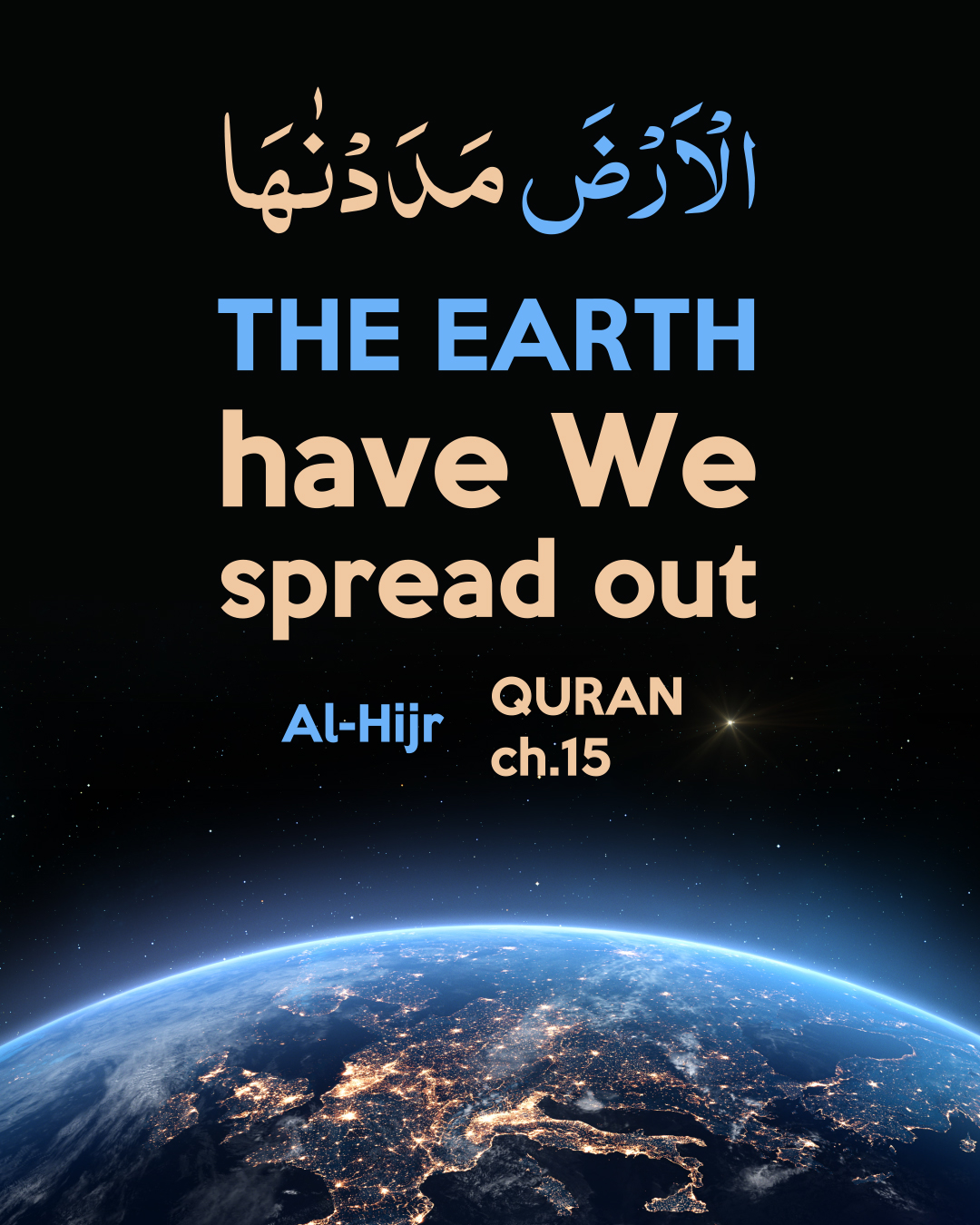
The Quran describes the earth as a creation deliberately spread out and prepared for life by Allah. In Surah Al-Hijr (15:19), Allah explains that He spread out the earth, set firm mountains upon it, and caused everything to grow in proper proportion. The earth is presented as a sign of Allah’s power, wisdom, and care for His creation. The concept of the Earth in the Quran is a profound reminder of His creation.
The Quran refers to mountains as “rawasiya,” meaning firm pegs or anchors. Allah placed them on the earth to stabilise its surface. This description aligns with the modern understanding that mountains have deep roots that help balance tectonic activity, showing that the Quran described this function long before science confirmed it.
The Arabic word “mawzun” means weighed, measured, and balanced. It indicates that nothing on earth grows randomly or excessively. Rainfall, vegetation, minerals, and ecosystems all exist in quantities and ratios that sustain life — a balance set by Allah as Al-Hakeem (The All-Wise).


Allah Says About Earth in the Quran
وَالۡاَرۡضَ مَدَدۡنٰہَا وَاَلۡقَیۡنَا فِیۡہَا رَوَاسِیَ وَاَنۡۢبَتۡنَا فِیۡہَا مِنۡ کُلِّ شَیۡءٍ مَّوۡزُوۡنٍ
“And the earth have We spread out, and set therein firm mountains and caused everything to grow therein in proper proportion.”
This verse from Surah Al-Hijr is one of the most powerful descriptions of the earth in the Quran. In a single sentence, Allah describes how He spread out the earth, anchored it with mountains, and caused everything to grow in measured balance. It is a verse that invites both reflection and gratitude.
How the Quran Describes the Design of the Earth
Allah begins this verse by describing the earth as something He deliberately spread out — not randomly formed, but carefully prepared for life. The Arabic carries the meaning of extending and making habitable, pointing to a planet that was designed with clear purpose. He then speaks of the firm mountains, referred to as “rawasiya,” placed as anchors to stabilise the earth’s surface. This is not poetic decoration; it is a precise description of how mountains function as stabilisers for the ground beneath them. Every detail in this verse points to intentional design, and understanding the earth in the Quran begins with recognising that nothing about this planet is accidental.
The most striking part of this verse is the final phrase: everything grows in proper proportion. The Arabic word “mawzun” means weighed, measured, and balanced. Rain falls in specific quantities. Plants grow in ecosystems that sustain one another. Minerals sit beneath the surface in deposits that serve human needs across generations. Allah did not simply create abundance; He created order within that abundance. As Al-Hakeem, the All-Wise, every element of the earth was placed with a wisdom that science continues to uncover and that faith has always recognised.
“You do not see in the creation of the Most Merciful any inconsistency.”
This verse from Surah Al-Mulk challenges anyone who doubts the perfection of creation to simply look again. Allah invites the human eye to search for a flaw, a crack, an inconsistency — and guarantees it will find none. When read alongside the description of the earth in the Quran from Surah Al-Hijr, the message becomes even more powerful: the earth was not only spread out and filled with life, it was done without a single error. As Al-Khaliq, the Creator, Allah fashioned everything with a precision that leaves no room for randomness or accident.
Why the Earth Points to Allah’s Power
The earth in the Quran is never presented as a standalone topic. It always points back to the One who created it. Mountains are not merely geological features; they are signs placed by Allah. Plants are not accidents of biology; they are provisions measured and distributed by a Creator who knows exactly what His creation needs. The Prophet (pbuh) taught Muslims to see the natural world as a source of reflection, not just resources. Every landscape, every harvest, every season is an invitation to recognise Allah’s power and to respond with worship and gratitude.
For a believer, studying the earth in the Quran is not just an intellectual exercise. It is an act of worship. When a Muslim reads that Allah spread out the earth and caused everything to grow in proper proportion, they are reading the signature of their Creator written across every continent, every mountain range, and every living thing. This awareness transforms how a person walks through the world — not as an owner, but as a custodian entrusted with something magnificent and accountable for how they treat it.
Explore our YouTube, Facebook and X pages for more Islamic Quotes and reflections on the signs of Allah in creation.
Mountains are described in the Quran as “rawasiya” — firm pegs or anchors placed by Allah to stabilise the earth. This imagery appears in multiple surahs and reflects a function that modern geology has confirmed: mountain roots extend deep into the earth’s crust, helping to balance tectonic plates.
The Quran is not a science textbook, but many of its descriptions of the natural world align with modern scientific findings. The role of mountains as stabilisers, the balance of ecosystems, and the spreading of the earth’s surface are all referenced in the Quran and continue to be validated by research.
Muslims should see the earth as a sign of Allah’s power, wisdom, and generosity. Every mountain, plant, and ecosystem reflects the attributes of Al-Khaliq (The Creator) and Al-Hakeem (The All-Wise). Studying the earth is an act of worship that deepens a believer’s gratitude and sense of responsibility as a custodian of creation.