
Social Media and Islam

Few forces have reshaped daily life as quickly as the smartphone in our pockets. For Muslims, social media is now where we learn, connect, do business, and share our faith — but it is also where backbiting, vanity, distraction and misinformation thrive. The relationship between social media and Islam is therefore one of the most pressing questions of our time, and one that timeless Islamic teaching is surprisingly well equipped to answer. This article offers seven honest lessons for navigating these platforms with both feet on the ground and the heart in the right place.
يَا أَيُّهَا الَّذِينَ آمَنُوا إِن جَاءَكُمْ فَاسِقٌ بِنَبَإٍ فَتَبَيَّنُوا
“O you who believe, if someone wicked comes to you with news, then verify it.”
A New Public Square

Social media has become the great gathering place of the modern age, a vast public square where billions meet to talk, argue, buy, sell and share their lives. For the Muslim community, its arrival has been a genuine blessing in many ways. A reminder, a verse or a lecture can now reach millions in seconds, scattered believers can find one another, and acts of charity can be organised across the globe overnight.
Yet the same square is also crowded with temptation. The very features that make these platforms so compelling — endless scrolling, instant reactions, the chase for approval — can quietly erode our character if we are not careful. What was meant to connect us can isolate us; what was meant to inform us can deceive us; and what was meant to fill empty moments can swallow whole hours of our lives.
This is why thinking seriously about social media and Islam matters so much. The point is not to demonise technology, which is in itself neither good nor bad, but to use it deliberately and with intention. Islam has always taught that every tool, every word and every glance carries moral weight, and a smartphone is no exception. The seven lessons that follow are an attempt to bring that ancient wisdom to a very modern challenge.
Each draws on principles the Prophet (pbuh) taught long before anyone could imagine a glowing screen, yet each fits our digital dilemmas with uncanny precision. The conversation about social media and Islam is not really about technology at all, but about the timeless state of the human heart. The platforms simply hold up a mirror, magnifying both our virtues and our vices, and what we choose to see in that mirror is largely up to us.
Social media is a tool: neither good nor bad in itself — what matters is how we use it.
Lesson 1: Guard Your Tongue and Your Keyboard

Islam treats words with enormous seriousness, and nowhere is that more relevant than online. The Prophet (pbuh) warned that much of what lands people in trouble is the harvest of their own tongues, and on social media the tongue has been replaced by the keyboard, where careless words spread further and last longer than ever before.
Backbiting, or gheebah, is one of the gravest sins of speech, and the comment section has made it almost effortless. Mocking a stranger, piling onto someone already being criticised, or sharing an unflattering screenshot can all amount to the very behaviour the Quran compares to devouring the flesh of a dead brother. A like or a retweet can make us a partner in another’s cruelty.
The Islamic standard for speech is simple but demanding: say something good or stay silent. Before posting, a believer might pause and ask whether the words are true, necessary and kind. If they fail that test, the wisest move is often to close the app and say nothing at all, sparing both our souls and our reputations. It helps to remember that nothing online is ever truly private or temporary; a hasty comment can be screenshotted, shared and remembered long after we wish it forgotten. The believer who writes as though God is reading every word, because He is, will rarely have cause for regret.
The Prophet (pbuh) taught: speak good or stay silent — a rule made for the comment section.
Lesson 2: Verify Before You Share

If there is one verse that could have been written for the social media age, it is the warning above: when news reaches you, verify it before acting. False information now travels faster than the truth, and a single careless share can spread a lie to thousands, damaging reputations and stirring up needless anger and division.
The Prophet (pbuh) cautioned that it is enough of a lie for a person to repeat everything they hear without checking it. On social media, repeating is as easy as tapping a button, which makes the duty to pause and verify more important than ever. Sensational claims, shocking quotes and viral outrage are precisely the things most likely to be distorted or entirely fabricated.
Practising this lesson means slowing down. Before sharing, a thoughtful Muslim checks the source, looks for confirmation, and considers whether passing the message on actually serves any good. In a culture built for speed, the discipline of patience and verification is a quiet but powerful form of worship, protecting both our integrity and the peace of the community. A community that checks before it shares is far harder to deceive and divide, which is perhaps why the Quran ties truthful reporting so closely to the wellbeing of the believers.
Lesson 3: Lower Your Gaze
Long before the internet, Islam taught both men and women to lower their gaze and guard their modesty. That instruction has only grown more relevant in a world where an ocean of inappropriate and immodest content is a single scroll away, served up by algorithms designed to capture and hold our attention by any means.
Lowering the gaze online is not about pretending temptation does not exist; it is about taking responsibility for what we choose to look at and linger on. It means curating our feeds deliberately, unfollowing what pulls us away from God, and resisting the endless stream of images crafted to provoke desire, envy or vanity. The eyes, as the scholars say, are a gateway to the heart.
This same modesty applies to what we ourselves post. In an age that rewards exposure and oversharing, choosing dignity and restraint is a countercultural act. A believer who guards their gaze and their image online is protecting an inner purity that no number of likes could ever replace. In guarding what enters and leaves through the screen, we are really guarding the heart itself, which Islam regards as the seat of all our deeds and the place God looks to first.
Guarding the gaze online means choosing what we look at — the eyes are a gateway to the heart.
Lesson 4: Beware the Comparison Trap
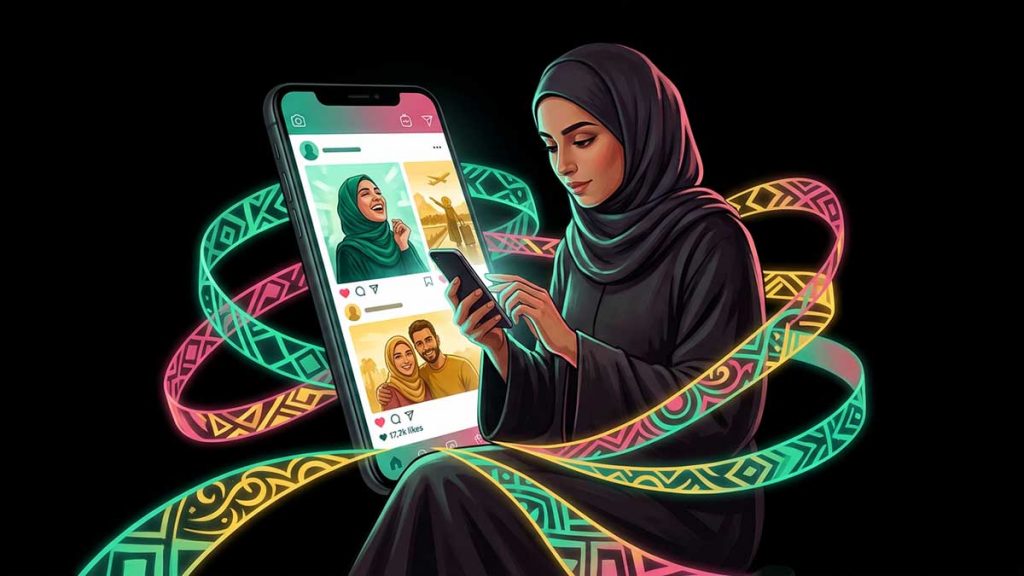
Perhaps the subtlest danger of social media is the way it invites us to compare our ordinary lives with everyone else’s carefully edited highlights. Scrolling through a parade of perfect holidays, perfect bodies and perfect families, it is dangerously easy to feel that our own blessings are somehow not enough, breeding envy, anxiety and a creeping ingratitude.
Islam offers a direct antidote in the form of gratitude and contentment. The Prophet (pbuh) advised believers to look at those who have less than them rather than those who have more, so that they never belittle the favours God has given them. That single habit turns the comparison trap on its head, replacing resentment with thankfulness.
There is also the other side of the coin: the temptation to show off, to curate our own highlight reel in search of admiration. Both envy and boasting spring from forgetting that everything we have is a gift on loan. A heart anchored in gratitude scrolls differently, neither covetous of others nor desperate for their applause. Many people now speak openly about how endless scrolling harms their mood and sense of self-worth, and researchers increasingly agree. Islam diagnosed the spiritual root of that unhappiness centuries ago: a heart that forgets to be grateful is a heart that is very hard to satisfy.
The Prophet (pbuh) said look at those who have less than you — so you never belittle God’s gifts.
Lesson 5: Mind Your Time

Time is among the most precious gifts God grants us, and one we will be questioned about. The Prophet (pbuh) named health and free time as two blessings that many people squander, and few things squander time as efficiently as an app engineered to keep us scrolling long after we meant to stop.
The danger is rarely a single dramatic waste, but the quiet accumulation of minutes: a glance here, a scroll there, hours dissolving without our noticing. Worse, these distractions can nibble away at what truly matters, pulling us from our prayers, our families and our duties, and leaving us strangely drained rather than refreshed.
Treating our time as the trust it is means setting limits, however unfashionable that sounds. Switching off notifications, keeping the phone away during prayer and at the dinner table, and choosing real presence over digital noise are small acts of discipline with large rewards. A Muslim mindful of self-restraint guards their hours as carefully as their wealth.
Lesson 6: Use It for Good

For all its dangers, social media is also an unprecedented opportunity to do good, and Islam never asks us to flee the world but to improve it. A kind word, a beneficial reminder, a beautiful verse or a link to genuine knowledge can ripple outward to people we will never meet, earning reward long after we have logged off.
These platforms have become powerful tools for dawah, sharing the beauty of the faith gently and wisely with a curious world. They allow Muslims to support one another, to strengthen the bonds of brotherhood across borders, to raise funds for those in need, and to counter ugliness with something better. Used well, a feed can become a quiet stream of ongoing charity.
The key is intention and content. If we fill our corner of the internet with what is true, useful and uplifting, we transform a potential distraction into a means of nearness to God. Every Muslim online is, in a sense, an ambassador for the faith, and that responsibility can be carried with grace rather than dread. Some of the most moving examples of faith in recent years have unfolded online, as ordinary Muslims answer questions, share their journeys and show a watching world the warmth at the heart of their religion. That, too, is a quiet form of worship.
A beneficial post can become ongoing charity — rewarding us long after we log off.
Lesson 7: Keep Your Intentions Sincere
Underneath every one of these lessons lies the foundation of all worship in Islam: intention. The Prophet (pbuh) taught that actions are judged by their intentions, and that each person will have only what they intended. On social media, where so much is done for an audience, this teaching cuts straight to the heart.
The danger is riya, doing good in order to be seen and praised rather than for the sake of God. A charitable act announced mainly to impress, an act of worship posted for applause, a display of piety performed for the camera — all risk hollowing out the very deeds that should bring us closer to our Lord. The reward of a deed done for likes may be only those likes.
This does not mean we must hide every good thing; sharing can inspire others. But it does mean constantly checking the heart, asking quietly who we are really doing this for. A believer who keeps their intentions sincere can move through the noisiest feed with a clear conscience, knowing their truest audience is the One who sees what no screen can show. This, in the end, is the deepest insight that the meeting of social media and Islam has to offer. Strip away the apps and the algorithms, and what remains is the oldest question of the spiritual life: for whose sake do we act?
The Prophet (pbuh) said actions are judged by their intentions — even the ones we post.
Finding the Balance
None of this calls for abandoning social media altogether. For most of us that is neither realistic nor necessary, and the platforms hold too much genuine good to dismiss. The goal, rather, is balance: to be the master of the tool rather than its servant, and to let our faith shape our scrolling instead of the other way around.
The relationship between social media and Islam ultimately comes down to mindfulness. The same heart that guards its tongue, its gaze, its time and its intentions in the physical world must do the same in the digital one, for God is equally present in both. With a little discipline and a clear purpose, these remarkable tools can serve our faith rather than slowly corrode it.
Perhaps the simplest test is this: does our use of these platforms leave us more grateful, more connected and more conscious of God, or less? Asking that honest question, again and again, is the surest way to keep social media in its proper place — a useful servant, never a master of the heart. Generations before us faced their own distractions and temptations, and met them with faith, discipline and the remembrance of God. Ours simply wear a new and glittering face, but the remedy is as old and as reliable as ever.
How do you keep your own time online healthy and meaningful? It is a question every Muslim now wrestles with. For more honest reflection on social media and Islam, and faith in the modern world, follow It’s About Islam — find us on YouTube, Instagram and TikTok.
Frequently Asked Questions
When it comes to social media and Islam, the platforms themselves are not haram; social media is a neutral tool. What matters is how it is used. Sharing beneficial content is rewarded, while backbiting, immodesty, lies and wasting time are sinful regardless of the medium.
Backbiting, or gheebah, is a serious sin whether spoken or typed. Mocking people, sharing unflattering content or piling onto criticism online all fall under it. Islam teaches us to say something good or stay silent.
By sharing beneficial knowledge, supporting one another, spreading kindness, raising charity, and doing dawah wisely. Used with sincere intention, a social media account can become a source of ongoing reward.
Set clear limits, switch off notifications, and keep your phone away during prayer and family time. Islam teaches that free time is a blessing we will be questioned about, so guarding it is an act of worship.
The Prophet (pbuh) taught that actions are judged by intentions. Doing good deeds online mainly to be seen and praised, known as riya, can empty them of reward. Keeping intentions sincere protects the heart.