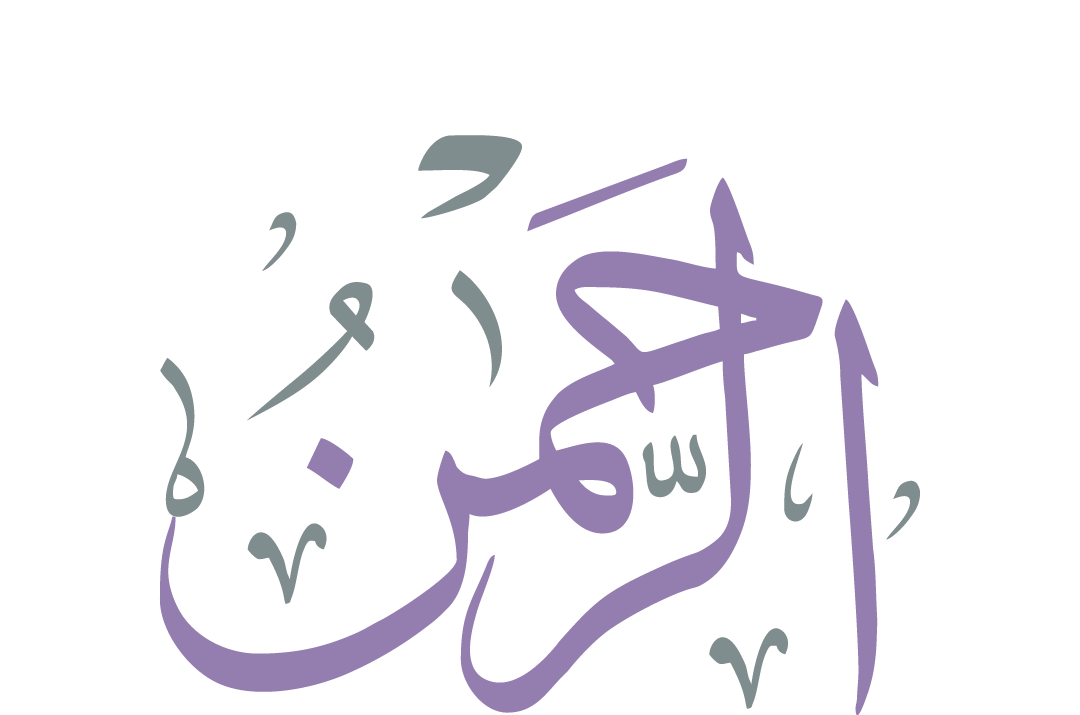
Ar-Rahman
The All-Compassionate
Ar-Rahman (ٱلرَّحْمَـٰنُ) is the first of the 99 Names of Allah and one of the most frequently mentioned names in the Quran. It means “The All-Compassionate” — the One whose mercy embraces every living thing without exception. Before we recite a single chapter of the Quran, we begin with this name: Bismillah ir-Rahman ir-Raheem. It is a constant reminder that Allah’s compassion is the foundation of all existence.
قُلِ ٱدۡعُواْ ٱللَّهَ أَوِ ٱدۡعُواْ ٱلرَّحۡمَـٰنَ ۖ أَيًّا مَّا تَدۡعُواْ فَلَهُ ٱلۡأَسۡمَآءُ ٱلۡحُسۡنَىٰ
“Say, ‘Call upon Allah or call upon the All-Compassionate. Whichever [name] you call — to Him belong the most beautiful names.'”
Meaning and Root of Ar-Rahman
The name Ar-Rahman comes from the Arabic root Ra-Ha-Mim (ر-ح-م), which carries the meaning of mercy, compassion, and tenderness. It is an intensive form (fa’lan) that indicates the vastness and abundance of Allah’s mercy — a mercy so immense that it surrounds all of creation at every moment.
Unlike other attributes of Allah, the name Ar-Rahman is exclusively reserved for Him. No human being or creation can be called Ar-Rahman, because only Allah possesses mercy of this magnitude. It is a name that defines His very essence — not merely what He does, but who He is. Every breath we take, every sunrise we witness, and every provision we receive is a direct manifestation of the mercy of Ar-Rahman.
In classical Arabic, scholars explain that the pattern of the word Ar-Rahman suggests mercy that is overflowing, active, and immediate. It is the kind of mercy that Allah extends universally — to believers and non-believers, to the righteous and the sinful, to humans, animals, and every creature across the heavens and the earth. This is what distinguishes Ar-Rahman from Ar-Raheem (The Most Merciful), which refers to a special, focused mercy reserved particularly for the believers in the Hereafter.
Ar-Rahman in the Quran
The name Ar-Rahman appears over 50 times in the Quran, making it one of the most emphasised divine names. An entire surah — Surah Ar-Rahman (Chapter 55) — is named after it. This surah is often called “The Beauty of the Quran” and opens with the name itself as its very first verse. It then unfolds a breathtaking catalogue of Allah’s blessings, repeatedly asking: “So which of the favours of your Lord would you deny?”
ٱلرَّحۡمَـٰنُ
“The All-Compassionate”
This single word opens the entire surah. The verses that follow immediately connect this name to the teaching of the Quran (55:2), the creation of humanity (55:3), and the gift of speech (55:4). The Quran itself is described as a gift of mercy — guidance sent from the All-Compassionate to help humanity find its way. This is a profound reminder that knowledge, understanding, and the ability to communicate are all expressions of divine compassion.
The name also appears prominently in Surah Al-Fatihah, the opening chapter of the Quran that Muslims recite in every prayer. In verse 1:1, the Basmalah reads: “In the name of Allah, the All-Compassionate, the Most Merciful,” and in verse 1:3, Allah describes Himself again as “The All-Compassionate, the Most Merciful.” This repetition at the very gateway of the Quran shows the centrality of mercy in Islam.
The Difference Between Ar-Rahman and Ar-Raheem
Both names share the same root (Ra-Ha-Mim) and both speak of Allah’s mercy, yet they carry distinct shades of meaning. Ar-Rahman describes an all-encompassing mercy that reaches every creature in existence — the rain that falls on every land, the sustenance given to every living being, the air that fills every lung. It is universal, unconditional, and constant.
Ar-Raheem, by contrast, refers to a specific, focused mercy that Allah reserves for those who believe in Him and strive to follow His guidance. It is the mercy of forgiveness, spiritual tranquillity, and eternal reward in the Hereafter. Together, these two names paint a complete picture: Ar-Rahman gives to all in this world, and Ar-Raheem rewards the faithful in the next.
Ar-Rahman mercy for all creation
Ar-Raheem mercy for the believers
This pairing appears in the Basmalah — “Bismillah ir-Rahman ir-Raheem” — which opens every surah of the Quran except Surah At-Tawbah. Muslims recite this phrase before eating, before travelling, before beginning any important task. It is perhaps the most spoken Arabic phrase in the world, and it places Allah’s mercy at the centre of every action.
Allah’s Mercy Encompasses Everything
One of the most powerful verses about divine mercy appears in Surah Al-A’raf, where Allah declares that His mercy extends to all things. This verse is a source of immense hope for every Muslim — no matter what difficulties or sins a person may face, the door of Allah’s compassion is never closed.
And My mercy encompasses all things
The Prophet Muhammad (pbuh) taught that Allah divided His mercy into one hundred parts. He sent down just one part to the earth — and it is through this single portion that all creatures show compassion to one another: a mother nursing her child, an animal sheltering its young, a stranger helping someone in need. The remaining ninety-nine parts are reserved for the Day of Judgement, when Allah will shower His servants with a mercy beyond anything this world has ever known. (Sahih Muslim 2752)
Ar-Rahman on the Throne
The Quran tells us that Ar-Rahman is the One who rose over the Throne (Al-Arsh). In Surah Ta-Ha (20:5), Allah says: “The All-Compassionate rose over the Throne.” This is significant because Allah chose to describe Himself with the name Ar-Rahman — not Al-Jabbar (The Compeller) or Al-Qahhar (The Subduer) — when speaking about His supreme authority over all creation. It tells us that the universe is governed not by tyranny but by mercy. Allah rules with compassion, and His sovereignty is inseparable from His kindness.
The All-Compassionate rose over the Throne in a manner befitting His majesty
How Believers Can Reflect Ar-Rahman
The Prophet Muhammad (pbuh) said: “The merciful are shown mercy by the All-Compassionate. Be merciful to those on earth, and the One above the heavens will be merciful to you.” (Sunan Abu Dawud 4941). This hadith uses the name Ar-Rahman directly — it is not an abstract theological concept but a living principle that Muslims are called to embody every day.
Reflecting on the name Ar-Rahman encourages believers to practise kindness, empathy, and compassion in their daily lives. Whether it is forgiving someone who has wronged you, helping a neighbour in need, speaking gently to a child, or even showing care towards animals, every act of mercy mirrors — in the smallest way — the infinite compassion of Allah. Knowing that Allah is Ar-Rahman also brings deep comfort during hardship: no trial is beyond His mercy, no prayer goes unheard, and no soul is forgotten.
As Muslims deepen their relationship with the 99 Names of Allah, understanding Ar-Rahman is the natural starting point. It is the first name, the most frequently invoked, and the one that colours every interaction between the Creator and His creation. From Al-Malik (The Sovereign) to Al-Quddus (The Most Holy) to As-Salam (The Source of Peace), every divine name is illuminated by the overarching reality that Allah is, above all, Ar-Rahman — The All-Compassionate.
Follow us on YouTube, Instagram and TikTok to discover more about Ar-Rahman and the other beautiful names of Allah.
Frequently Asked Questions
Ar-Rahman (ٱلرَّحْمَـٰنُ) means “The All-Compassionate” or “The Entirely Merciful.” It comes from the Arabic root Ra-Ha-Mim (ر-ح-م), which conveys mercy, compassion, and tenderness. It is the first of the 99 Names of Allah and describes a mercy so vast that it encompasses all of creation — every human, every animal, and every being in the universe.
Both names come from the same Arabic root and both describe Allah’s mercy, but they differ in scope. Ar-Rahman refers to a universal mercy that covers all creation — believers and non-believers alike — in this world. Ar-Raheem refers to a specific, focused mercy that Allah reserves for the believers, particularly in the Hereafter. Together they appear in the Basmalah: “Bismillah ir-Rahman ir-Raheem.”
The name Ar-Rahman appears over 50 times in the Quran as a direct reference to Allah. Additionally, it features in the Basmalah (“In the name of Allah, the All-Compassionate, the Most Merciful”) that opens every surah except Surah At-Tawbah. Key appearances include Surah Ar-Rahman 55:1, Surah Al-Fatihah 1:3, and Surah Ta-Ha 20:5.
No. The name Ar-Rahman is exclusively reserved for Allah and cannot be given to a human being on its own. However, a person can be named Abd Ar-Rahman (عبد الرحمن), meaning “Servant of the All-Compassionate,” which is one of the most beloved names in Islam. The Prophet Muhammad (pbuh) said that the most beloved names to Allah are Abdullah and Abd Ar-Rahman. (Sahih Muslim 2132)
Surah Ar-Rahman (Chapter 55) is named after this beautiful name of Allah. It contains 78 verses and is often called “The Beauty of the Quran.” The surah opens with the name Ar-Rahman and then lists Allah’s countless blessings upon creation, repeatedly asking: “So which of the favours of your Lord would you deny?” It covers blessings in this life and descriptions of Paradise in the Hereafter.