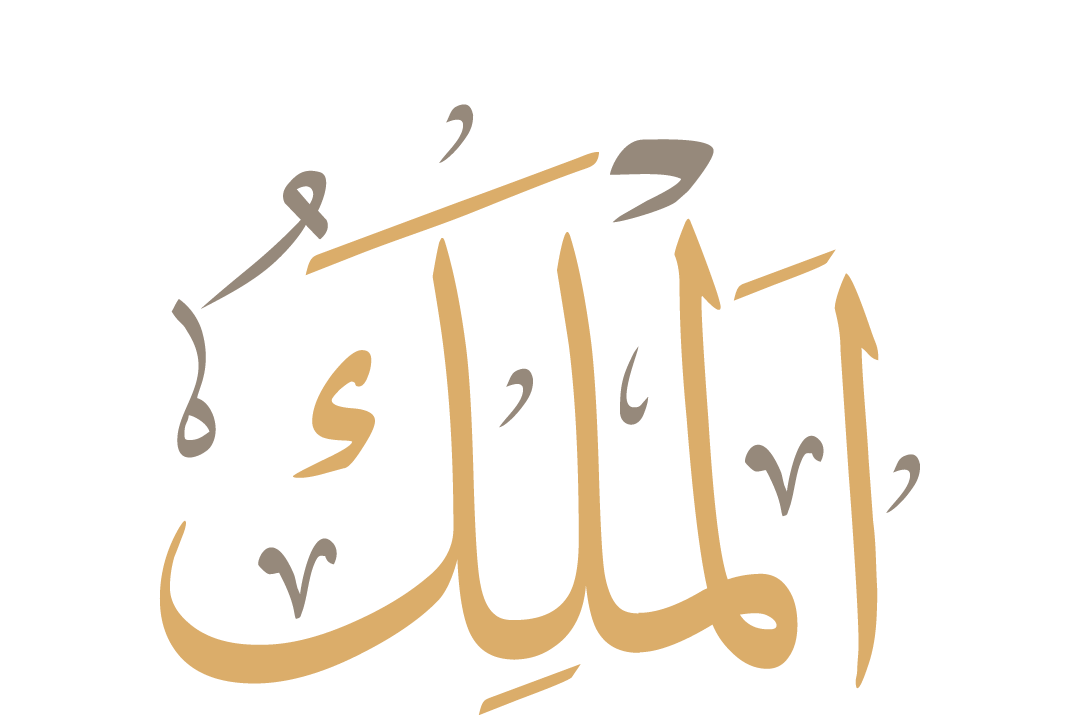
Al-Malik
The Sovereign
Al-Malik (ٱلْمَلِكُ) is the third of the 99 Names of Allah and means “The Sovereign” or “The King.” It declares that all dominion, authority, and power belong to Allah alone. Every kingdom on earth rises and falls, every ruler governs for a time — but Allah’s sovereignty is absolute, eternal, and unchallenged. He is the King of all kings, the ultimate authority over every realm of existence.
هُوَ ٱللَّهُ ٱلَّذِى لَآ إِلَـٰهَ إِلَّا هُوَ ٱلۡمَلِكُ ٱلۡقُدُّوسُ ٱلسَّلَـٰمُ
“He is Allah, other than whom there is no deity, the Sovereign, the Pure, the Perfection.”
Meaning and Root of Al-Malik
The name Al-Malik comes from the Arabic root Mim-Lam-Kaf (م-ل-ك), which carries the meaning of sovereignty, dominion, kingship, and ownership. It is one of the most powerful roots in the Arabic language, giving rise to words like mulk (dominion), maalik (owner), and malakut (heavenly kingdom). When applied to Allah, Al-Malik indicates absolute and unconditional authority over everything that exists.
Unlike earthly kings whose power is limited by borders, time, and circumstances, Allah’s kingship has no boundaries. He governs the seen and the unseen, the heavens and the earth, the affairs of atoms and galaxies. No decree can override His decree, no authority can challenge His authority, and no event takes place in the universe without His permission. This is the meaning of Al-Malik — a sovereignty so complete that nothing falls outside of it.
Scholars note that the name Al-Malik also carries the connotation of self-sufficiency. A true king needs nothing from his subjects, and Allah needs nothing from His creation. He is rich beyond measure, and all that exists depends upon Him while He depends upon nothing. This distinguishes Allah’s kingship from every other form of authority — it is rooted not in power taken, but in power that has always been and always will be.
Al-Malik in the Quran
The name Al-Malik and its related forms appear numerous times throughout the Quran. One of the most comprehensive mentions is in Surah Al-Hashr (59:23), where Allah lists several of His names in succession — beginning with Al-Malik, followed by Al-Quddus (The Most Holy) and As-Salam (The Source of Peace). This pairing shows that Allah’s sovereignty is not one of tyranny but of purity, peace, and perfection.
In Surah Al-Mu’minun, Allah describes Himself as the True King, exalted above all else. This verse is a powerful declaration of divine authority that places Allah’s kingship beyond comparison with any created being.
فَتَعَـٰلَى ٱللَّهُ ٱلۡمَلِكُ ٱلۡحَقُّ ۖ لَآ إِلَـٰهَ إِلَّا هُوَ رَبُّ ٱلۡعَرۡشِ ٱلۡكَرِيمِ
“Exalted is Allah, the True King; there is no deity except Him, Lord of the Noble Throne.”
The name also appears in Surah Al-Fatihah (1:4) in the form Maaliki Yawm id-Deen — “Master of the Day of Judgement.” Every Muslim recites this verse multiple times a day in prayer, acknowledging that the final judgement belongs exclusively to Allah. In Surah Ta-Ha (20:114), the Prophet Muhammad (pbuh) is instructed to say: “My Lord, increase me in knowledge” — preceded by the declaration “Exalted is Allah, the True King.”
Al-Malik and Al-Maalik
Two names of Allah share the same root but carry distinct shades of meaning. Al-Malik means “The King” — it speaks of authority, governance, and supreme rule. Al-Maalik means “The Owner” — it speaks of possession, proprietorship, and absolute ownership. Allah is both: He rules over creation as its King, and He owns creation as its sole Proprietor.
This distinction is beautifully expressed in Surah Ali ‘Imran (3:26), where Allah is called Maalik al-Mulk — “Owner of Sovereignty.” He does not merely reign; He owns the very concept of kingship itself. He grants authority to whom He wills and strips it from whom He wills, elevates whom He wills and humbles whom He wills.
You give sovereignty to whom You will
and You take sovereignty away from whom You will
This verse is a reminder that no earthly power is permanent. Empires rise and fall, leaders come and go, but Allah’s sovereignty — Al-Malik — remains unchanged. For believers, this is a source of both humility and hope: humility because all power ultimately belongs to Allah, and hope because the One who holds all authority is also Ar-Rahman (The All-Compassionate) and Ar-Raheem (The Most Merciful).
Al-Malik in Surah An-Nas
The very last surah of the Quran — Surah An-Nas (Chapter 114) — opens with three descriptions of Allah: the Lord of mankind, the King of mankind, and the God of mankind. The placement of Al-Malik here, in the final words of the Quran, is deeply significant. It bookends the entire revelation: from Al-Fatihah’s “Master of the Day of Judgement” to An-Nas’s “King of mankind,” the Quran begins and ends by affirming Allah’s kingship.
Lord of mankind King of mankind God of mankind
This surah is a prayer for protection, and by invoking Allah as Al-Malik, the believer is acknowledging that only the true King has the power to protect from harm. No worldly authority, no wealth, no army can offer the security that comes from placing your trust in the Sovereign of all creation.
How Believers Can Reflect Al-Malik
Understanding that Allah is Al-Malik transforms a believer’s relationship with the world. It means recognising that every blessing — health, wealth, family, talent — is a trust from the King, not a personal possession. It means accepting that outcomes are ultimately in Allah’s hands, and that true success lies not in accumulating worldly power but in submitting to the One who holds all power.
The Prophet Muhammad (pbuh) said: “Allah will seize the earth on the Day of Resurrection and will fold the heaven in His right hand, then He will say: ‘I am the King. Where are the kings of the earth?'” (Sahih al-Bukhari 7382). This hadith is a profound reminder that every claim to authority in this world is temporary. Only Allah’s kingship endures.
Reflecting on Al-Malik also encourages justice. A believer who understands that Allah is the ultimate Judge and Sovereign strives to be fair in their dealings, honest in their speech, and humble in their conduct. As we journey through the 99 Names of Allah, Al-Malik stands as a majestic reminder: every knee will bow, every head will lower, and every tongue will acknowledge that sovereignty belongs to Allah alone.
Explore our YouTube, TikTok, Instagram and X channels to learn more about Al-Malik and the rest of the 99 Names of Allah.
Frequently Asked Questions
Al-Malik (ٱلْمَلِكُ) means “The Sovereign,” “The King,” or “The Master.” It comes from the Arabic root Mim-Lam-Kaf (م-ل-ك), which conveys sovereignty, dominion, and kingship. It is the third of the 99 Names of Allah and declares that all authority and power in the universe belong exclusively to Allah.
Both names share the same Arabic root (م-ل-ك) but differ in emphasis. Al-Malik means “The King” and highlights Allah’s supreme authority and governance over creation. Al-Maalik means “The Owner” and emphasises absolute possession and proprietorship. In Surah Ali ‘Imran (3:26), both concepts unite in the title Maalik al-Mulk — “Owner of Sovereignty” — showing that Allah both rules and owns all that exists.
The name Al-Malik and its related forms (Malik, Maalik, Mulk, Malakut) appear dozens of times across the Quran. Key appearances include Surah Al-Hashr (59:23), Surah Al-Mu’minun (23:116), Surah An-Nas (114:2), and Surah Al-Fatihah (1:4) where Allah is called “Master of the Day of Judgement.” An entire surah — Surah Al-Mulk (Chapter 67) — is named after this root.
The name Al-Malik with the definite article “Al-” is generally reserved for Allah. However, the name Malik (without “Al-“) is permissible and widely used as a personal name, meaning “king” or “master.” A person can also be named Abd Al-Malik (عبد الملك), meaning “Servant of the Sovereign.” The Prophet Muhammad (pbuh) warned against using the name “King of Kings” (Malik al-Amlak), as this title belongs only to Allah. (Sahih al-Bukhari 6205)
Surah An-Nas (Chapter 114), the very last surah of the Quran, opens by calling upon Allah as “the Lord of mankind, the King of mankind, the God of mankind.” It is a prayer for protection, and by invoking Allah as the King, the believer acknowledges that only the true Sovereign has the power to shield from harm. Muslims recite this surah daily as part of their morning and evening supplications.