
Islamic Finance Explained
For anyone who has ever wondered how Muslims save, invest and bank without paying or earning interest, Islamic finance offers a fascinating answer. It is a complete approach to money built on fairness, shared risk and ethics rather than debt and speculation. In this guide, Islamic finance is explained through seven simple principles — from the famous ban on interest to modern tools like Sharia-compliant mortgages, sukuk and takaful — so you can understand exactly how halal money works, and why a growing number of people, Muslim and non-Muslim alike, are drawn to it.
وَأَحَلَّ اللَّهُ الْبَيْعَ وَحَرَّمَ الرِّبَا
“But Allah has permitted trade and forbidden interest.”
What Is Islamic Finance?
At its simplest, this is a way of managing money that follows the ethical guidance of Islam, known as Sharia. The system rests on a single core belief: that money is a means of exchange, not a commodity to be rented out for profit, and that wealth should be earned through genuine effort, trade and shared risk rather than through interest or gambling.
This is not a niche idea for a handful of banks. Islamic finance has grown into a global industry worth several trillion dollars, spanning more than eighty countries, with full Sharia-compliant banks, investment funds, insurance providers and even government bonds all built on the same foundations. Many large conventional banks now offer halal products too.
What makes the model distinctive is its moral grounding. Every transaction is meant to be fair, transparent and tied to something real and useful in the world. Profit is welcomed and encouraged, but only when it comes with real risk and real value, never as a guaranteed reward for simply lending money.
Over the seven principles that follow, halal money is explained piece by piece, showing how this ethical framework shapes everything from a humble savings account to a multi-billion-dollar bond. None of it is as complicated as it first sounds. Once you grasp the handful of ideas below, most products on offer start to make intuitive sense, and the unfamiliar jargon quickly stops being intimidating. It also helps to know that these rules were not invented to make life difficult, but to protect ordinary people from exploitation and to keep the economy honest. Seen in that light, each principle is less a restriction than a safeguard, designed to make sure that money serves people rather than the other way around.
Principle 1: No Riba (Interest)
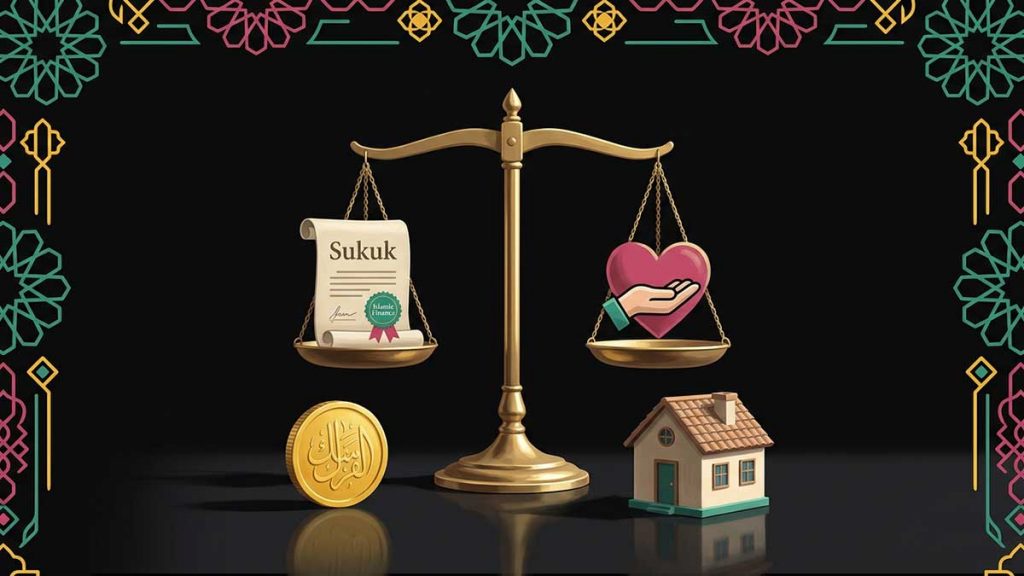
The single most important rule is the prohibition of riba, usually translated as interest or usury. The Quran is unusually firm on this point, and the verse above makes the contrast plain: trade is permitted, but interest is forbidden. Charging extra simply for the use of money is seen as unjust, because it guarantees a profit to the lender while loading all the risk onto the borrower.
In practice, this means a Sharia-compliant bank cannot offer a loan at five per cent interest, nor a savings account that pays a fixed interest rate. Instead, banks and customers enter into partnerships, leases or trade arrangements where both sides genuinely share in the outcome, whether that turns out to be profit or loss.
The wisdom behind the ban is social as much as financial. Interest-based debt can trap individuals and whole nations in cycles of repayment, steadily widening the gap between rich and poor. By removing it, the system aims to keep money circulating through real economic activity that benefits everyone, rather than piling up as debt in a few hands. This is why scholars describe interest not merely as a financial technique but as a moral and economic harm that the entire system is deliberately designed to avoid.
Money cannot simply earn money through interest — profit must come with real risk.
Principle 2: Sharing Risk and Reward

If interest is out, how does a bank make money? The answer is risk-sharing. Rather than lending and demanding a fixed return, the bank invests alongside its customer, and both share whatever profit or loss results. This single shift transforms the entire relationship between a bank and the people it serves.
Take a business that needs funding. Instead of a loan, the bank might become a partner, contributing capital in exchange for an agreed share of the profits. If the business thrives, both prosper. If it struggles, the bank shares the loss rather than demanding repayment regardless. Everyone ends up with a genuine stake in success.
This principle reflects a deep sense of fairness. It discourages reckless lending, because the financier only earns if the venture truly creates value. It also builds a more cooperative kind of economy, where banks and customers act as partners working towards a shared goal rather than opponents sitting on either side of a debt. In the best examples, this turns a bank from a distant lender into something closer to a working partner that genuinely wants the customer’s venture to flourish. Critics sometimes argue that, in reality, some products end up mimicking conventional loans, and scholars take that concern seriously. The ideal, though, remains a genuine sharing of fortune, and the best institutions work hard to honour both the letter and the spirit of the rule.
The bank shares the loss as well as the profit — not just collects repayment.
Principle 3: No Gambling or Hidden Uncertainty

The rules also forbid maysir (gambling) and gharar (excessive uncertainty or speculation). A contract should be clear, with both parties knowing exactly what they are agreeing to. Deals where the outcome depends purely on chance, or where crucial details are hidden or left undefined, are simply not allowed.
This rules out much of what caused the great financial crises of recent decades, such as betting on complex products that few people genuinely understood. By insisting on transparency and real, tangible substance behind every transaction, the system steers clear of the casino-style speculation that can destabilise whole economies.
It does not, however, mean avoiding all risk. Ordinary business risk, where an investor genuinely shares in the ups and downs of a real venture, is not only allowed but encouraged. The line is drawn at pure gambling, and at hidden, unfair uncertainty that one party could quietly exploit at another’s expense. A farmer agreeing to sell next season’s crop at a fixed, fair price is taking a sensible business risk; a person staking their savings on a spin of a wheel is gambling. The difference lies in whether the deal is built on real activity and clear terms, or on pure chance dressed up as investment.
Every deal must be clear, honest and transparent — never a gamble or a hidden bet.
Principle 4: Investing Only in What Is Halal

Money in Islam must be earned and invested in ways that are halal, meaning permissible and ethical. Sharia-compliant funds therefore screen out businesses whose core activity is harmful or forbidden, such as alcohol, gambling, tobacco, weapons, pork products and, of course, interest-based banking itself.
This makes the approach an early and natural form of ethical or responsible investing, an idea that has since become hugely popular across the world. Many non-Muslims are drawn to it for exactly this reason, preferring to know that their savings are not quietly funding industries they find troubling.
Beyond avoiding harm, the deeper aim is to put wealth to good use. Investing in healthcare, education, housing, clean energy, technology and honest trade is seen as a way of benefiting society while earning a living, turning the simple act of saving into something with real moral weight. For a generation increasingly concerned about where their money ends up, this built-in conscience is one of the most appealing features of Islamic finance.
Halal funds screen out alcohol, gambling and harmful trades — ethical investing centuries early.
Principle 5: Money Backed by Real Assets

A defining feature of the system is that money should be linked to real, tangible assets and genuine economic activity. Wealth is not meant to be conjured out of paper deals alone; behind every financing arrangement there should be a real house, a real piece of equipment, a real business or a real trade taking place.
This is why Sharia-compliant banks favour buying and selling actual goods, leasing real property, or partnering in real ventures. When a bank helps a family buy a home, for instance, it typically purchases the house itself and then sells or leases it to the family, rather than simply handing over cash and charging interest on the loan.
Tying money to real assets keeps finance grounded in the everyday economy that people can see and touch. It curbs the kind of runaway speculation that inflates bubbles, and it ensures the financial system serves the production of useful things rather than floating free above it. When finance stays connected to bricks, machinery and trade in this way, booms and busts tend to be gentler, because there is always something solid underneath the numbers.
Behind every deal stands a real house, business or trade — not paper money alone.
Principle 6: The Building Blocks of Halal Banking
To put these principles into practice, the industry uses a toolkit of distinctive contracts. In a murabaha arrangement, the bank buys an item and sells it to the customer at an agreed, transparent mark-up, paid in instalments — a common way to finance cars or homes without any interest at all.
An ijara is essentially a lease, where the bank owns an asset and rents it out, sometimes with an option for the customer to buy it at the end. Musharaka and mudaraba are partnership contracts, where profits are shared according to agreement and losses are borne fairly by those who provided the capital.
On a larger scale, sukuk are often called Islamic bonds, but instead of paying interest they give investors a share in real assets and the income those assets generate. Takaful, meanwhile, is cooperative insurance, where members contribute to a shared pool that supports whoever among them suffers a loss, helping one another rather than betting against each other.
Together these instruments allow individuals, businesses and even whole governments to raise and manage money in line with their faith, proving that a full modern financial system can run without a single penny of interest. Each contract simply replaces interest with a real transaction — a sale, a lease, a partnership or a pooling of risk — all of which can be understood by anyone willing to look past the unfamiliar Arabic names. Specialist scholars, often sitting on a bank’s Sharia board, review each product to confirm it genuinely follows the rules rather than just borrowing their vocabulary. This oversight is one of the quiet strengths of the system, giving customers confidence that the label on the tin matches what is actually inside.
Sukuk give investors a share in real assets and income — not a fixed rate of interest.
Principle 7: Zakat and the Social Heart of Money
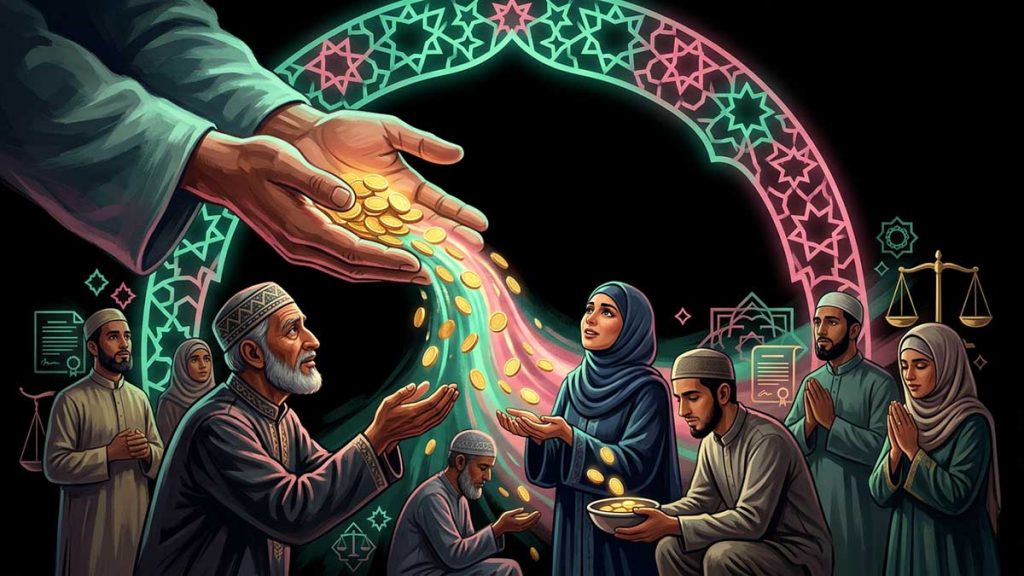
The system does not end with avoiding harm; it actively builds in generosity. Every financially able Muslim pays zakat, an annual portion of their accumulated wealth given to the poor and those in need. It is not charity in the optional sense, but a duty and one of the five pillars of the faith.
Zakat acts as a powerful engine for circulating wealth from those who have plenty to those who have little, reducing inequality and ensuring money keeps moving through society rather than sitting idle. Alongside it, voluntary generosity and a regular sadaqah habit are warmly encouraged.
This social dimension is what truly sets the model apart. Money is never treated as purely private; it carries responsibilities towards the wider community. Wealth is seen as a trust from God, something to be enjoyed, grown and shared rather than simply hoarded for its own sake. This belief reframes the whole purpose of money: success is measured not only by how much you accumulate, but by how much good you do with it. In that sense, Islamic finance is as much a moral philosophy as a set of banking rules, and that is precisely what so many people find refreshing about it.
Allah destroys interest and gives increase for charities — the very opposite of riba.
Islamic Finance in the Modern World
Far from being a relic of the past, Islamic finance is one of the fastest-growing parts of the global financial system. Sharia-compliant banks, investment funds and insurance providers now operate across the Muslim world and well beyond it, in financial centres from London and Kuala Lumpur to the Gulf and Africa.
For ordinary Muslims, this growth means real choice. Where once there was little alternative to interest-based banking, families can now find compliant savings, home financing, pensions and investments to suit their needs. Non-Muslims, too, increasingly turn to these products for their ethical and asset-backed nature.
Of course, the field is still developing, and scholars and economists continue to debate how best to apply timeless principles to fast-moving modern markets. But the core idea endures and resonates widely: a financial life built on fairness, real value and shared responsibility rather than debt and speculation. As more banks, fintech apps and even governments adopt these tools, Islamic finance is quietly reshaping how millions of people relate to their money, and proving that ethics and economics need not pull in opposite directions.
Curious to put these ideas into practice in your own life? Understanding the basics is the first step towards money that matches your values. For more on Islamic finance explained simply, and other everyday guidance, follow It’s About Islam — find us on YouTube, TikTok and Pinterest.
Frequently Asked Questions
It is a way of managing money that follows Islamic ethics. It bans interest and gambling, requires fairness and shared risk, ties money to real assets, and invests only in halal, ethical activities.
Interest is seen as unjust because it guarantees profit to the lender while placing all the risk on the borrower. Islam encourages earning through trade, partnership and shared risk instead, keeping money tied to real value.
Yes. Sharia-compliant banks and funds are open to everyone, and many non-Muslims choose them for their ethical, transparent and asset-backed approach, which overlaps closely with responsible investing.
Instead of lending money and charging interest, a halal home finance provider usually buys the property and then sells or leases it to you at an agreed price or rent, so no interest is involved.
No. It covers savings, investment funds, sukuk (Islamic bonds), takaful (cooperative insurance), pensions and charity through zakat, forming a complete financial system guided by fairness and shared responsibility.