
Hidden Islamic Landmarks
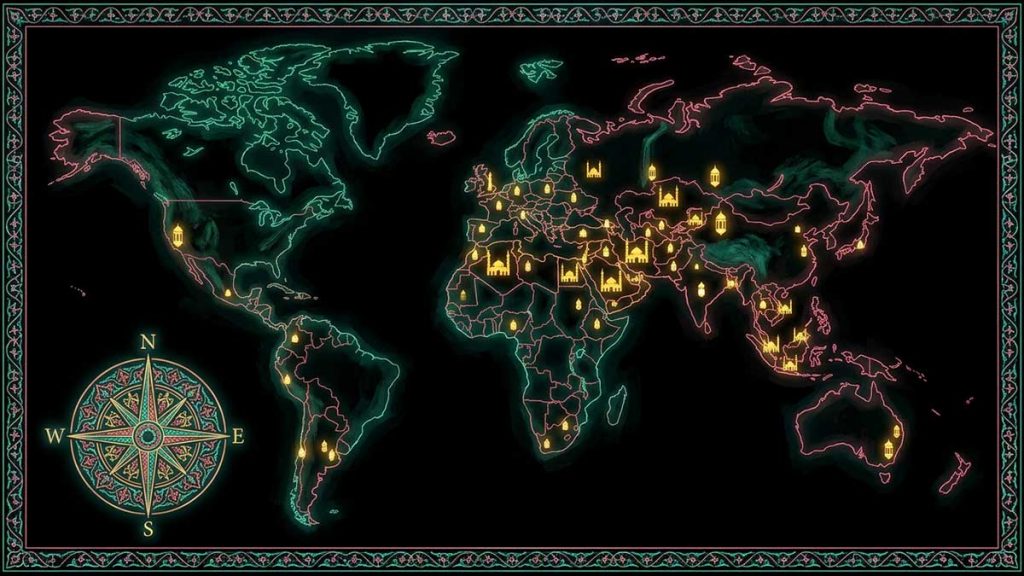
Most people can picture the Kaaba in Makkah, the Blue Mosque in Istanbul or the gleaming Taj Mahal. But the Islamic world has scattered across the globe a treasury of lesser-known wonders, each one breathtaking in its own way. From a giant mosque sculpted entirely from mud in the heart of Africa to a chamber in Iran that turns sunlight into a rainbow, these hidden Islamic landmarks tell the story of a faith that has inspired extraordinary beauty in every land it has touched. Here are eight remarkable places, far from the usual tourist trail, that deserve a spot on any traveller’s list.
قُلْ سِيرُوا فِي الْأَرْضِ فَانظُرُوا كَيْفَ بَدَأَ الْخَلْقَ
“Say, travel through the land and observe how He began creation.”
Beyond the Famous Few
Islamic architecture is one of humanity’s great artistic achievements, and yet our mental image of it is often limited to a handful of icons. The most celebrated sites draw millions of visitors, while countless equally astonishing places stand quietly in towns and cities the guidebooks tend to overlook. To explore them is to discover just how vast, varied and inventive Muslim heritage truly is.
The Quran repeatedly urges believers to travel through the earth and reflect on what they find, and journeying to these places is a wonderful way to answer that call. Every mosque, madrasa and monument carries the devotion of the people who built it, frozen in stone, tile and timber. Together they trace the spread of Islam across continents and centuries, each region adding its own flavour to a shared faith.
Of course, the ultimate destination for any Muslim remains Makkah and the rites of Hajj, and the great monuments of the faith are treasured the world over. But beyond those famous few lies a wider world of wonder. The eight hidden Islamic landmarks below are an invitation to look further, to marvel at the creativity of the believers, and perhaps to plan a journey of your own. Some lie in famous countries, others in places you might never expect to find a mosque at all. What unites them is the way each transforms a simple act of worship into an encounter with beauty, history and the genius of the believers who came before us.
1. The Great Mosque of Djenné, Mali

Rising from the floodplains of central Mali stands the largest mud-brick building on earth, and one of the most spectacular sights in all of Africa. The Great Mosque of Djenné is built entirely from sun-dried earth, its towering walls studded with wooden beams that give it an almost living, sculptural quality. It is the masterpiece of Sudano-Sahelian architecture and a UNESCO World Heritage Site.
What makes it truly extraordinary is that it is renewed by hand every single year. In a remarkable communal festival, the whole town gathers to re-plaster the mosque with fresh mud, climbing the protruding wooden beams that double as built-in scaffolding. It is at once an act of maintenance, worship and shared identity, binding the community to its mosque generation after generation.
Standing before its great earthen walls at sunset, glowing warm and golden, visitors often describe a sense of awe quite unlike that of any marble or stone monument. Here is a landmark that is humble and monumental at the same time, shaped from the very soil of the land, and utterly unforgettable. For travellers willing to venture off the beaten path, few experiences in West Africa rival the sight of this earthen giant glowing in the late afternoon. It is the kind of place that lingers in the memory long after the journey home.
Djenné’s great mosque is the largest mud-brick building on earth — re-plastered by the whole town each year.
2. The Registan, Samarkand, Uzbekistan

Once the beating heart of the Silk Road, the ancient city of Samarkand holds what many consider the single most beautiful public square in the Islamic world. The Registan is framed by three colossal madrasas, their soaring portals and ribbed turquoise domes covered in a dazzling skin of glazed tilework that shimmers in the desert light.
Built under the Timurid dynasty from the fifteenth century onward, these grand colleges were centres of learning where students once studied theology, astronomy and mathematics. The intricacy of their decoration is staggering, with geometric patterns, flowing arabesques and bands of sacred calligraphy covering nearly every surface in shades of blue, gold and green.
To stand in the centre of the Registan, surrounded on three sides by these towering masterpieces, is to feel the splendour of a civilisation at its height. Few places capture the marriage of faith, scholarship and breathtaking artistry quite like this jewel of Central Asia, yet it remains far less visited than it deserves.
Samarkand’s Registan dazzles with turquoise domes and glazed tilework from the height of the Silk Road.
3. The Great Mosque of Xi’an, China

Tucked into the old Muslim quarter of the Chinese city of Xi’an is one of the most surprising mosques in the world. At first glance, the Great Mosque of Xi’an looks nothing like the mosques of the Middle East. There are no domes or towering minarets; instead, there are graceful pavilions, tiled roofs that sweep up at the corners, and tranquil garden courtyards in the classical Chinese style.
One of the oldest and largest mosques in China, it has served the country’s Muslim community for many centuries. Its minaret takes the form of an elegant pagoda, and its prayer hall sits at the end of a series of peaceful courtyards, blending Chinese craftsmanship with Islamic worship in a way found almost nowhere else on earth.
The mosque is a beautiful reminder that Islam has never belonged to a single culture or style. Wherever the faith has travelled, it has woven itself into local traditions of art and building, producing treasures like this one that feel both wholly Chinese and wholly Islamic at the very same time.
The Great Mosque of Xi’an has pagodas and garden courtyards — Islam in classical Chinese style.
4. The Pink Mosque, Shiraz, Iran

In the Iranian city of Shiraz hides what may be the most photographed interior in the Muslim world, and with good reason. The Nasir al-Mulk Mosque, affectionately known as the Pink Mosque, appears modest from the street. Step inside on a sunny morning, however, and you enter a kaleidoscope of pure colour.
The mosque’s western hall is fitted with walls of stained glass, and as the early sun streams through them, the whole space is flooded with shifting pools of crimson, gold, blue and violet light dancing across the carpets and columns. It is an experience of beauty so intense that visitors often fall completely silent, simply watching the colours move.
Beyond the famous glass, the mosque is adorned with delicate tilework in soft rose and pink tones, giving it its popular name. It stands as a stunning example of how Persian artisans used light itself as a building material, turning the simple act of morning prayer into an encounter with breathtaking, almost otherworldly beauty.
Shiraz’s Pink Mosque turns dawn sunlight into pools of dancing colour through walls of stained glass.
5. The Wazir Khan Mosque, Lahore, Pakistan
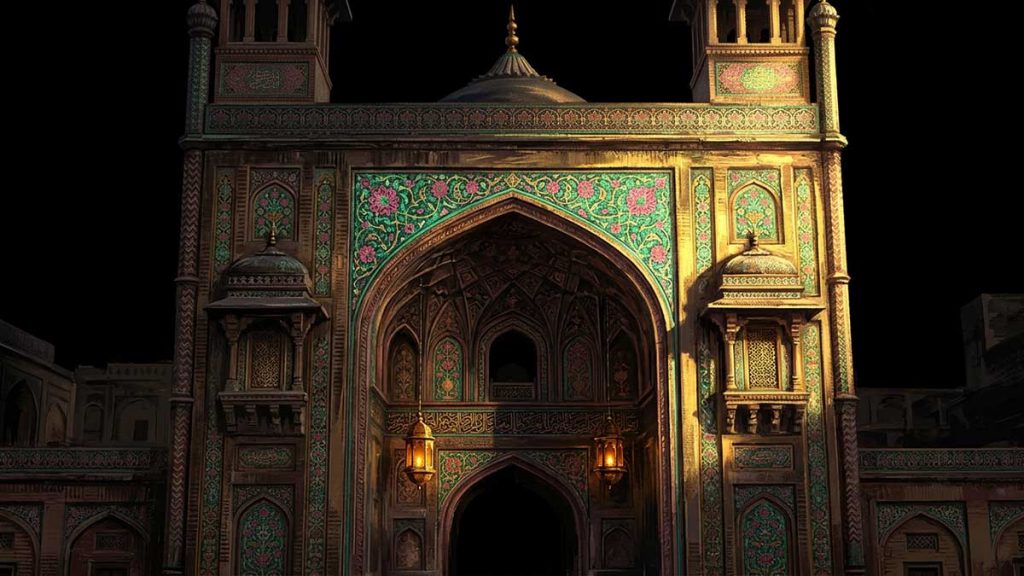
The Pakistani city of Lahore is famous for the mighty Badshahi Mosque, but a short walk away in the old walled city lies a smaller and arguably even more exquisite jewel. The Wazir Khan Mosque, built in the seventeenth century under the Mughals, is celebrated as one of the most beautifully decorated mosques anywhere in the world.
Its glory lies in its surfaces. Almost every inch is covered in intricate faience tilework and vivid fresco painting, a riot of flowers, vines, geometric patterns and elegant calligraphy in deep blues, greens, oranges and yellows. Craftsmen spent years adorning its walls, courtyard and towering gateway, creating a masterpiece of Mughal decorative art.
Walking through its bustling bazaar entrance into the calm of its tiled courtyard feels like stepping into a living museum of Islamic craftsmanship. While crowds flock to its larger neighbour, the Wazir Khan Mosque rewards those who seek it out with detail and colour of a richness that is difficult to forget. Many who come to Lahore for its grandest sites leave speaking most of all about this smaller mosque. Its sheer density of colour and craftsmanship makes it a favourite among the most rewarding hidden Islamic landmarks in all of South Asia.
6. Timbuktu’s Mosques and Manuscripts, Mali

Few names conjure distance and mystery like Timbuktu, yet this remote Malian city was once one of the greatest centres of learning in the entire world. At its heart stand ancient earthen mosques, including the famous Djinguereber and the Sankoré, their distinctive mud architecture echoing the great mosque of Djenné to the south.
During its golden age, Timbuktu drew scholars from across Africa and the Muslim world to study at its mosque-universities. It became a hub of knowledge in theology, law, astronomy and medicine, and its libraries swelled with hundreds of thousands of handwritten manuscripts, many of which survive to this day as a priceless record of African Islamic scholarship.
To visit Timbuktu is to touch a chapter of history that overturns lazy assumptions about the past. Here, on the edge of the Sahara, flourished a civilisation of books and learning long before many of the world’s modern universities existed, a powerful testament to the value Islam has always placed on the pursuit of knowledge.
Timbuktu’s libraries held hundreds of thousands of manuscripts — a Saharan city of learning.
7. The Ubudiah Mosque, Malaysia
In the small royal town of Kuala Kangsar in Malaysia sits one of South-East Asia’s most elegant mosques. The Ubudiah Mosque, with its gleaming golden dome encircled by smaller domes and slender minarets, is widely regarded as one of the most beautiful mosques in the country.
Completed in the early twentieth century, it was commissioned by a sultan in fulfilment of a vow and built in a graceful style that blends Mughal and Moorish influences. Its brilliant white walls and shining golden domes, set against tropical greenery, make it a serene and photogenic landmark that seems to glow in the equatorial sun.
While Malaysia boasts many grander and more modern mosques, the Ubudiah is cherished for its harmony and refinement rather than its size. It is a reminder that hidden Islamic landmarks are not always ancient ruins; sometimes they are quiet gems of more recent centuries, lovingly maintained and full of grace. Set beside a tranquil river and framed by hills, it makes for one of the most serene stops on any journey through Malaysia.
Malaysia’s Ubudiah Mosque is famed for its gleaming golden domes set against tropical green.
8. The Great Mosque of Córdoba, Spain
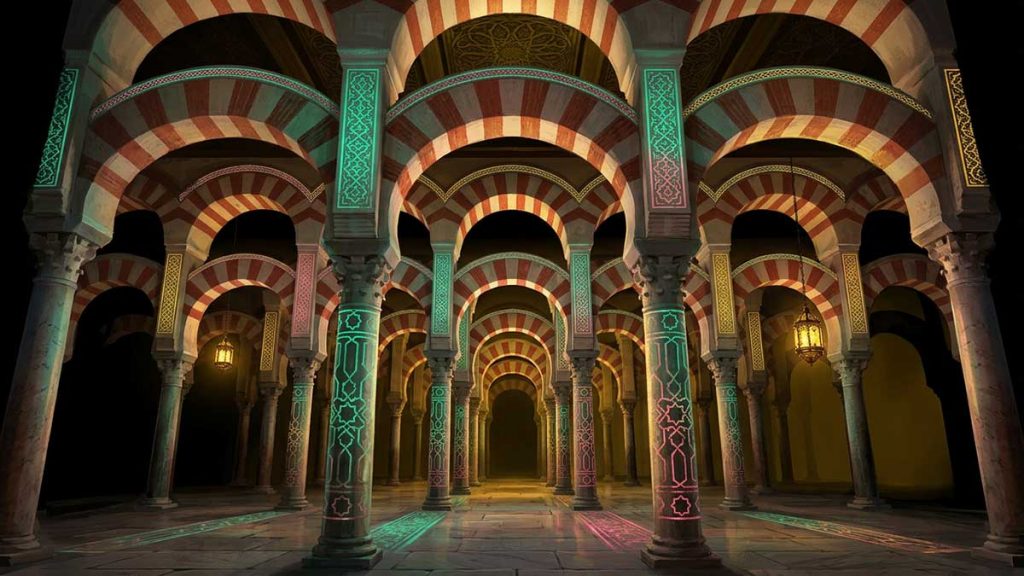
In the south of Spain stands one of the most evocative monuments of Islamic Europe. The Great Mosque of Córdoba, built during the centuries of Muslim rule in Andalusia, is renowned for its vast hypostyle prayer hall, an enchanting forest of hundreds of columns linked by distinctive red-and-white striped double arches stretching as far as the eye can see.
For around three centuries Córdoba was a dazzling capital of learning and culture, and its great mosque stood at the centre of that flourishing. The building’s serene arches, intricate mihrab and elegant proportions still convey the sophistication of Al-Andalus, even though the structure was converted into a cathedral after the city changed hands.
Today it draws visitors from around the globe, yet many travellers still do not realise its origins as one of the most important mosques in Islamic history. Walking beneath its endless arches, it is impossible not to feel the echoes of the worshippers who once filled this remarkable hall, a living link to the golden age of Muslim Spain. For Muslim visitors in particular, the experience can be deeply moving, a chance to stand quietly where ancestors in faith once prayed. It is a poignant reminder of a civilisation that briefly made Spain a beacon of learning for all of Europe.
Córdoba’s great mosque holds a forest of striped double arches from the golden age of Muslim Spain.
Travelling With Purpose
These eight places are only a beginning. From the mosques of Cairo and the shrines of Central Asia to quiet gems in the Balkans, the Maldives and beyond, the world is rich with hidden Islamic landmarks waiting to be discovered. Each one is a window onto the faith and the people who shaped it in that corner of the earth.
For a Muslim, travel can be far more than sightseeing. Seeing the devotion captured in these buildings can deepen one’s own faith, broaden the heart, and inspire gratitude for the global family of believers who raised them. As the Quran reminds us, journeying through the land and reflecting on what we see is itself a form of worship and remembrance.
Whether you ever reach these distant places or simply marvel at them from afar, they carry a quiet lesson. The beauty of Islam has never been confined to one country, climate or culture; it has blossomed everywhere from the Sahara to the Silk Road. Seeking out these hidden Islamic landmarks is a joyful way to witness that beauty, and to honour the faith and creativity that built them. Each name on this list is a doorway into a different time and place, and there are countless more besides. The believers who raised them are long gone, but the beauty they left behind still speaks across the centuries.
Which of these would you most love to visit one day? There is a whole world of Islamic beauty out there to explore. For more on hidden Islamic landmarks, history and travel, follow It’s About Islam — find us on YouTube, Facebook and Pinterest.
Frequently Asked Questions
Lesser-known gems include the mud-brick Great Mosque of Djenné in Mali, the Registan in Samarkand, the Great Mosque of Xi’an in China, the stained-glass Pink Mosque in Iran, the Wazir Khan Mosque in Lahore, and the Great Mosque of Córdoba in Spain.
The Great Mosque of Djenné in Mali is the largest mud-brick building on earth. Built entirely from sun-dried earth, it is re-plastered by hand each year by the whole community in a remarkable festival, and is a UNESCO World Heritage Site.
The Nasir al-Mulk Mosque in Shiraz, known as the Pink Mosque, is famous for its stained-glass windows. On sunny mornings, light streaming through the coloured glass floods the interior with shifting pools of crimson, gold and blue.
Many of these sites welcome visitors of all faiths, though some active mosques have rules on dress, timing and access. As always, travellers should dress modestly, behave respectfully, and check local guidance before visiting any place of worship.
Yes. The Quran repeatedly urges believers to travel through the land and reflect on creation and history. For Muslims, visiting beautiful mosques and sites of heritage can deepen faith and gratitude, making travel a meaningful form of reflection.