
AI and Islam
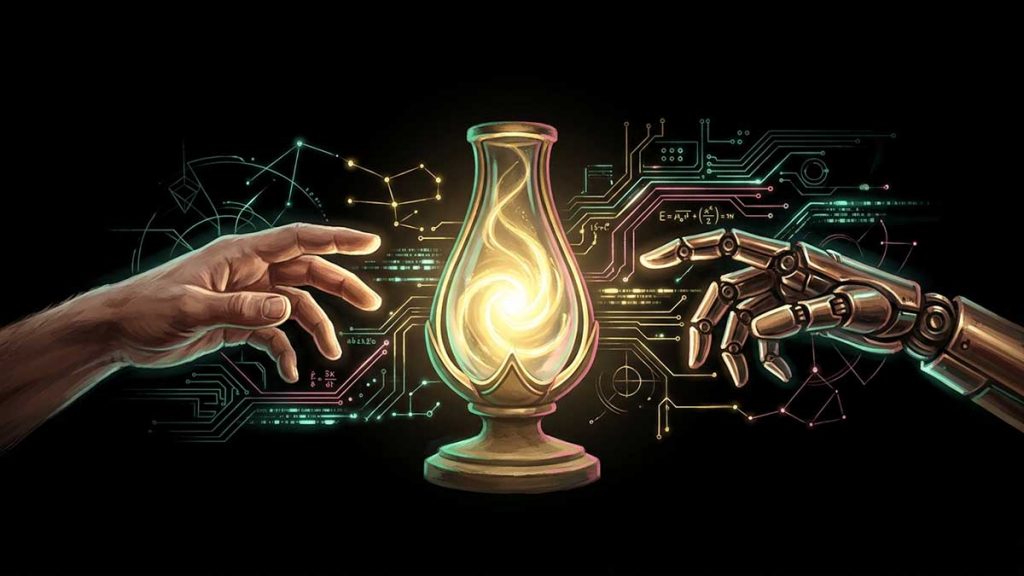
Artificial intelligence is no longer science fiction. It writes our emails, answers our questions, drives our cars and increasingly shapes the world around us. For Muslims, this raises a host of fresh and fascinating questions. Is it permissible to use AI? Can a machine ever answer matters of faith? What happens to truth, to work, to human dignity in an age of thinking machines? The relationship between AI and Islam is one of the defining conversations of our time, and the good news is that the timeless wisdom of Islam has a great deal to say about it. Here are seven crucial questions, and how Islamic principles help us answer them.
عَلَّمَ الْإِنسَانَ مَا لَمْ يَعْلَمْ
“He taught man that which he knew not.”
Faith Meets the Machine
Every generation faces a new technology that seems to change everything, and ours is artificial intelligence. From the apps that wake us for Fajr to the systems diagnosing illness in our hospitals, AI is quietly weaving itself into the fabric of daily life. For some it inspires excitement, for others unease, and for many simply a tangle of difficult questions about what it all means.
Islam has never feared knowledge or progress. The very first word revealed to the Prophet (pbuh) was Iqra, meaning Read, and the verse above reminds us that all human knowledge is ultimately a gift from God, who taught humanity what it did not know. A faith that opened with a command to learn is hardly going to recoil from a powerful new tool for learning.
Yet Islam also insists that knowledge and power carry responsibility, and that everything we touch can be used for good or for harm. A sword can defend the innocent or murder them; the internet can spread truth or filth; and artificial intelligence is no different. The question, as always, is not whether the tool exists, but how a believer should use it.
Thinking carefully about AI and Islam, then, is not about issuing simple verdicts of permitted or forbidden. It is about bringing centuries of ethical wisdom to bear on genuinely new dilemmas, so that Muslims can embrace what is beneficial, guard against what is harmful, and keep their hearts anchored to God through it all. The seven questions that follow map out that terrain. It is worth saying at the outset that none of these questions has a single, simple answer carved in stone; new technology always outpaces old rulings, and the dialogue between AI and Islam is very much a living one, with thoughtful Muslims and scholars still working through the details. What follows is a framework for thinking, grounded in principles that have guided the faith for centuries.
The first word revealed was Read — Islam was born championing knowledge.
Question 1: Is It Permissible to Use AI?
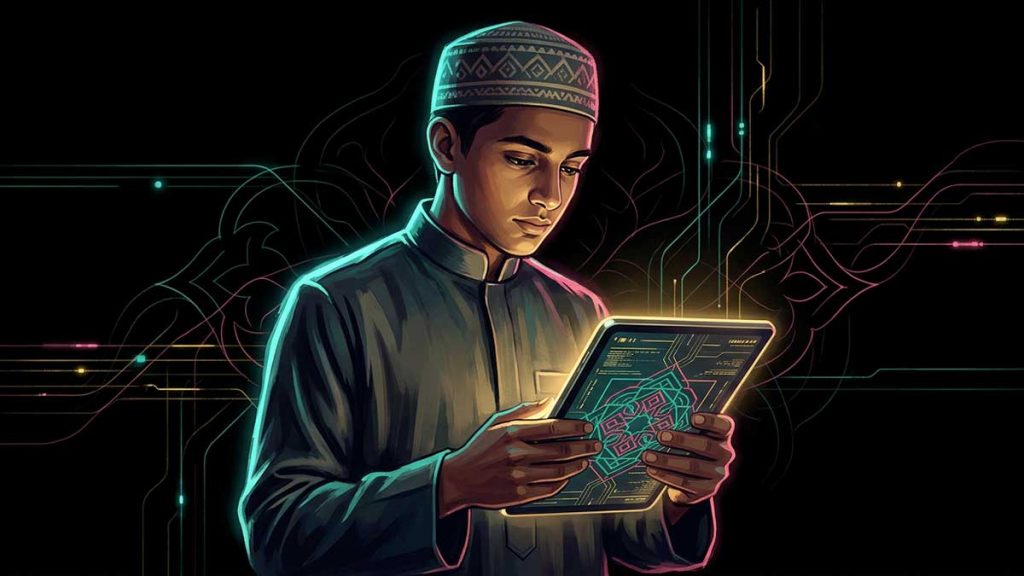
The most basic question is also the easiest to answer. In Islamic ethics, tools themselves are generally neutral; what matters is the purpose they serve and the consequences they bring. Just as the printing press, the telephone and the computer were all embraced for the good they could do, artificial intelligence is, in principle, permissible to use and develop.
Used well, AI is a remarkable servant. It can translate the Quran into a hundred languages, help students grasp difficult ideas, detect disease earlier than any doctor, optimise charity and relief work, and free people from dull and dangerous labour. None of this conflicts with Islam; much of it advances the very goals, such as healing the sick and spreading knowledge, that the faith holds dear.
The permission, however, comes with the same condition attached to every tool: it must be used for what is lawful and beneficial, not for what is harmful or forbidden. AI built to deceive, to exploit, to spy unjustly or to spread corruption falls under the things Islam prohibits, not because it is AI, but because of what it is being made to do. The technology is neutral; our intentions and actions are not.
Like the pen or the printing press, AI is a tool judged by how it is used — not good or evil in itself.
Question 2: Can AI Replace Scholars and Imams?
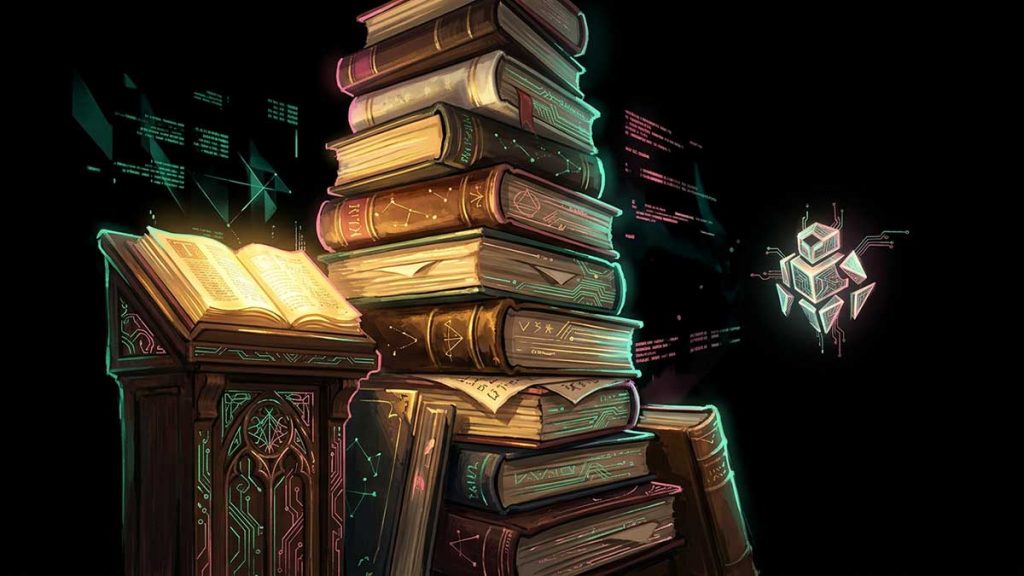
Here Islam draws a firm and important line. While AI can be a helpful study aid, it cannot replace genuine Islamic scholarship or religious authority. Issuing a fatwa, a considered religious ruling, requires deep knowledge, sound judgement, an understanding of context, and crucially the God-consciousness, or taqwa, that no algorithm can possess.
There is a very practical danger here too. AI chatbots are known to invent confident-sounding answers that are simply wrong, a flaw engineers politely call hallucination. When the subject is dinner recipes that is a nuisance; when it is a question of halal and haram, or a matter that affects someone’s faith and conscience, it can cause real harm. A machine feels no weight of responsibility for the souls it advises.
The wise approach is to treat AI as one might treat a search engine or an index: useful for finding information and pointing the way, but never the final word. For real religious guidance, Muslims turn to qualified scholars and teachers who carry both learning and accountability. Likewise, the prayer must be led by a living human being; a recording or a robot can never stand in for the imam before God.
No algorithm has taqwa — AI can inform a question, never replace a scholar who answers before God.
Question 3: AI and the Pursuit of Knowledge

If there is one area where AI and Islam meet most happily, it is the pursuit of knowledge. Islam places enormous value on learning, calling the seeking of knowledge a duty and the scholar’s ink as worthy as the martyr’s blood. Anything that genuinely helps people learn, understand and discover sits comfortably within that tradition.
Artificial intelligence is, at its best, an extraordinary engine of learning. It can make the wisdom of the world’s libraries searchable in seconds, tutor a child in a remote village, translate between languages that once divided people, and accelerate research into medicine, climate and the cosmos. For a faith that reveres the All-Knowing and urges its followers to reflect on creation, these are gifts to be welcomed.
There is a caution, though, woven into the celebration. Knowledge in Islam is meant to be understood and lived, not merely retrieved. If we let machines do all our thinking, we risk gaining information while losing wisdom, and convenience while losing depth. The ideal is to use AI as a ladder that lifts human understanding higher, not a crutch that lets the mind grow lazy and the heart grow cold.
Question 4: Intention and Accountability
A cornerstone of Islamic ethics is that we are accountable for our actions, and that those actions are judged by their intentions. This principle cuts straight to the heart of the AI debate. A machine has no intention, no soul and no moral responsibility; it is the human being who builds, deploys and uses it who will answer for the outcome.
This matters enormously as AI takes on weightier roles. When an algorithm denies someone a loan, flags them to the authorities or shapes the news they see, it is tempting to shrug and say the computer decided. Islam allows no such evasion. Behind every system stands a chain of human choices, and responsibility cannot be outsourced to a machine that cannot be called to account.
For the Muslim, this is both a warning and an empowerment. It means we must use these tools with care, mindful that we will be questioned about the good or harm they do through our hands. But it also affirms our dignity: we are not at the mercy of our machines, but their masters and their moral guardians. The intention in the heart, as ever, is what gives an action its true weight.
Actions are judged by intentions — and we answer for how we use our tools not the machine.
Question 5: Truth, Deepfakes and Deception
Few of AI’s powers are as troubling as its ability to fabricate. Today a machine can generate fake images, clone a person’s voice and create videos of events that never happened, so convincing that the eye cannot tell. In a religion that treasures truth and condemns lying and deception, this raises a serious moral alarm.
Islam is unambiguous on honesty. The Prophet (pbuh) was known as the truthful even before prophethood, and he warned that lying leads to wickedness and ruin. Creating or knowingly spreading a deepfake to deceive, defame or defraud is a clear sin, dressed in new technology but condemned by the oldest of principles. Slandering someone with a fabricated video is no less a slander for being digital.
The believer’s duty, then, is twofold. We must never use these tools to deceive, and we must be far more careful about what we accept and pass on, since the Quran already commands us to verify news before acting on it. In an age when seeing is no longer believing, the Muslim’s commitment to truth, and to checking before sharing, becomes a vital anchor of trust in a sea of fakery.
In an age of deepfakes, the believer’s rule still holds: never deceive, and verify before you share .
Question 6: Bias, Justice and Human Dignity
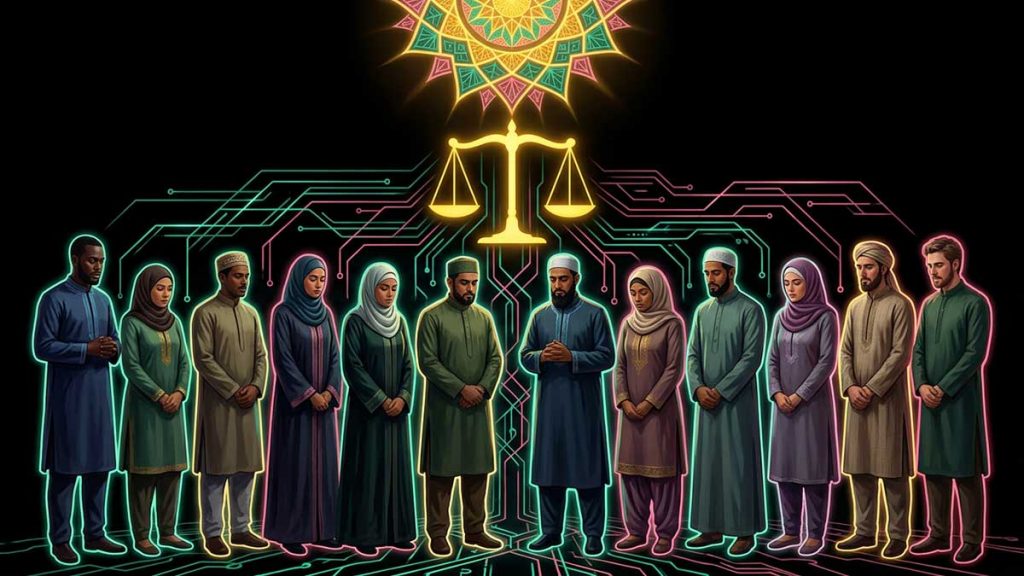
AI systems learn from human data, and so they can quietly absorb and amplify our worst prejudices. An algorithm trained on biased records may treat people unfairly on the basis of race, gender or background, all while wearing a mask of cold objectivity. For a faith built on justice, this is a danger that cannot be ignored.
Islam commands fairness in the clearest terms, with the Quran instructing believers that God commands justice and good conduct. That obligation does not vanish when decisions are handed to a machine. Muslims involved in building or using AI carry a duty to guard against bias, to test systems for fairness, and to ensure technology does not entrench the very injustices the faith came to abolish.
Underlying all of this is the Islamic insistence on human dignity. The Quran declares that God has honoured the children of Adam, granting every human being a worth that no system may trample. People must never be reduced to mere data points, and the gravest moral judgements about human lives should not be surrendered wholesale to machines. As the Creator alone fashioned us with purpose, our value can never be calculated by an algorithm.
Allah commands justice — so a machine that inherits our bias must never be left to judge unchecked.
Question 7: Work, Purpose and Over-Reliance
As AI grows more capable, it raises anxious questions about work and purpose. If machines can do so much, what becomes of human labour, and of the meaning many of us find in it? These are real concerns, and Islam, which dignifies honest work and warns against idleness, takes them seriously.
The faith offers a balanced response. It encourages embracing tools that ease genuine hardship, while reminding us that our worth was never measured by productivity alone. A Muslim’s ultimate purpose is the worship and remembrance of God and service to His creation, something no machine can do on our behalf. Societies, meanwhile, bear a responsibility to ensure that the gains of automation are shared justly and that people are not simply cast aside.
There is also a subtler, spiritual danger: over-reliance. When every answer, every task and every moment of boredom can be outsourced to a device, the mind and the heart can grow slack. The Prophet (pbuh) regularly sought refuge with God from laziness, and that prayer feels newly urgent in an age of effortless convenience. The goal is to let AI serve our purpose, never to let it quietly replace it, and to keep our connection to our Lord alive and awake.
The Prophet (pbuh) sought refuge from laziness — convenience must never dull the heart or mind.
A Tool in the Hands of Believers
Step back from the individual questions, and a clear picture emerges. Artificial intelligence is one of the most powerful tools humanity has ever created, and like every tool before it, it can build or destroy depending on the hand that wields it. Islam does not ask Muslims to fear it or to flee from it, but to master it with wisdom and conscience.
The principles are the same ones the faith has always taught: seek what is beneficial, shun what is harmful, hold fast to truth, act with justice, honour human dignity, keep your intentions pure, and never let anything come between you and the remembrance of God. Apply these to AI, and a believer can navigate this new world with both confidence and care.
Ultimately, the meeting of AI and Islam is a reminder of something deeply reassuring. Machines may grow ever cleverer, but wisdom, accountability and the human soul remain God’s domain, not the computer’s. Used as a faithful servant rather than a false master, artificial intelligence can be one more way for believers to learn, to heal, to serve and to marvel at the boundless knowledge of the One who taught humanity all it knows. In the years ahead, the conversation around AI and Islam will only deepen, as the technology grows and new dilemmas arise that no one can yet foresee. Meeting them well will take knowledge, humility and a firm grip on first principles, and approached in that spirit, even the most bewildering advances become simply one more chapter in humanity’s long search for understanding under God.
How do you balance these new tools with your faith in everyday life? It is a question worth thinking through carefully. For more thoughtful reflection on AI and Islam, and faith in a changing world, follow It’s About Islam — find us on YouTube, X and Threads.
Frequently Asked Questions
No. AI is generally considered a neutral tool, and using it is permissible. What matters is the purpose: using AI for beneficial, lawful ends is fine, while using it to deceive, harm or do what is forbidden is not.
It is unwise to rely on AI for fatwas. Chatbots can give confident but incorrect answers, and they lack the knowledge, context and accountability of a real scholar. Use AI to find information, but turn to qualified scholars for religious guidance.
Islam strongly condemns lying and deception. Creating or sharing deepfakes to deceive, defame or defraud is sinful. Muslims are also commanded to verify news before sharing it, which is more important than ever in an age of fabricated media.
It can, if misused. Islam teaches that God has honoured every human being, so people must not be reduced to data points, and the most serious moral decisions should not be handed entirely to machines that can inherit human bias.
By seeking what is beneficial, avoiding what is harmful, holding to truth and justice, keeping intentions sincere, and never letting convenience replace worship, effort or the remembrance of God. AI should serve a believer’s purpose, not erode it.