
Muslim Inventors

Long before the modern laboratory, a remarkable group of Muslim inventors and scholars lit up the world with discovery. Between roughly the 8th and 14th centuries, during what is now called the Islamic Golden Age, they laid the foundations of algebra, optics, surgery, chemistry and engineering — gifts the whole world still relies on today. This guide profiles ten of the greatest Muslim inventors, the breakthroughs that made them famous, and the faith that drove their endless curiosity. Their stories are a reminder that, in Islam, seeking knowledge has always been bound up with worship.
طَلَبُ الْعِلْمِ فَرِيضَةٌ عَلَى كُلِّ مُسْلِمٍ
“Seeking knowledge is an obligation upon every Muslim.”
The Golden Age of Muslim Inventors

The achievements of the great Muslim inventors did not happen by accident. Islam places enormous value on learning, and the very first word revealed in the Quran was a command to read. With that spirit, the early Muslim world became a magnet for scholars of every background. In Baghdad, the famous House of Wisdom gathered and translated the knowledge of the Greeks, Persians, Indians and others, then pushed it far beyond what had come before.
For centuries, the centres of learning in Baghdad, Cordoba, Cairo and Damascus led the world in mathematics, medicine, astronomy and engineering. To these scholars, studying the universe was a way of drawing closer to its Creator, Al-Alim, the All-Knowing. Knowledge and faith were never rivals; they were two sides of the same search for truth.
From the 8th to the 14th century, Muslim scholars led the world in science, medicine and engineering.
Allah asks: are those who know equal to those who do not know?
One invention made all the others possible: paper. After Muslims learned the art of paper-making in the 8th century, books became affordable, and great libraries sprang up across the Muslim world — Baghdad alone is said to have held more books than all of Europe combined. Caliphs and rulers poured wealth into this pursuit, paying scholars in gold and building observatories, hospitals and academies. Knowledge was not a hobby for the few; it was a treasured part of civilisation, open to Muslims, Christians and Jews who often worked side by side in the search for understanding.
By the 10th century, the library of Cordoba in Muslim Spain is thought to have held some four hundred thousand books, at a time when the largest libraries in Christian Europe counted theirs in the hundreds. Cairo, Damascus and Bukhara became famous seats of learning, and institutions such as Al-Azhar grew into centres of study that still endure today. This was the soil in which the great inventors of the age grew — a world that prized the pen as highly as the sword.
Al-Khwarizmi: The Father of Algebra

Working in the House of Wisdom in the 9th century, Muhammad ibn Musa al-Khwarizmi gave the world a tool it could not do without: algebra. The very word comes from the title of his book, al-jabr, and his methods for solving equations are still taught in every school on earth. He also helped introduce the decimal place-value system and the numerals we now call Arabic numerals, replacing clumsy older systems and making arithmetic possible for ordinary people.
His influence runs even deeper than mathematics. When his name was translated into Latin as “Algoritmi,” it gave us the word “algorithm” — the step-by-step logic that powers every computer, search engine and smartphone today. Few people in history have shaped the modern world as quietly, or as completely.
The word “algorithm” comes from the name of the Muslim mathematician Al-Khwarizmi.
Al-Khwarizmi’s curiosity ranged far beyond equations. He compiled detailed astronomical tables charting the movements of the sun, moon and planets, and revised the geography of the ancient world, calculating the coordinates of hundreds of cities. Perhaps most importantly, he championed the use of zero as a placeholder and the elegant decimal system that depends on it. Without that simple idea, the mathematics behind modern science, banking and technology would be almost unthinkable.
Ibn al-Haytham: The Father of Optics
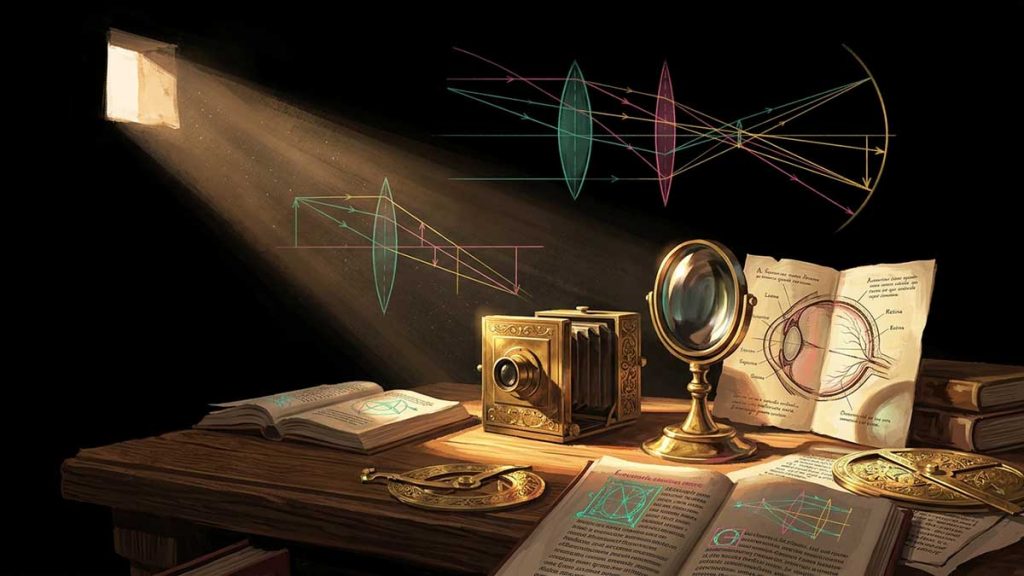
Ibn al-Haytham, known in the West as Alhazen, transformed how humanity understands light and vision. In his groundbreaking Book of Optics, he correctly explained that we see because light reflects from objects into our eyes — overturning centuries of mistaken belief. He described the camera obscura, the principle behind every camera ever built, and studied lenses, mirrors and the way light bends.
Even more importantly, he insisted that ideas must be tested by experiment and evidence, not simply accepted from the past. In doing so, he laid out the scientific method roughly six centuries before it took hold in Europe. His careful study of light makes him one of the most important Muslim inventors and thinkers of all time.
Ibn al-Haytham described the scientific method six centuries before Europe.
What set Ibn al-Haytham apart was his refusal to accept any claim without proof. In a bold work titled Doubts Concerning Ptolemy, he challenged one of the most respected authorities of the ancient world, arguing that even the greatest names must be questioned and tested. His writings, translated into Latin, went on to shape European thinkers such as Roger Bacon and, centuries later, Johannes Kepler. In an age that prized tradition, he taught the world to value evidence above reputation.
Al-Jazari: The Father of Robotics
If you have ever been amazed by a robot, you owe a debt to Al-Jazari. Writing in 1206, this brilliant engineer compiled The Book of Knowledge of Ingenious Mechanical Devices, describing some fifty machines in stunning detail. Among them were automata — mechanical figures that could be set to perform different actions — making him, in the eyes of many historians, the father of robotics.
His celebrated elephant clock combined Greek, Indian, Persian and Arabian elements into a single working marvel. He also pioneered the crankshaft and segmental gears, components still found in countless engines and machines today. Al-Jazari proved that the genius of Muslim inventors reached well beyond paper and theory into the moving, mechanical world.
Al-Jazari built programmable machines eight centuries before modern robotics.
The range of Al-Jazari’s machines was breathtaking. He designed water-raising devices that fed gardens and cities, an automated hand-washing basin with an early flushing mechanism, peacock-shaped fountains, and even a programmable musical band mounted on a boat to entertain royal guests. Each device blended beauty with engineering, turning cold mechanics into objects of wonder. Many of the principles he set down were rediscovered by European engineers only hundreds of years later.
Pioneers of Medicine: Al-Zahrawi and Ibn Sina

Two Muslim inventors changed medicine forever. Al-Zahrawi, known in Europe as Abulcasis, is often called the father of modern surgery. His vast medical encyclopaedia, Al-Tasrif, described and illustrated more than two hundred surgical instruments — many of which, such as forceps and the surgical needle, are still recognisable in operating theatres today. European surgeons relied on his work for some five hundred years.
Al-Zahrawi invented over 200 surgical instruments still recognised by surgeons today.
His contemporary, Ibn Sina — Avicenna to Europeans — wrote The Canon of Medicine, a monumental work that organised all the medical knowledge of its age. It became the standard textbook in European universities for more than six hundred years, an astonishing record for a single book. Together, these two physicians shaped how the world heals, and remind us that seeking a cure is itself a form of mercy and a prayer for beneficial knowledge.
The detail in their work still astonishes doctors today. Al-Zahrawi pioneered the use of dissolvable internal stitches made from animal gut, described how to control bleeding, and designed special instruments for childbirth and dentistry. Ibn Sina, meanwhile, suspected that some diseases spread invisibly from person to person, recommended quarantine to stop outbreaks, and laid out careful rules for testing new medicines — ideas remarkably close to the clinical trials of the modern world.
These physicians did not work alone. The Muslim world built some of history’s first true hospitals, known as bimaristans, where patients of every faith were treated free of charge, doctors were trained, and careful records were kept. Medicine became not just a science but a public service and an act of compassion — the healing of the body seen as a way of honouring the One who gave it life.
Jabir ibn Hayyan and the Birth of Chemistry
The science of chemistry owes its very foundations to Jabir ibn Hayyan, known in Latin as Geber. Working in the 8th century, he transformed the older, secretive craft of alchemy into something far more systematic and experimental. He developed and refined essential laboratory processes — distillation, crystallisation, filtration and evaporation — and is credited with perfecting the alembic, an apparatus still central to chemistry and even to the modern world’s industries.
Jabir treated the natural world as something to be observed, measured and understood rather than guessed at. In studying how substances combine and change, he was, in a sense, marvelling at the handiwork of Al-Khaliq, the Creator. His insistence on careful experiment earned him a lasting title: the father of chemistry.
Jabir’s approach was strikingly modern. He sorted substances into careful categories, described how to prepare powerful acids and purify metals, and insisted that every claim be confirmed by repeated, measured experiment. He is even said to have warned that the scholar who does not perform practical work and conduct experiments will never succeed. That experimental spirit is the very heartbeat of science today.
More Muslim Inventors Who Shaped the World

The Golden Age was rich with brilliant minds, and four more deserve a special mention. Abbas ibn Firnas, working in 9th-century Cordoba, became one of the first people in history to attempt human flight, gliding through the air with a set of feathered wings centuries before the aeroplane. He also experimented with lenses and glass-making, blending science with imagination.
Fatima al-Fihri founded the University of al-Qarawiyyin in Fez in the year 859 — recognised today as the oldest existing degree-granting university in the world. A devout woman who used her inheritance to build a place of learning, she reminds us that Muslim inventors and pioneers were not only men, and that education itself can be a gift to all humanity.
Al-Idrisi, the great geographer, produced one of the most accurate world maps of the medieval era, the Tabula Rogeriana, drawing together knowledge from across the known world. And Al-Razi, known as Rhazes, was a towering physician who was the first to clinically distinguish smallpox from measles and who championed careful observation at the patient’s bedside. From the skies to the operating room to the map of the earth, these innovators expanded the limits of what was possible.
The roll-call of brilliance hardly ends there. The astronomer Al-Battani refined our measurement of the length of the year, Al-Sufi catalogued the stars and recorded a distant galaxy, and skilled craftsmen built astrolabes and mechanical timepieces of remarkable precision. For every name remembered today, many more worked quietly in workshops and observatories, each adding a thread to an extraordinary tapestry of discovery.
Beyond these famous names, the wider world of Muslim inventors and scholars transformed everyday life in countless ways. They perfected the astrolabe for navigation and timekeeping, built some of the first true hospitals — with separate wards, pharmacies and training for new doctors — mapped the stars with astonishing accuracy, harnessed wind and water with advanced mills and irrigation, and even gave the world coffee, first brewed in the highlands of Yemen. Each of these gifts was the fruit of a civilisation that treasured learning.
The Lasting Legacy of Muslim Inventors
The work of these Muslim inventors did not stay in the East. As their books were translated into Latin in places like Toledo, their discoveries flowed into Europe and helped spark the Renaissance and the later scientific revolution. The algebra of Al-Khwarizmi, the optics of Ibn al-Haytham, the medicine of Ibn Sina and the surgery of Al-Zahrawi became the building blocks on which modern science was raised.
Much of Europe’s Renaissance was built on knowledge preserved and advanced by Muslim inventors and scholars.
The fingerprints of this golden era are still all around us. When European scholars gathered in cities like Toledo to translate Arabic books into Latin, they unlocked centuries of progress in a single generation. The merchant Fibonacci helped spread Arabic numerals through Europe after learning them in North Africa, and a whole family of scientific words — algebra, algorithm, alchemy, alcohol, alkali, cipher, zenith and almanac — entered our languages straight from Arabic, a living echo of this remarkable age.
Their greatest lesson, though, is not found in any single invention. It is the way they united deep faith with fearless curiosity, treating the study of creation as an act of devotion to its Maker, Al-Hakim, the Most Wise. For Muslims today, the story of these inventors is both a source of pride and a challenge: to keep seeking knowledge, to keep building, and to use whatever we discover for the benefit of all people.
That challenge feels especially urgent today. The same faith that inspired Al-Khwarizmi and Ibn al-Haytham still calls Muslims to learn, to question and to create, whether in a research lab, a classroom or a new business. Honouring this heritage is not about looking back with nostalgia; it is about carrying the same blend of devotion and curiosity forward, and trusting that the pursuit of beneficial knowledge remains, as it always was, a path that draws us closer to our Creator.
The brilliance of these Muslim inventors is a legacy worth remembering and sharing. Follow It’s About Islam for more stories from Islamic history and heritage — find us on YouTube, Facebook and X.
Frequently Asked Questions
Some of the most famous Muslim inventors include Al-Khwarizmi (algebra), Ibn al-Haytham (optics), Al-Jazari (mechanical engineering and robotics), Al-Zahrawi (surgery), Ibn Sina (medicine) and Jabir ibn Hayyan (chemistry).
Their contributions include algebra and the concept of the algorithm, the foundations of optics and the camera, the scientific method, advances in surgery and medicine, and the core processes of chemistry — all of which underpin modern science and technology.
The Islamic Golden Age lasted roughly from the 8th to the 14th century, with major centres of learning in Baghdad, Cordoba, Cairo and Damascus producing breakthroughs in science, medicine, mathematics and engineering.
Fatima al-Fihri, a Muslim woman, founded the University of al-Qarawiyyin in Fez, Morocco, in the year 859. It is recognised as the oldest existing degree-granting university in the world.
Islam teaches that seeking knowledge is an obligation, and the Quran repeatedly urges people to reflect on creation. For Muslim scholars, studying the natural world was a way of understanding and honouring its Creator, so faith and science went hand in hand.