
What Is a Qibla Compass and How Does It Work?
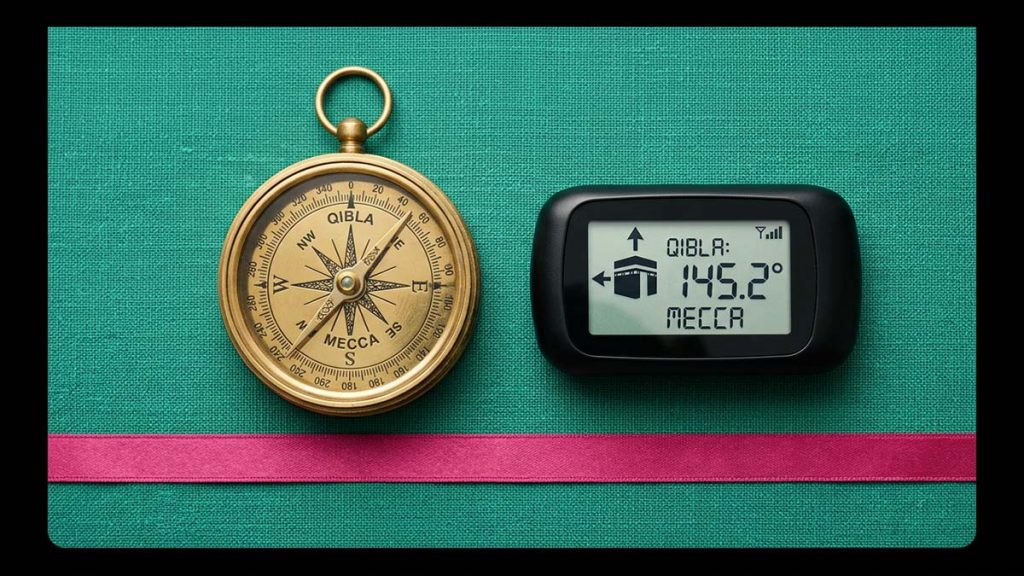
A qibla compass is a special compass that helps Muslims find the qibla, the direction of the Kaaba in Makkah, which they face during their five daily prayers. By pointing the way towards the holy city, it lets a worshipper orient themselves correctly wherever they happen to be, from an unfamiliar hotel room to a quiet spot outdoors. Small, simple and reliable, it has long been a trusted travelling companion for Muslims.
Facing the qibla is part of the prayer, so knowing the right direction matters greatly, especially in new or unfamiliar places. A qibla compass makes this easy, settling any doubt and allowing the believer to pray with confidence and peace of mind. In this guide we explain what a qibla compass is, why it helps, the importance of facing the Kaaba, how it finds the direction, how to use one, the types and modern apps available, its value for travel and tips for accurate results.
فَوَلِّ وَجْهَكَ شَطْرَ الْمَسْجِدِ الْحَرَامِ
“So turn your face towards the Sacred Mosque.”
What Is a Qibla Compass?
A qibla compass is a compass adapted to help Muslims locate the direction of prayer. Like any compass it has a magnetic needle that points towards north, but it adds markings, a numbered dial or a chart that lets the user work out the precise direction of the Kaaba in Makkah from wherever they are.
Traditional versions are handheld dials, often paired with a small booklet or table listing the correct angle for major cities around the world. The user lines up the needle with north, then reads off the marked bearing to find the way to face for prayer.
Today the idea takes many forms, from pocket dials and keyrings to compasses built into prayer mats and clocks, and digital versions on phones. Whatever the form, the purpose is the same, to point the worshipper reliably towards the holy Kaaba.
Turn your face wherever you may be towards the Sacred Mosque in every prayer you make
6 Reasons It Helps
Its usefulness rests on faith and practicality alike. Here are six reasons a qibla compass helps Muslims so much.
- It finds the direction of prayer towards the Kaaba
- It brings confidence and peace of mind in prayer
- It is invaluable in new and unfamiliar places
- It is small, portable and easy to carry
- It needs no battery or signal to work
- It helps travellers pray correctly anywhere
Facing the Kaaba in Prayer
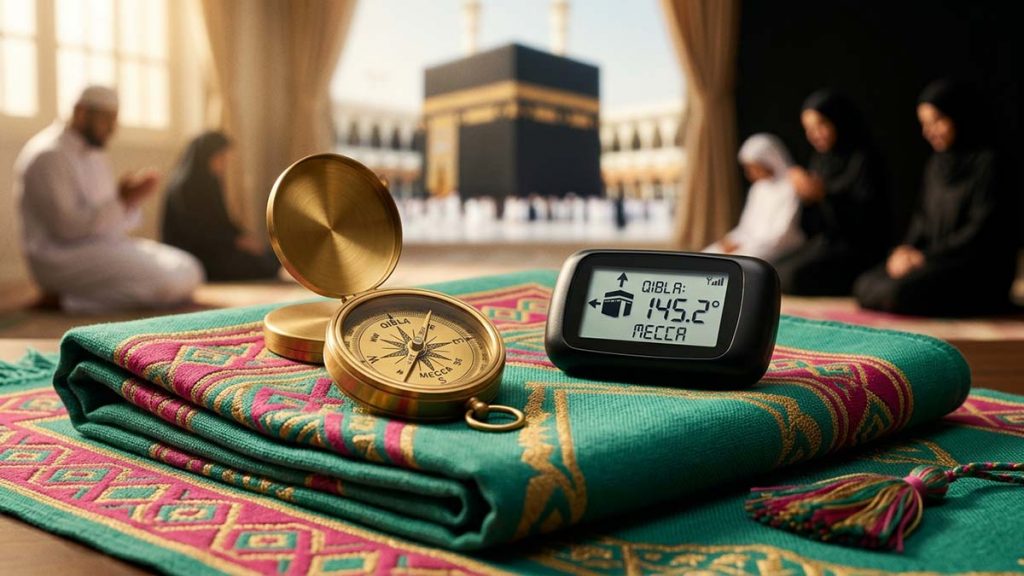
Facing the qibla is an established part of the Muslim prayer. The Quran instructs the believers to turn their faces towards the Sacred Mosque in Makkah, the site of the holy Kaaba, so that Muslims everywhere pray in unity towards a single sacred point.
This shared direction is deeply meaningful. Whether a person prays in Scotland, Indonesia or anywhere between, they turn towards the same blessed house, joining a worldwide community of worshippers united in their focus upon the Lord.

At the same time, Islam is merciful and practical. The Prophet Muhammad (pbuh) taught that for those who cannot determine the exact direction, what lies between east and west can serve as the qibla, so a sincere effort to face correctly is what is asked of the believer.
What lies between the east and the west is a direction for the prayer for the one who seeks it
How It Finds the Direction
A qibla compass works on the simple science of magnetism. Its needle is a small magnet that naturally aligns itself with the earth’s magnetic field, swinging to point towards magnetic north and giving the user a fixed reference from which all other directions can be measured.
From that northward bearing, the direction of Makkah can be worked out. Because the angle to the Kaaba differs from place to place, a qibla compass uses a dial, a marked pointer or an accompanying table of city bearings to translate north into the correct direction of prayer for a given location.
Once set up, the user simply turns until the needle and the markings align, and the indicated direction shows the qibla. It is a neat blend of natural science and careful design, putting the way to Makkah in the palm of the hand.
A qibla compass points by the earth’s own field first to magnetic north then marks the way to Makkah
Using a Qibla Compass

Using a qibla compass is straightforward once you know the steps. First place it on a flat, level surface away from metal objects and electronics, which can disturb the needle, and let the needle settle so it points steadily towards north. A prayer mat with a built-in compass makes this even easier.
Next, find the correct bearing for your location, either from the markings on the compass dial or from an accompanying table of city directions. Rotate the compass or the dial so that the needle lines up with north exactly as the instructions require.
With everything aligned, the qibla marking now points towards Makkah, and you can lay your mat and stand to face that way. After a little practice the whole process takes only moments, giving a clear and confident direction for prayer.
Types and Modern Apps
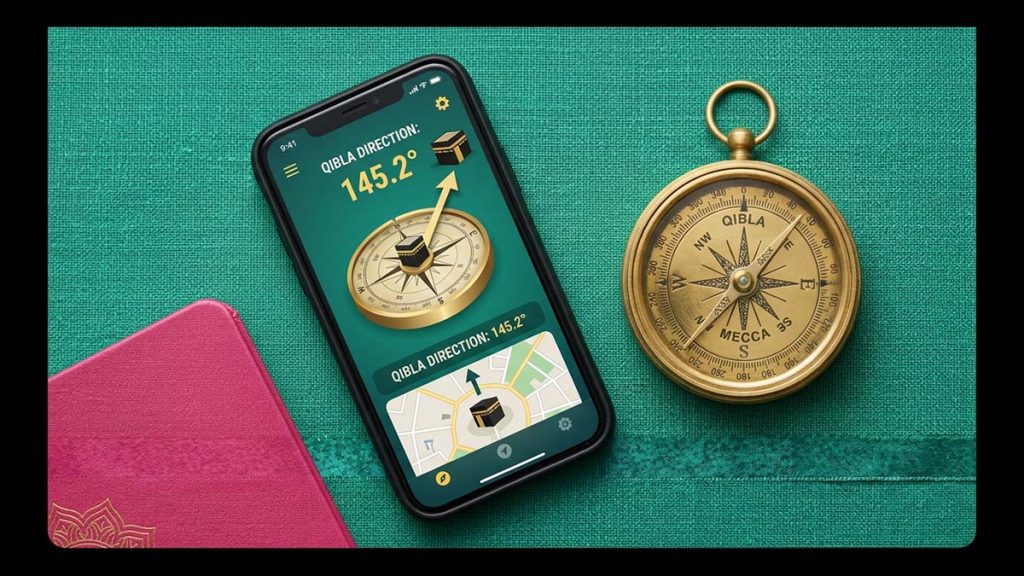
Qibla compasses come in many forms to suit different needs. Classic handheld dials and keyring compasses are reliable and need no power, while compasses built into prayer mats, travel clocks and even prayer rugs combine the function neatly with other items. A travel prayer mat often includes one.
In recent years, smartphone apps have become hugely popular. Using the phone’s built-in compass, location and satellite data, a qibla app can display an arrow pointing towards Makkah on the screen, updating instantly as the phone is turned, which many find quick and convenient.
Each type has its place. Digital apps are handy and precise when a phone is charged and has a signal, while a simple physical compass is wonderfully dependable anywhere, needing no battery, making many Muslims happy to keep both to hand.
Modern apps now use the phone and the satellites to show the qibla clearly on a glowing screen
For Travel and New Places
It is when travelling that a qibla compass truly proves its worth. Arriving in an unfamiliar city, hotel or country, a Muslim may have no idea which way to face for prayer, and a compass quickly removes that uncertainty wherever they find themselves.
This makes it a beloved travel companion. Tucked into a bag alongside a travel mat, a qibla compass ensures that the prayers can be kept on time and faced correctly throughout a journey, whether in a busy airport, a remote campsite or a quiet roadside stop.
There is real comfort in this reliability. Knowing the direction of prayer is settled lets the traveller focus fully on their worship, turning towards Makkah with the same confidence far from home as they would in their own neighbourhood. That quiet assurance is one of the small mercies that make worship while travelling feel calm and unhurried, wherever the journey may lead.
On unfamiliar ground far from home a compass settles the heart and the direction of prayer
Tips for Accurate Direction
A few simple tips help a qibla compass give its most accurate reading. Always use it on a flat, level surface and keep it well away from metal objects, mobile phones, speakers and electrical devices, all of which can pull the needle off course and give a false direction.
It is also wise to double-check when you can. Comparing the compass result with a trusted qibla app, or with the direction others pray in a known location, helps confirm you have it right, especially in a new place where you have no other reference.
Finally, remember the spirit of mercy in this matter. The aim is a sincere and careful effort to face the right way, and once you have done your best to find the qibla, you may pray with a settled heart, turning towards the Sacred Mosque guided by Allah, Al-Hadi, the Guide.
Facing the Kaaba unites Muslims everywhere in prayer, and we share more on worship and travel across our channels. Find us on YouTube, Instagram and Threads.
Frequently Asked Questions
A qibla compass is a compass adapted to help Muslims find the qibla, the direction of the Kaaba in Makkah faced during prayer. Using a magnetic needle and markings, it shows the correct direction from any location.
Its magnetic needle points to north, and a dial or table of city bearings translates that into the direction of Makkah for your location. Aligning the needle with the markings reveals the qibla to face for prayer.
The Quran instructs believers to turn their faces towards the Sacred Mosque in Makkah, so Muslims worldwide pray in unity towards one sacred point, the Kaaba, joining a single global community of worshippers.
Place it on a flat surface away from metal and electronics, let the needle settle on north, then align it using the dial or a city bearing table. The qibla marking then points towards Makkah for you to face.
Qibla apps use the phone’s compass, location and satellite data and are generally accurate when the phone has charge and signal. Keeping a simple physical compass too is wise, as it works reliably anywhere without power.
Islam is merciful in this. The Prophet (pbuh) taught that what lies between east and west can serve as the qibla, so a sincere, careful effort to face the right direction is what is asked, and you may then pray with a settled heart.