

The Great Mosque of Paris
A mosque that saved lives
Nestled in the heart of the Latin Quarter of Paris, just steps from the Jardin des Plantes, the Grande Mosquee de Paris (مسجد باريس الكبير) is the oldest mosque in metropolitan France and one of the largest in Europe. Inaugurated in 1926, this stunning Hispano-Moorish masterpiece was built as a tribute to the more than 70,000 Muslim soldiers who gave their lives fighting for France during the First World War. Behind its walls lies a story of extraordinary courage, when the mosque became a secret refuge for Jewish families fleeing Nazi persecution during the Second World War.
In this article, we explore the history, architecture, and fascinating facts about the Great Mosque of Paris, a monument where faith, courage, and the beauty of Islamic art stand side by side.
What Is the Great Mosque of Paris?
The Great Mosque of Paris covers an area of 7,500 square metres, of which more than 3,500 square metres are devoted to lush gardens. Located in the 5th arrondissement of Paris, the mosque complex includes prayer rooms, an Andalusian garden with fountains and exotic plants, a library, a conference hall, a gift shop, and a celebrated cafe and restaurant where visitors can enjoy sweet mint tea and traditional North African pastries. It also houses a traditional hammam (Turkish bath), open to both men and women on separate days.
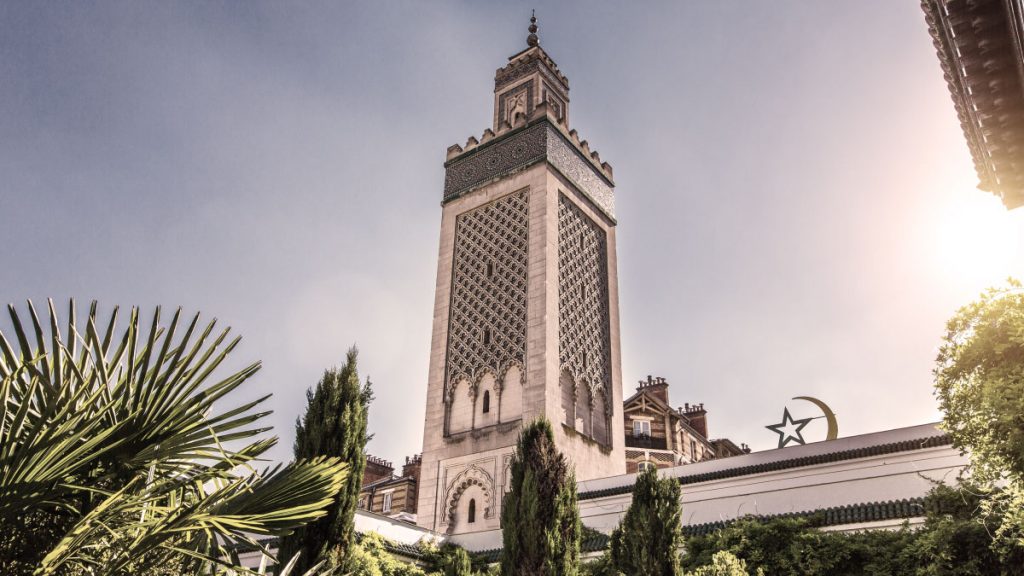
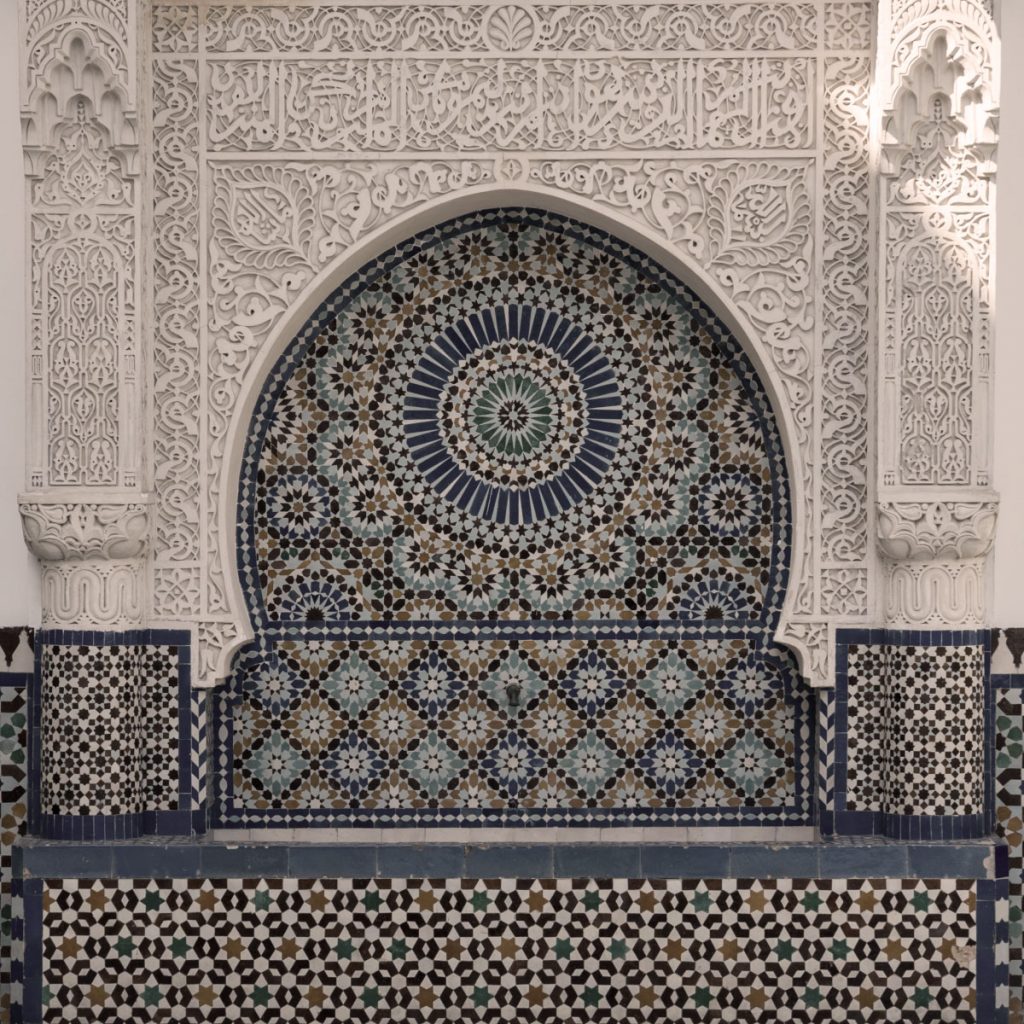
The mosque was designed by the architect Maurice Mantout, who was born in Algiers, and its construction was entrusted to specialised craftsmen from North Africa who were brought to Paris specifically for the project, using traditional materials and techniques. The result is a building that transports visitors from the streets of Paris to the medinas of Fez and the palaces of Granada, with every surface alive with zellige tilework, carved stucco, and intricate wooden screens.
The Architecture: A Piece of the Orient in Paris
Inspired by the Great Mosques of North Africa
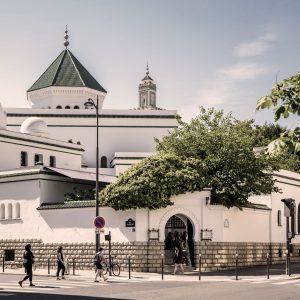
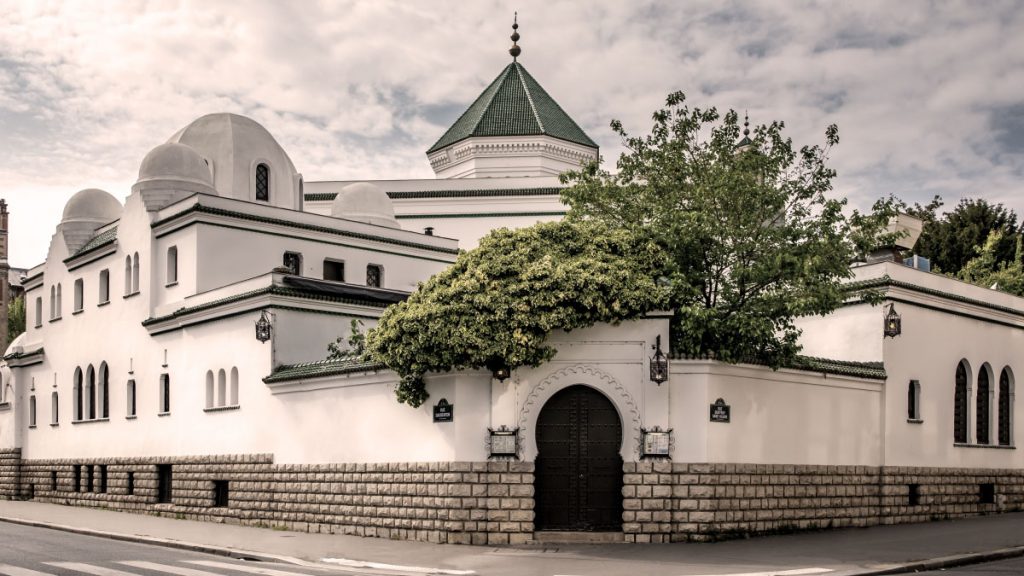
The Great Mosque of Paris is designed in the Hispano-Moorish style, drawing deeply from the architectural traditions of the Islamic world. Its courtyard, horseshoe arches, and green-tiled roofs are inspired by the Qarawiyyin Mosque in Fez, Morocco, one of the oldest mosques in the world. Its 33-metre minaret is modelled after the Zaytuna Mosque in Tunis, Tunisia. The lush garden, with its sculpted arcades, fountains, and marble pools, draws inspiration from the legendary Alhambra palace in Granada, Spain.
At 33 metres, the minaret is exactly ten times smaller than the Eiffel Tower (330 metres), a charming coincidence that gives it a unique place in the Parisian skyline. It rises above the low-rise neighbourhood with quiet dignity, visible from the surrounding streets as a gentle reminder of the Islamic heritage woven into the fabric of the French capital.
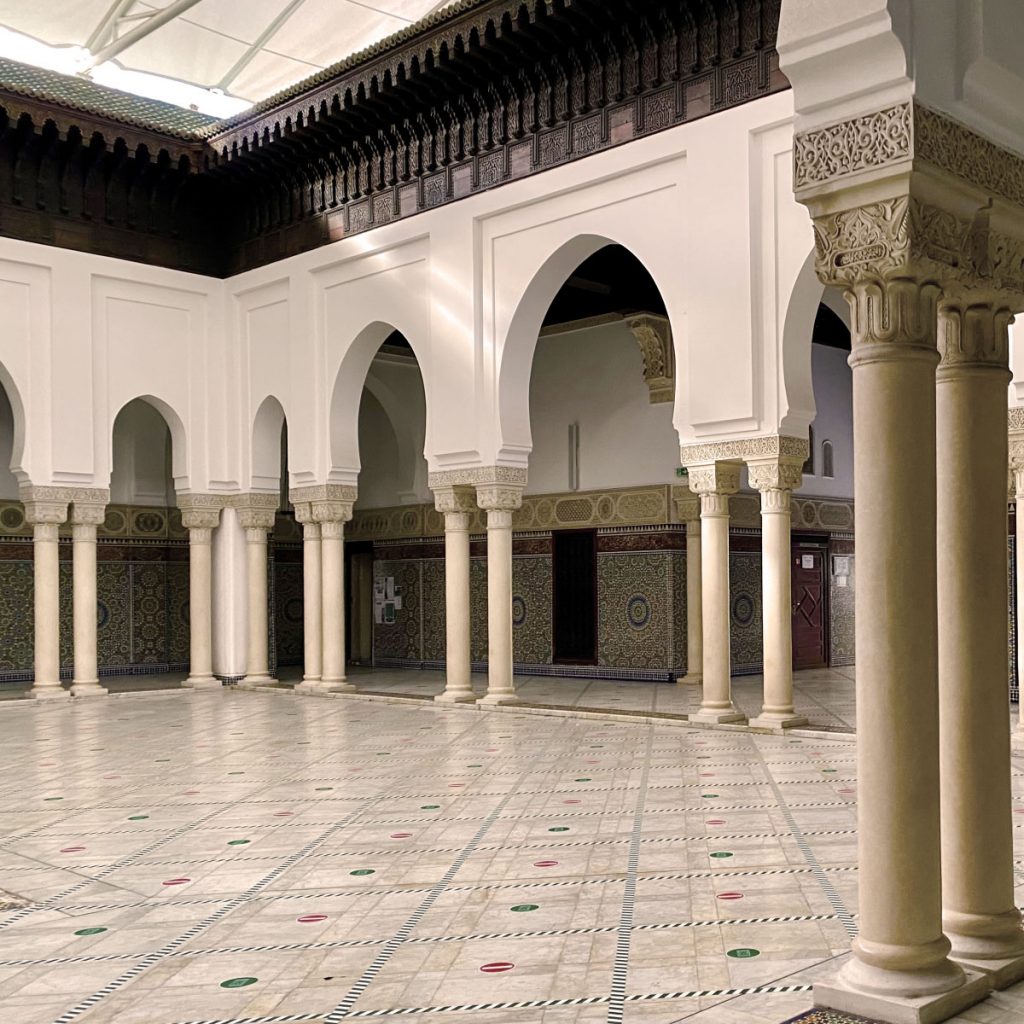
The decorative programme of the mosque was created by North African artisans using traditional techniques that have been passed down for centuries. The walls and corridors shimmer with zellige mosaics in vibrant blues, greens, and whites, while hand-carved stucco and wrought iron from Morocco adorn the arches and doorways. The prayer hall features a magnificent hand-sculpted cedar dome, a giant chandelier, and precious carpets donated by King Fouad of Egypt and the Bey of Tunis. The entrance to the Grand Patio is a jewel of Moroccan art, with its door decorated with Kufic calligraphy reproducing verses from the Quran.
The 33-metre minaret is exactly ten times smaller than the Eiffel Tower standing at 330 metres
The Andalusian Garden
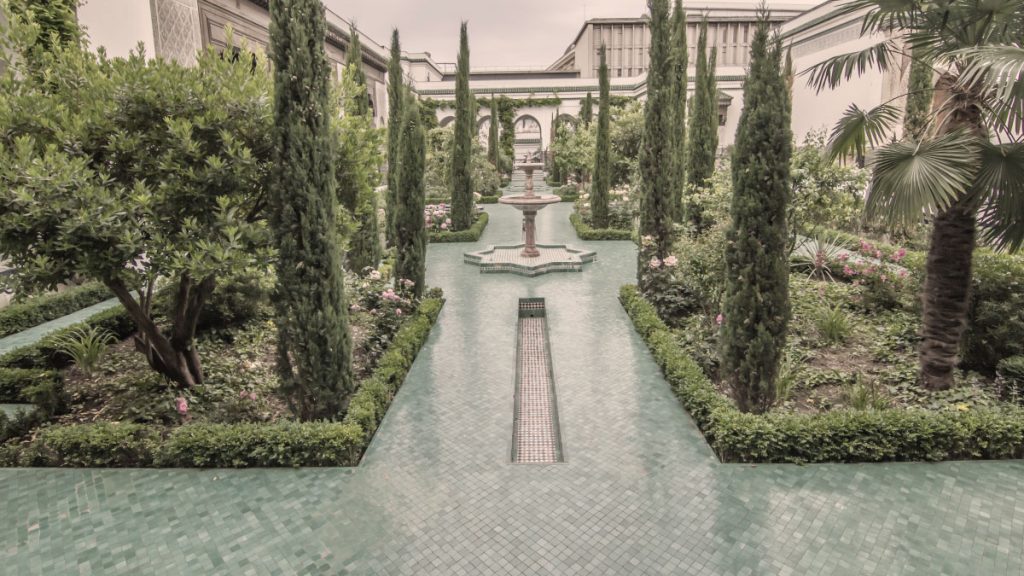
At the heart of the complex lies a serene Andalusian garden, inspired by the courtyards of the Alhambra. Enclosed by sculpted arcades and horseshoe arches, the garden is filled with palm trees, exotic flowers, and climbing wisteria that drape over the arches each spring. Water fountains, waterfalls, and marble pools add to the atmosphere of tranquillity. It is one of the most peaceful corners of Paris, a hidden oasis where the noise of the city simply melts away.
The Cafe, the Hammam, and the Souk
The mosque is also home to a beloved Moorish cafe, where visitors can sit beneath the arcades and enjoy sweet mint tea, traditional pastries, and North African dishes in an atmosphere that feels a world away from the bustling streets of the Latin Quarter. The complex also includes a traditional hammam (Turkish bath), open to both men and women on separate days, and a small souk (market) selling earthenware, brass, and colourful fabrics.
The History of the Great Mosque of Paris
A Tribute to the Fallen
The Great Mosque of Paris owes its existence to the sacrifice of Muslim soldiers from France’s colonies in North Africa who fought and died in the First World War. At the Battle of Verdun alone in 1916, an estimated 70,000 Muslim soldiers fell. The French nation felt a deep obligation to honour this sacrifice, and in 1920, a law was passed allocating funds for the construction of a mosque in Paris.

A Mosque That Saved Lives
During the Nazi occupation of Paris, the mosque’s rector, Si Kaddour Benghabrit, turned the building into a secret sanctuary. He sheltered Jewish refugees and resistance fighters in the mosque’s labyrinthine cellars and tunnels, provided forged Muslim identity certificates to help them escape arrest, and even had names carved onto the Muslim cemetery to create convincing cover stories.
Dr Albert Assouline documented approximately 1,600 ration cards issued by the mosque for the Jewish families who found refuge there. The mosque also sheltered stranded British paratroopers. It remains one of the most remarkable acts of interfaith courage in modern history.
At the laying of the first stone on 19th October 1922, Marshal Lyautey declared: “When this minaret is erected, it will rise towards the beautiful sky of Ile-de-France one more prayer of which the Catholic towers of Notre-Dame will not be jealous.” Four years later, on 15th July 1926, the mosque was inaugurated in the presence of the President of the French Republic, Gaston Doumergue, and dignitaries from across the Muslim world.
The First Stone Is Laid
On 19th October 1922, Marshal Lyautey lays the first stone of the Great Mosque of Paris. The project is funded by the French state as a tribute to the more than 70,000 Muslim soldiers who died fighting for France in the First World War. The architect Maurice Mantout, born in Algiers, designs the building in the Hispano-Moorish style, and specialised North African artisans are brought to Paris to create the tilework and carvings.
The Mosque Is Inaugurated
After four years of construction, the Great Mosque of Paris is officially inaugurated in the presence of the President of the French Republic, Gaston Doumergue, and dignitaries from across the Muslim world. The Parisian press praises the building as “an incomparable oriental vision” and “a monument whose brilliance does not concede to the most beautiful mosques of the Orient.”
A Secret Sanctuary
During the Nazi occupation of Paris, the mosque’s rector Si Kaddour Benghabrit transforms the building into a secret refuge. Jewish families, resistance fighters, and stranded British paratroopers are sheltered in the mosque’s cellars and tunnels. Forged Muslim identity certificates are issued, and names are carved onto the Muslim cemetery as cover stories. Approximately 1,600 ration cards are documented for those who found refuge there.
Historic Monument Status
The Great Mosque of Paris and its Islamic Centre are officially listed in the supplementary inventory of Historic Monuments by decree, recognising the building’s architectural and cultural significance. The mosque is also awarded the label of “Twentieth Century Heritage” (Patrimoine du XXe siecle), cementing its place in France’s national heritage.
The Heart of French Islam
Today, the Great Mosque of Paris serves as the spiritual centre of the Muslim community in France, home to about six million Muslims. The mosque houses the Institut Al-Ghazali, a seminary for the training of imams and Muslim chaplains, and plays a central role in certifying halal food in France. Its cafe, hammam, and gardens draw visitors from around the world, making it one of Paris’s most beloved hidden gems.
Where Mercy Met Courage
The Great Mosque of Paris is far more than a beautiful building. It is a monument to sacrifice, solidarity, and the universal mercy at the heart of Islam. Built to honour Muslim soldiers who gave their lives for a country far from their homeland, and later transformed into a refuge for those fleeing persecution regardless of their faith, this mosque embodies the very meaning of its religion’s most central value: mercy.
Allah says in Surah Al-Maaida of the Quran:
ؕوَمَنۡ اَحۡیَاہَا فَکَاَنَّمَاۤ اَحۡیَا النَّاسَ جَمِیۡعًا
Whoever saves a life it is as if he has saved all of humanity
The people of the Great Mosque of Paris lived this verse. In the darkest hours of the Second World War, they opened their doors, forged certificates, and risked their lives to save others. Their courage stands as one of the most powerful examples of interfaith compassion in modern history.
FAQ About the Great Mosque of Paris
The Great Mosque of Paris is located in the 5th arrondissement of Paris, in the Latin Quarter, next to the famous Jardin des Plantes (Botanical Garden). It is easily accessible by Metro via the Censier-Daubenton or Place Monge stations on Line 7.
Construction began on 19th October 1922 and the mosque was inaugurated on 15th July 1926, making it the oldest mosque in metropolitan France. It was designed by architect Maurice Mantout (born in Algiers) in the Hispano-Moorish style and built by specialised North African craftsmen.
The mosque was built as a tribute to the more than 70,000 Muslim soldiers from France’s North African colonies who died fighting for France during the First World War, particularly at the Battle of Verdun in 1916. In 1920, the French government passed a law allocating funds for its construction as a symbol of the nation’s gratitude.
During the Nazi occupation of Paris, the mosque’s rector Si Kaddour Benghabrit turned the building into a secret sanctuary. Jewish refugees and resistance fighters were hidden in the mosque’s cellars and tunnels, given forged Muslim identity certificates to help them escape arrest, and had fake names carved onto the Muslim cemetery as cover stories. Dr Albert Assouline documented approximately 1,600 ration cards issued by the mosque for those who sheltered there. The mosque also protected stranded British paratroopers.
Yes, the Great Mosque of Paris is open to visitors every day except Fridays. Visitors can explore the gardens, corridors, and patios for a small admission fee. The main prayer hall is off-limits to non-Muslim visitors, but it can be viewed from a distance. The cafe, restaurant, hammam, and souk are open to all, making the mosque one of the most welcoming cultural landmarks in Paris.
Beyond exploring the architecture and gardens, visitors can enjoy sweet mint tea and traditional North African pastries at the Moorish cafe, browse the small souk for handcrafted goods, or book a session at the traditional hammam (open to men and women on separate days). The mosque also hosts guided tours, cultural exhibitions, and educational programmes through its library and conference hall.
A Living Testament to Mercy
The Great Mosque of Paris is a monument that speaks to the best of what humanity can be. Born from the grief of war, adorned with the beauty of centuries of Islamic art, and sanctified by the courage of those who risked everything to save the lives of strangers, it stands today as one of the most meaningful places of worship in the world.
As Allah, Ar-Rahman (The Most Merciful), bestows His mercy upon all of creation, the people of this mosque showed that same mercy in the darkest of times, proving that the walls of a mosque are not just stone and tile, but the outstretched arms of a faith that shelters all who seek its protection.
May Allah preserve the mosques of this Ummah and bless those who build and maintain them. Ameen.