The Hassan II Mosque
Where the ocean meets prayer
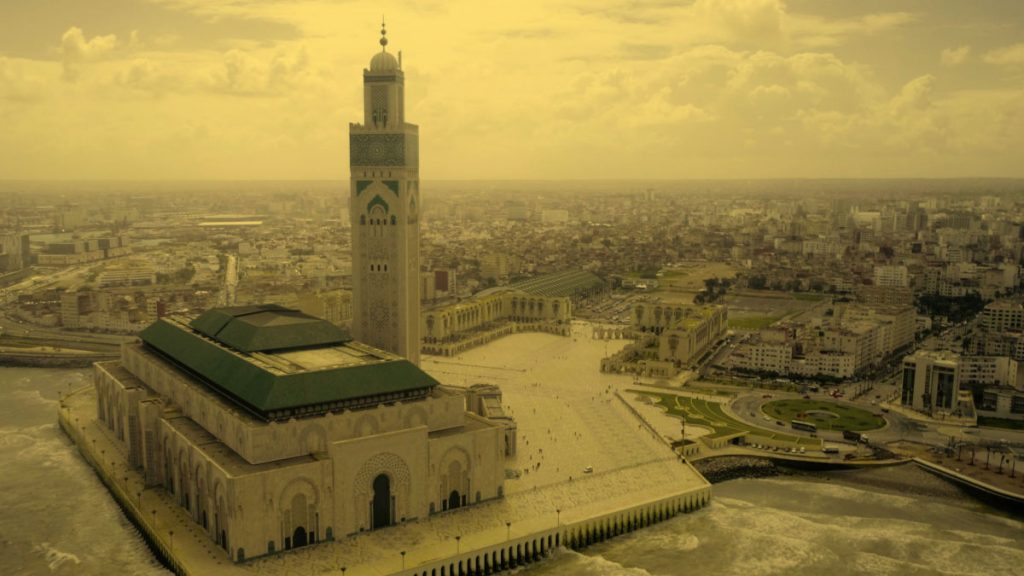
Standing on the edge of the Atlantic Ocean in Casablanca, Morocco, half on the water and half on land, the Hassan II Mosque (مسجد الحسن الثاني) is one of the largest and most spectacular mosques in the world. Its minaret rises to 210 metres (689 feet), the tallest religious structure on earth, with a laser beam that shoots 30 kilometres towards Makkah at night. It can hold 105,000 worshippers, its roof slides open to reveal the sky, and its glass floor allows the faithful to pray directly above the ocean waves. Inspired by the Quranic verse “His throne was upon the water”, this mosque was the dream of King Hassan II, built by the hands of over 10,000 Moroccan artisans as a gift to the nation and to God.
In this article, we explore the history, architecture, and fascinating facts about the Hassan II Mosque, a monument where the Atlantic, the sky, and the artistry of an entire nation meet in the worship of Allah.
“I want to build this mosque on the water because God’s throne is on the water.”
What Is the Hassan II Mosque?
The Hassan II Mosque is the largest mosque in Morocco and Africa and one of the largest in the world. Its complex covers over 9 hectares (22 acres) and sits on a promontory jutting out over the Atlantic, with much of the structure built on land reclaimed from the ocean using 300,000 cubic metres of concrete and 40,000 tonnes of steel. The mosque can accommodate an astonishing 105,000 worshippers: 25,000 inside the main prayer hall and 80,000 on the exterior plaza.
The mosque was designed by the French architect Michel Pinseau, who had lived in Casablanca for over 20 years and studied Moroccan Islamic architecture extensively, drawing inspiration from the Koutoubia Mosque in Marrakesh, the Hassan Tower in Rabat, and the great mosques of Cordoba, Damascus, and Kairouan. Construction began on 12th July 1986 and was completed on 30th August 1993, with up to 1,400 workers by day and 1,100 by night during the most intense phases. Nearly all materials were sourced from Morocco: cedarwood from the Middle Atlas Mountains, marble from Agadir, and granite from Tafraoute.
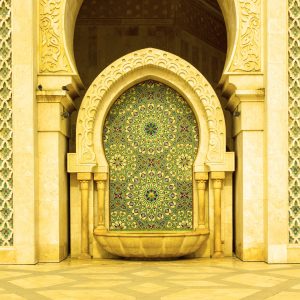
The mosque can hold 105,000 worshippers 25,000 inside and 80,000 on the ocean-facing plaza
The Architecture: God’s Throne Upon the Water
The Tallest Minaret on Earth
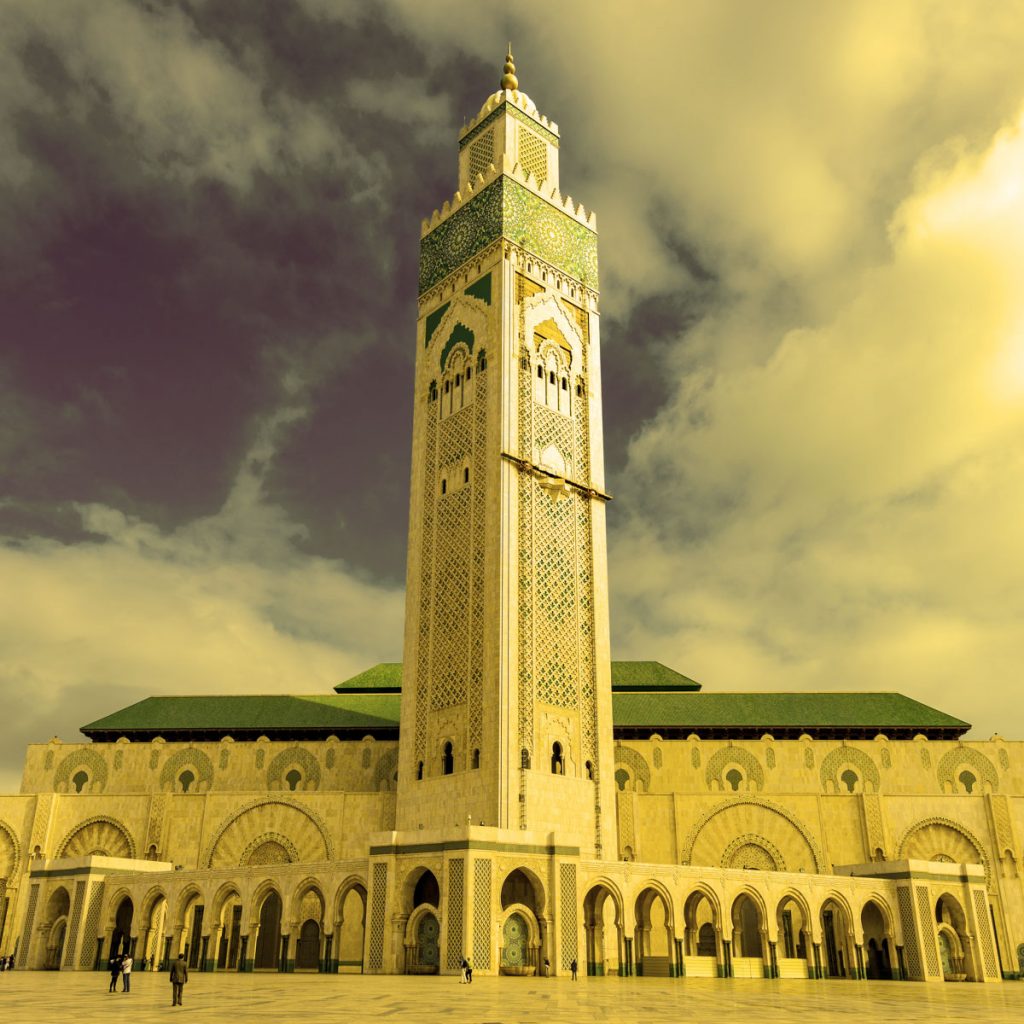
The Hassan II Mosque’s most commanding feature is its minaret, rising to 210 metres (689 feet), making it the tallest religious structure in the world and the tallest building in Morocco. At night, a laser beam shoots 30 kilometres from the top of the minaret towards Makkah, a luminous guide pointing the way to God across the darkness of the Atlantic. The minaret’s design draws on the classic Moroccan square-tower tradition seen in the Koutoubia and Hassan Tower, but on a scale never before attempted.
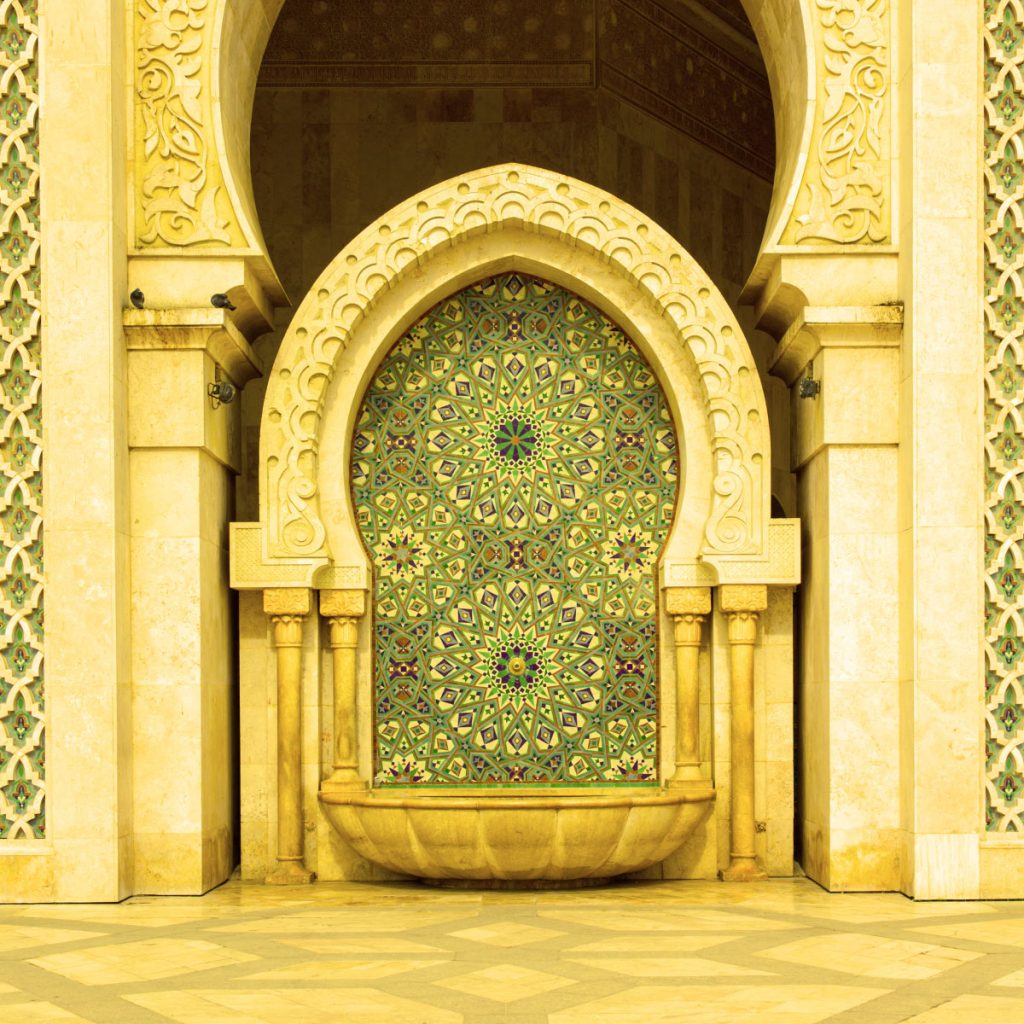
The mosque’s architectural style blends Moorish and traditional Moroccan elements with influences from across the Islamic world. Horseshoe arches, intricate zelliges (geometric mosaic tilework), carved stucco, and cedarwood latticework adorn every surface, recalling the splendour of the Alhambra and the Mezquita of Cordoba. The building is also engineered to withstand earthquakes and features a heated floor and electric doors.
King Hassan II famously declared: “I wish Casablanca to be endowed with a large, fine building of which it can be proud until the end of time. I want to build this mosque on the water, because God’s throne is on the water. Therefore, the faithful who go there to pray, to praise the Creator on firm soil, can contemplate God’s sky and ocean.” True to his vision, the mosque’s glass floor allows worshippers to see the ocean waves beneath their feet as they pray, and the retractable roof slides open on special occasions to reveal the sky above, so that the faithful can truly pray between heaven and sea.
The 210-metre minaret fires a laser beam towards Makkah visible 30 kilometres across the Atlantic at night
10,000 Moroccan Master Craftsmen
The interior of the Hassan II Mosque is a celebration of Moroccan craftsmanship on a scale never before seen. Over 6,000 master craftsmen (maâlems) and a total workforce of more than 10,000 artisans worked around the clock to carve, paint, and tile every surface. The official records note 854 qualified masters in carpentry, 80 in plasterwork, and 100 in zellige (mosaic tilework). The marble walls, the fragrant cedarwood ceilings, the hand-carved stucco, the frescoes, and the geometric mosaics are all the work of Moroccan hands, using materials from Moroccan soil. The only exceptions are the white granite columns and the 50 glass chandeliers from Murano, Italy.
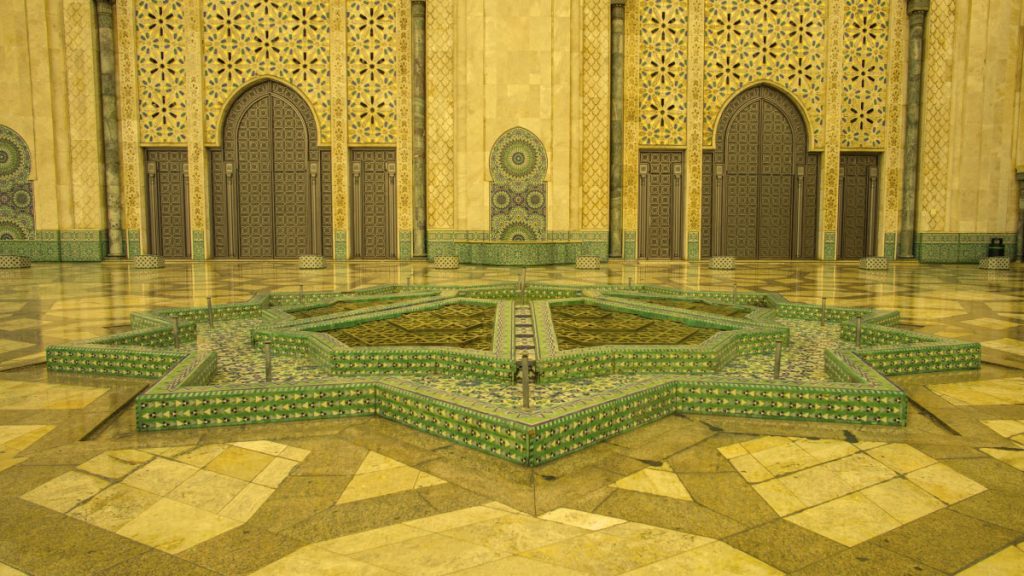
Over 10,000 Moroccan artisans worked day and night for seven years to carve every surface by hand
A Roof That Opens to the Heavens
One of the most extraordinary features of the Hassan II Mosque is its retractable roof, an automated sliding structure that opens on special occasions to reveal the sky above the prayer hall. When the roof is open, the worshippers below can feel the ocean breeze and gaze upward at the heavens, fulfilling King Hassan II’s vision that the faithful should be able to contemplate God’s sky and ocean as they pray. Beneath them, the glass floor panels reveal the Atlantic waves rolling under the mosque, so that the worshipper is suspended between the two great creations of Allah: the sea below and the sky above.
The retractable roof opens to reveal the sky while the glass floor shows the ocean waves beneath
The History of the Hassan II Mosque

A King’s Dream Built by a Nation
The idea for the mosque came from King Hassan II himself, who wanted to give Casablanca a spiritual monument worthy of its status as Morocco’s largest city and economic capital. He envisioned a mosque that would reflect the greatness of Moroccan architectural tradition while embracing the latest technology. In 1986, he laid the foundation stone on the Atlantic coast. The financing of the mosque became a national effort: an estimated 12 million Moroccans donated to the project, with every donor receiving a receipt and certificate. The smallest contribution was just 5 dirhams. The total cost reached approximately $800 million.
The mosque was inaugurated on 30th August 1993, an event that coincided with the commemoration of the Prophet’s birth (Mawlid) and was covered by more than 800 journalists from around the world. Today, the Hassan II Mosque is the only mosque in Morocco open to non-Muslim visitors, welcoming people of all faiths to experience its beauty through guided tours.
The King’s Declaration
King Hassan II declares that Casablanca shall have a grand mosque built upon the water, inspired by the Quranic verse “His throne was upon the water.” He envisions a monument that will showcase Moroccan craftsmanship and serve as a spiritual centre for the nation. A design competition follows, won by French architect Michel Pinseau.
Construction Begins
King Hassan II lays the foundation stone on the Atlantic coast. Land is reclaimed from the ocean using 300,000 cubic metres of concrete and 40,000 tonnes of steel. Over 10,000 Moroccan artisans work in shifts around the clock. An estimated 12 million Moroccans donate to the project, making it a truly national endeavour.
Inauguration on the Prophet’s Birthday
After seven years of construction, the Hassan II Mosque is inaugurated on the anniversary of the Prophet’s birth (Mawlid), covered by over 800 international journalists. The mosque becomes the largest in Africa, the third largest in the world, and home to the tallest minaret on earth at 210 metres.
A Cultural Complex Grows
The Hassan II Mosque Foundation is created in 2009 under the honorary presidency of King Mohammed VI to manage the mosque and its cultural institutions. A media library is launched in 2010, the Hassan II Museum is inaugurated in 2012, and an Academy of Traditional Arts is established, transforming the mosque into a complete cultural and spiritual complex.
Morocco’s Most Iconic Landmark
The Hassan II Mosque remains the largest mosque in Africa and one of the most visited Islamic landmarks in the world. It is the only mosque in Morocco open to non-Muslim visitors, offering guided tours in multiple languages. Its complex includes a madrasa (Quranic school), a 6,000 square metre hammam, a museum, an academy, a media library, and a public library.
Between the Sky and the Sea
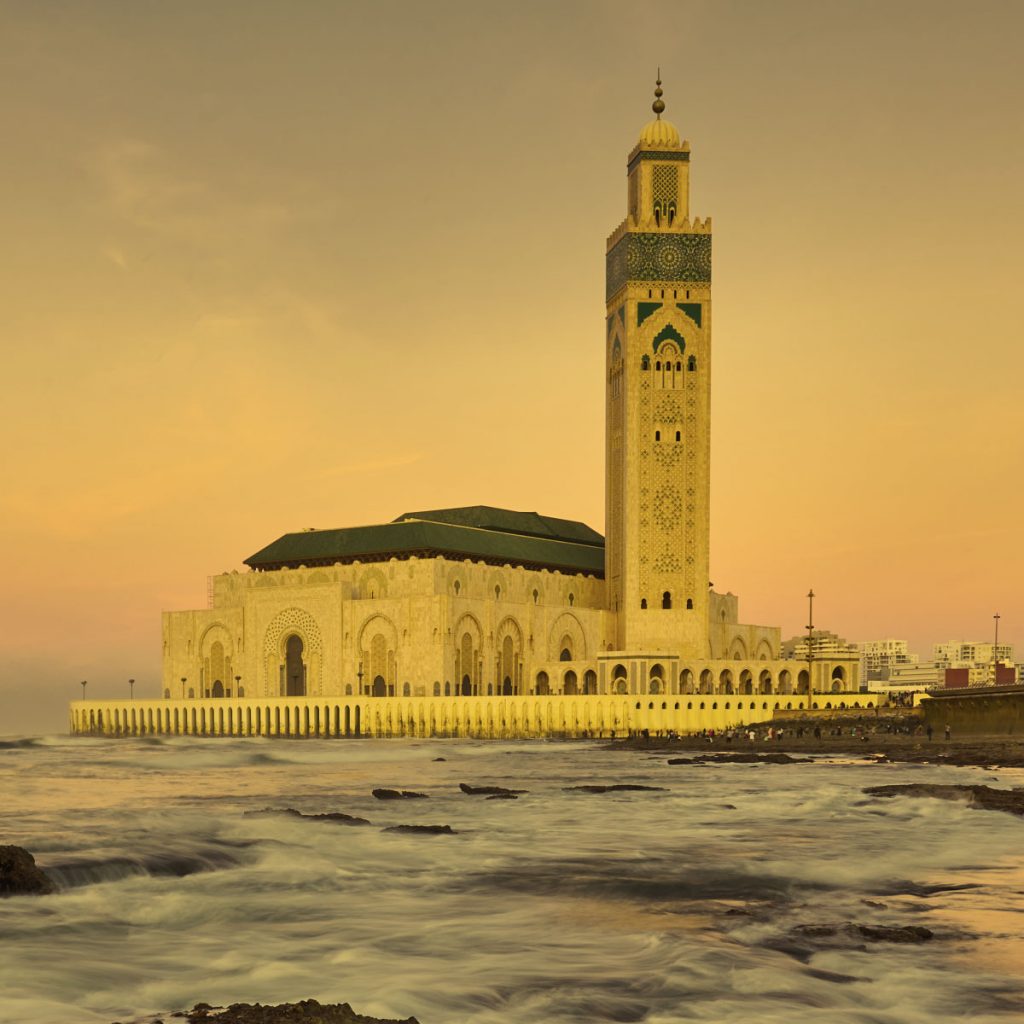
The Hassan II Mosque is perhaps the only mosque in the world where the worshipper can feel the ocean beneath, the sky above, and the wind from the Atlantic flowing through an open roof. It is a mosque built not only from marble and cedar, but from the collective faith of 12 million donors, from the hands of 10,000 master craftsmen, and from the vision of a king who believed that the greatest act of devotion was to build a house of God on the very edge of the world, where land meets ocean and earth meets sky.
Allah says in Surah Hud of the Quran:
وَہُوَ الَّذِیۡ خَلَقَ السَّمٰوٰتِ وَالۡاَرۡضَ فِیۡ سِتَّۃِ اَیَّامٍ وَّکَانَ عَرۡشُہٗ عَلَی الۡمَآءِ
“And it is He who created the heavens and the earth in six days, and His Throne was upon the water.”
This is the verse that inspired King Hassan II to build his mosque on the Atlantic. Nearly four centuries after the great mosques of the Ottoman and Mughal empires, Morocco answered with a mosque that belongs entirely to its own tradition, built by its own people from its own soil, standing where no mosque had ever stood before: on the threshold between the created world and the infinite ocean, pointing the way to Makkah with a beam of light.
FAQ About the Hassan II Mosque
The mosque is located on Boulevard Sidi Mohammed Ben Abdallah in Casablanca, Morocco, on a promontory jutting out over the Atlantic Ocean, nestled between the harbour and the El Hank Lighthouse. It is approximately a 20-minute walk from the nearest train station at Casa-Port.
Construction began on 12th July 1986 and was completed on 30th August 1993, taking approximately seven years. The mosque was designed by French architect Michel Pinseau and built by a workforce of over 10,000 Moroccan artisans working in shifts around the clock. The total cost reached approximately $800 million, funded largely by public donations from an estimated 12 million Moroccan citizens.
Yes. The Hassan II Mosque is the only mosque in Morocco open to non-Muslim visitors. Guided tours are available in multiple languages outside of prayer times. Visitors should dress modestly, covering arms and legs, and women should cover their hair. The mosque’s museum is also included in the guided tour.
King Hassan II was inspired by the Quranic verse from Surah Hud (11:7): “His Throne was upon the water.” He wanted the faithful to be able to contemplate God’s sky and ocean as they prayed. The mosque was built on land reclaimed from the Atlantic, with a glass floor that reveals the ocean waves below and a retractable roof that opens to the sky above.
The minaret stands at 210 metres (689 feet), making it the tallest religious structure in the world and the tallest building in Morocco. At night, a laser beam shoots 30 kilometres from the top of the minaret in the direction of Makkah. The minaret also serves as a beacon for ships arriving at the port of Casablanca.
Beyond the main prayer hall, the Hassan II Mosque complex includes a madrasa (Quranic school), a 6,000 square metre hammam (baths), a public library, a media library, the Hassan II Museum (inaugurated 2012), an Academy of Traditional Arts, a large esplanade, and extensive gardens. It also has an underground car park and a School of Islamic Sciences for religious and Arabic studies.
Where the Ocean Meets the Prayer
The Hassan II Mosque is a mosque like no other. It stands where no building should stand, on the edge of the Atlantic, defying the waves. It was paid for not by a treasury but by 12 million individual acts of faith. It was built not by machines but by the hands of 10,000 master craftsmen who carved every surface with the precision and love of their ancestors. And it was dreamed into existence by a king who believed that the most beautiful place to worship Allah is where His two greatest creations meet: the sky and the sea.
As Allah, Al-Khaliq (The Creator), created the heavens, the earth, and the oceans, the Hassan II Mosque stands at the meeting point of all three, a reminder that every direction the eye turns, it sees nothing but the work of God.
May Allah preserve the mosques of this Ummah and bless those who build and maintain them. Ameen.