
Education in Islam

Read, in the name of your Lord
Education in Islam began with a single word: Read. The first revelation to the Prophet Muhammad (pbuh) was not a command to pray or fast but to seek knowledge. He declared learning an obligation upon every Muslim, called scholars the inheritors of the Prophets, and promised that the path of knowledge leads to Paradise. What follows is a journey through what the Quran and Sunnah teach about learning.
What the Prophet Taught About Knowledge
The Prophet (peace be upon him) did not treat knowledge as an accessory to faith. He placed it at the foundation. He made seeking it obligatory, elevated its practitioners above worshippers, and warned that without knowledge, worship itself becomes empty and religion becomes vulnerable. Every hadith on this subject points in the same direction: a Muslim who does not seek knowledge is neglecting one of the most fundamental duties of the faith.
The Virtues of Knowledge
An obligation upon every Muslim, male and female, without exception. A path to Paradise for whoever walks it sincerely. A continuing legacy that benefits the knower even after death. A protection against ignorance, misguidance, and the tricks of Shaytan. A form of worship more beloved to Allah than voluntary prayer alone.
The Status of Scholars
Inheritors of the Prophets who carry forward their legacy of truth. Elevated by Allah in rank above those who do not possess knowledge. The angels lower their wings out of pleasure for the seeker of knowledge. All of creation prays for them including the fish in the depths of the sea. One scholar is more formidable against Shaytan than a thousand worshippers.

The Prophetic Teachings on Knowledge
An Obligation, Not a Choice
The Prophet (peace be upon him) said: “Seeking knowledge is an obligation upon every Muslim” (Ibn Majah 224). The Arabic word used is faridah, the same word used for the five daily prayers, for fasting in Ramadan, and for Zakat. This is not a recommendation. It is a command that places knowledge on the same level as the pillars of the faith. The scholars explain that the knowledge which is obligatory includes everything a Muslim needs to worship Allah correctly, to fulfil their duties, and to avoid what is forbidden. Beyond this, every branch of beneficial knowledge, from medicine and science to language and law, carries immense reward for the one who pursues it with sincerity.
“Seeking knowledge is an obligation upon every Muslim”
The Scholars Are the Inheritors of the Prophets
The Prophet (peace be upon him) said: “The scholars are the inheritors of the Prophets. The Prophets did not leave behind gold or silver coins, but they left behind knowledge. Whoever takes hold of it has been given an abundant share” (Abu Dawud, Tirmidhi). This hadith redefines what it means to be wealthy. The Prophets, the most honoured human beings in existence, did not leave material wealth as their legacy. They left knowledge. And the scholars who carry that knowledge forward are their heirs. In Islam, the real inheritance is not property or money. It is understanding.
“The scholars are the inheritors of the Prophets”
A Path to Paradise

The Prophet (peace be upon him) said: “Whoever takes a path upon which to obtain knowledge, Allah makes the path to Paradise easy for him” (Tirmidhi). He also said: “The angels lower their wings out of pleasure for the seeker of knowledge. The inhabitants of the heavens and earth, even the fish in the depths of the water, seek forgiveness for the scholar” (Abu Dawud, Tirmidhi). These are not poetic exaggerations. The Prophet was describing a cosmological reality: the entire created order responds to the sincere pursuit of knowledge. When a person sits down to learn about their Lord, the universe itself supports them.
Knowledge Over Worship

The Prophet (peace be upon him) said: “The virtue of knowledge is more beloved to me than the virtue of worship, and the best of your religion is piety” (al-Bayhaqi). He also said: “One scholar is more formidable against Shaytan than a thousand worshippers” (Tirmidhi). These hadiths may surprise those who assume that worship alone is the highest pursuit in Islam. But without knowledge, worship can become innovation. Without knowledge, sincerity can become misguided zeal. Without knowledge, a person can worship for decades and still be upon the wrong path. Knowledge gives worship its direction. It is the compass without which the journey of faith has no map.
“One scholar is more formidable against Shaytan than a thousand worshippers”
The Cave of Hira: When the First Word from Heaven Was “Read”
Muhammad ibn Abdullah (peace be upon him) was forty years old. He had retreated to the Cave of Hira on Jabal al-Nour, as he often did, seeking solitude and reflection. He could neither read nor write. He was a merchant, an orphan who had been raised by his grandfather and then his uncle. Nothing in his worldly biography suggested what was about to happen.
The angel Jibril appeared and seized him. “Read!” the angel commanded. Muhammad replied: “I cannot read.” The angel pressed him so tightly he could barely breathe, then released him and said again: “Read!” Again he replied: “I cannot read.” A third time the angel pressed him, and then released him and spoke the words that would change the course of human history: “Read, in the name of your Lord who created. Created man from a clinging substance. Read, and your Lord is the Most Generous. Who taught by the pen. Taught man that which he knew not” (Quran 96:1-5, Bukhari 4953).
Consider what Allah chose as the opening word of His final revelation to humanity. Not a command to pray. Not a command to fight. Not a command to give charity. “Read.” And immediately after it: “Who taught by the pen. Taught man that which he knew not.” In five verses, Allah established that knowledge is not merely important in Islam. It is the starting point. Everything that followed in the next twenty-three years of revelation, every prayer, every law, every moral teaching, rested on this foundation: knowledge comes first.
Knowledge That Outlasts Death
The Prophet (peace be upon him) said: “When a person dies, his deeds come to an end, except for three: ongoing charity, beneficial knowledge, and a righteous child who prays for him” (Sahih Muslim). Of the three things that continue to benefit a person in their grave, two are directly connected to knowledge: the knowledge itself, and the righteous child who could only have become righteous through proper education. A teacher who teaches a student something beneficial receives reward every time that student acts upon it, teaches it to someone else, or passes it on to the next generation. The chain never breaks. A single act of teaching can generate centuries of reward.
“Whoever teaches some knowledge will have the reward of the one who acts upon it”
Islam’s Answer to Modern Life
Islam’s teachings on knowledge speak directly to some of the deepest challenges facing education and intellectual life today.
The Crisis of Purpose in Education

In much of the modern world, education has been reduced to a means of earning money. Students study to get grades. Grades lead to qualifications. Qualifications lead to jobs. The entire system serves the economy. Islam offers a radically different framework. Knowledge in Islam is pursued first and foremost for the sake of Allah. The Prophet warned: “Whoever seeks knowledge to impress the scholars, to argue with the foolish, or to attract the attention of people, Allah will admit him into Hellfire” (Tirmidhi). The intention behind learning matters as much as the learning itself. When knowledge is sought sincerely, it becomes worship. When it is sought for show, it becomes a burden.
Information Without Wisdom

We live in an age of unlimited information but declining wisdom. More data is produced every day than at any point in human history, yet people are less able to distinguish truth from falsehood, beneficial knowledge from harmful distraction. The Prophet anticipated this. He used to pray: “O Allah, I seek refuge in You from knowledge that does not benefit” (Sahih Muslim). Islam does not celebrate knowledge for its own sake. It distinguishes between beneficial knowledge (ilm nafi’) and useless or harmful knowledge. The test is simple: does this knowledge bring you closer to Allah, help you serve others, or improve the world? If not, it may be a distraction dressed as learning.
Knowledge and Humility
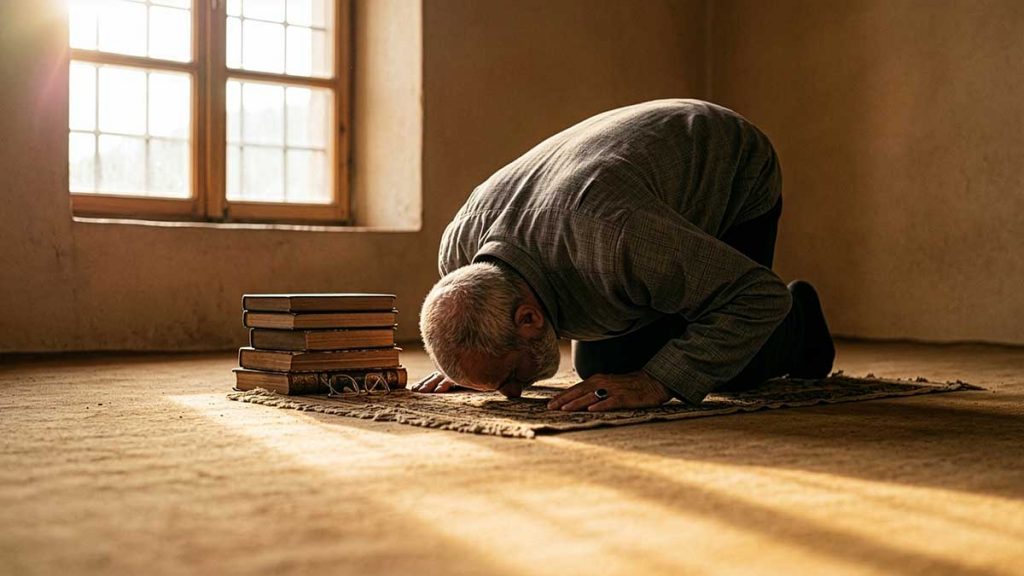
The Quran makes a statement that modern academia rarely acknowledges: “Only those who have knowledge truly fear Allah” (Quran 35:28). In Islam, the purpose of knowledge is not intellectual superiority. It is humility before the Creator. The more a person learns about Allah’s creation, His laws, and His attributes, the more they recognise their own smallness and the more profound their reverence becomes. A scholar who is not humble has missed the entire point. The Prophet himself, the most knowledgeable human being who ever lived, was also the most humble. He mended his own shoes, milked his own goats, and sat on the ground with the poorest of his companions.
“O Allah, I seek refuge in You from knowledge that does not benefit”
A Reflection from the Quran
Allah says in Surah Al-Alaq of the Quran:
اِقۡرَاۡ بِاسۡمِ رَبِّکَ الَّذِیۡ خَلَقَ ﴿۱﴾ خَلَقَ الۡاِنۡسَانَ مِنۡ عَلَقٍ ﴿۲﴾ اِقۡرَاۡ وَرَبُّکَ الۡاَکۡرَمُ ﴿۳﴾ الَّذِیۡ عَلَّمَ بِالۡقَلَمِ ﴿۴﴾ عَلَّمَ الۡاِنۡسَانَ مَا لَمۡ یَعۡلَمۡ ﴿۵﴾
“Read, in the name of your Lord who created. Created man from a clinging substance. Read, and your Lord is the Most Generous. Who taught by the pen. Taught man that which he knew not.”
These are the first five verses ever revealed. They contain no mention of prayer, fasting, pilgrimage, or charity. They speak only of reading, creation, generosity, the pen, and knowledge. Allah chose to begin His final message to humanity not with a legal code, but with an invitation to learn. The pen is mentioned because it is the tool by which knowledge is preserved and transmitted across generations. And the phrase “taught man that which he knew not” is a reminder that all knowledge, whether scientific or spiritual, is ultimately a gift from Allah. Every discovery, every insight, every moment of understanding is a reflection of His generosity. The Muslim who sits down to learn, to read, to study, is responding to the very first command that came from heaven to earth.

Frequently Asked Questions
Yes. The Prophet (peace be upon him) said: “Seeking knowledge is an obligation upon every Muslim” (Ibn Majah 224). The Arabic word used is faridah, the same term used for obligatory acts of worship. This applies equally to men and women, and covers both religious knowledge and any knowledge necessary for fulfilling one’s duties in life.
The first word was “Iqra”, meaning “Read” or “Recite.” It was revealed to the Prophet Muhammad (peace be upon him) in the Cave of Hira by the angel Jibril. The first five verses (Surah Al-Alaq 96:1-5) speak of reading, creation, the pen, and knowledge, establishing that Islam begins with learning.
The Prophet called scholars “the inheritors of the Prophets” (Abu Dawud, Tirmidhi). He said the angels lower their wings for the seeker of knowledge, and that all of creation, including the fish in the sea, prays for the scholar. The Quran states that Allah raises in rank those who have been given knowledge (58:11). One knowledgeable person is considered more formidable against Shaytan than a thousand worshippers.
Yes. Islam does not draw a rigid line between religious and worldly knowledge. The Quran repeatedly calls on believers to observe creation, reflect on the heavens and the earth, and use their intellect. The Islamic Golden Age produced groundbreaking advances in medicine, mathematics, astronomy, chemistry, and optics, all driven by the Quranic imperative to learn. Any knowledge that benefits humanity and is pursued with sincerity is considered praiseworthy in Islam.
The rewards are immense. The Prophet said that whoever walks a path to seek knowledge, Allah makes the path to Paradise easy for them (Tirmidhi). He also said that beneficial knowledge is one of only three things that continue to benefit a person after death (Sahih Muslim). A person who teaches knowledge receives the same reward as every person who acts upon it, creating a chain of reward that can last for generations.
Beneficial knowledge (ilm nafi’) is any knowledge that brings a person closer to Allah, helps them serve others, or improves the world. The Prophet used to pray for it every morning (Ibn Majah). Harmful knowledge is knowledge sought for pride, argument, or worldly show. The Prophet warned that seeking knowledge to impress scholars or argue with the foolish leads to Hellfire (Tirmidhi). The intention behind learning determines whether it is an act of worship or a source of punishment.
Islam is the only major world religion whose founding revelation began with the word “Read.” From that single command in a dark cave on the outskirts of Makkah, an entire civilisation of learning was born. The Prophet made knowledge obligatory. The Quran made it the path to reverence of Allah. And the scholars who carry this knowledge forward were given the title of heirs to the Prophets. In a world drowning in information but starving for wisdom, Islam’s message is more urgent than ever: seek knowledge, seek it sincerely, seek it for the sake of Allah, and it will light your path in this world and the next.
As Allah, Al-Alim (The All-Knowing), possesses knowledge of all things seen and unseen, and shared a portion of that knowledge with humanity through revelation, the pen, and the intellect, may we honour this gift by never ceasing to learn, to teach, and to seek His pleasure through every word we read and every truth we share.
May Allah grant us beneficial knowledge, protect us from knowledge that does not benefit, and make us among those whose learning becomes a light for others in this life and a source of mercy in the Hereafter. Ameen.
The first word revealed to the Prophet (pbuh) was Read. If this article reignited your love of learning, share it with a student, a teacher, or anyone who has ever wondered whether knowledge still matters. Subscribe to YouTube for deeper explorations, follow us on Instagram for daily wisdom, and connect with us on LinkedIn where faith and professional purpose meet.