The Ubudiah Mosque
A Sultan’s golden vow
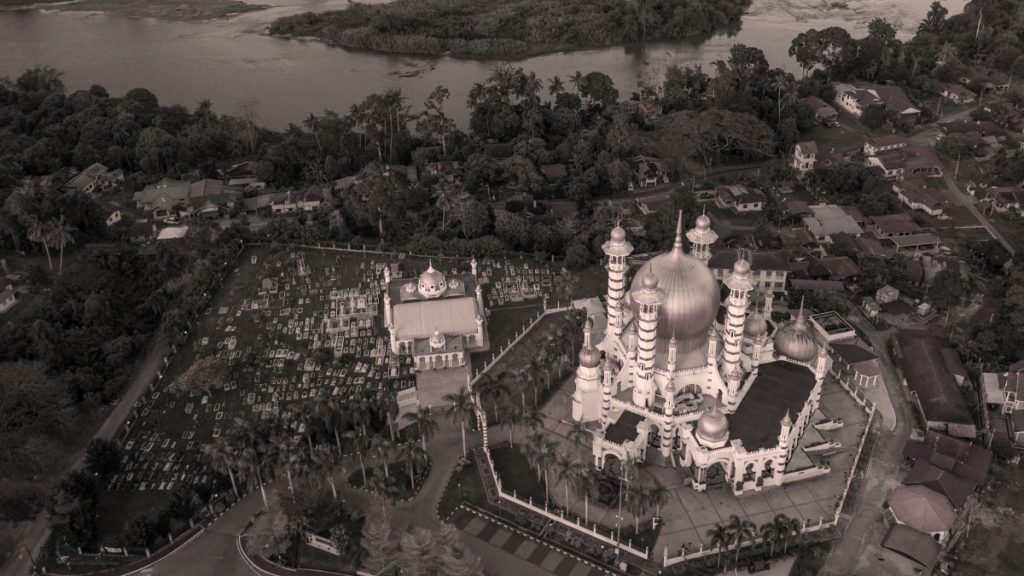
Perched on the hilltop of Bukit Chandan in the royal town of Kuala Kangsar, Perak, Malaysia, the Ubudiah Mosque (Masjid Ubudiah) is widely regarded as the most beautiful mosque in Malaysia. Its golden domes and black-and-white striped minarets rise above the royal palaces and mausoleums of the Perak sultans, a shimmering crown on the landscape of this ancient royal town. The name “Ubudiah” means “self-surrender to Allah”, and the mosque was born from a Sultan’s vow of gratitude: a promise that if he recovered from illness, he would build a mosque of great beauty as thanksgiving to God.
In this article, we explore the history, architecture, and fascinating facts about the Ubudiah Mosque, a royal house of worship where a sultan’s prayer of gratitude became one of Southeast Asia’s most treasured landmarks.
“Build me a mosque of great beauty.”
What Is the Ubudiah Mosque?
The Ubudiah Mosque is the Royal Mosque of the State of Perak, located beside the Royal Mausoleum (Makam Al-Ghufran) on Jalan Istana at Bukit Chandan, about 3 kilometres from Kuala Kangsar town. The mosque was commissioned by the 28th Sultan of Perak, Sultan Idris Murshidul’adzam Shah, and designed by the British government architect Arthur Benison Hubback, the same man who designed the Kuala Lumpur Railway Station, the Ipoh Railway Station, and the Jamek Mosque of Kuala Lumpur, all of which are considered among the most beautiful colonial-era buildings in Malaysia.
Construction began on 26th September 1913 and was completed in late 1917, at a total cost of $224,000 Straits Dollars, a vast sum at the time. The mosque is built in the Indo-Saracenic style, a fusion of Indian, Islamic, and European architectural traditions that was popular among British architects in colonial India and Malaya at the turn of the 20th century. The mosque has an octagonal plan, with the main prayer hall measuring 60 feet in diameter and the full octagon with verandah extending to 96 feet.
“Ubudiah” means “self-surrender to Allah” built as a Sultan’s vow of gratitude for healing
The Architecture: Gold, Marble, and Moorish Arches
The Golden Dome
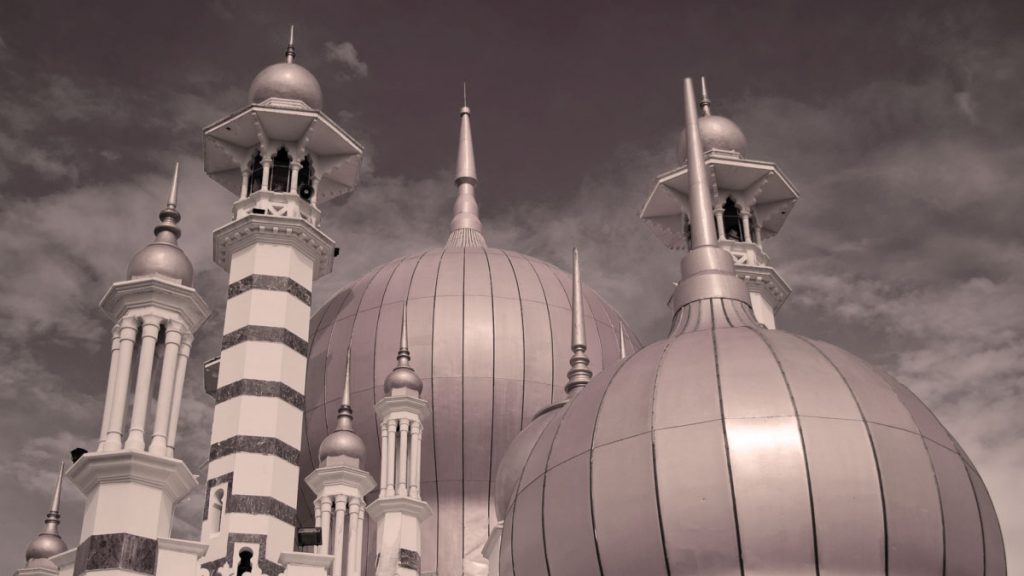
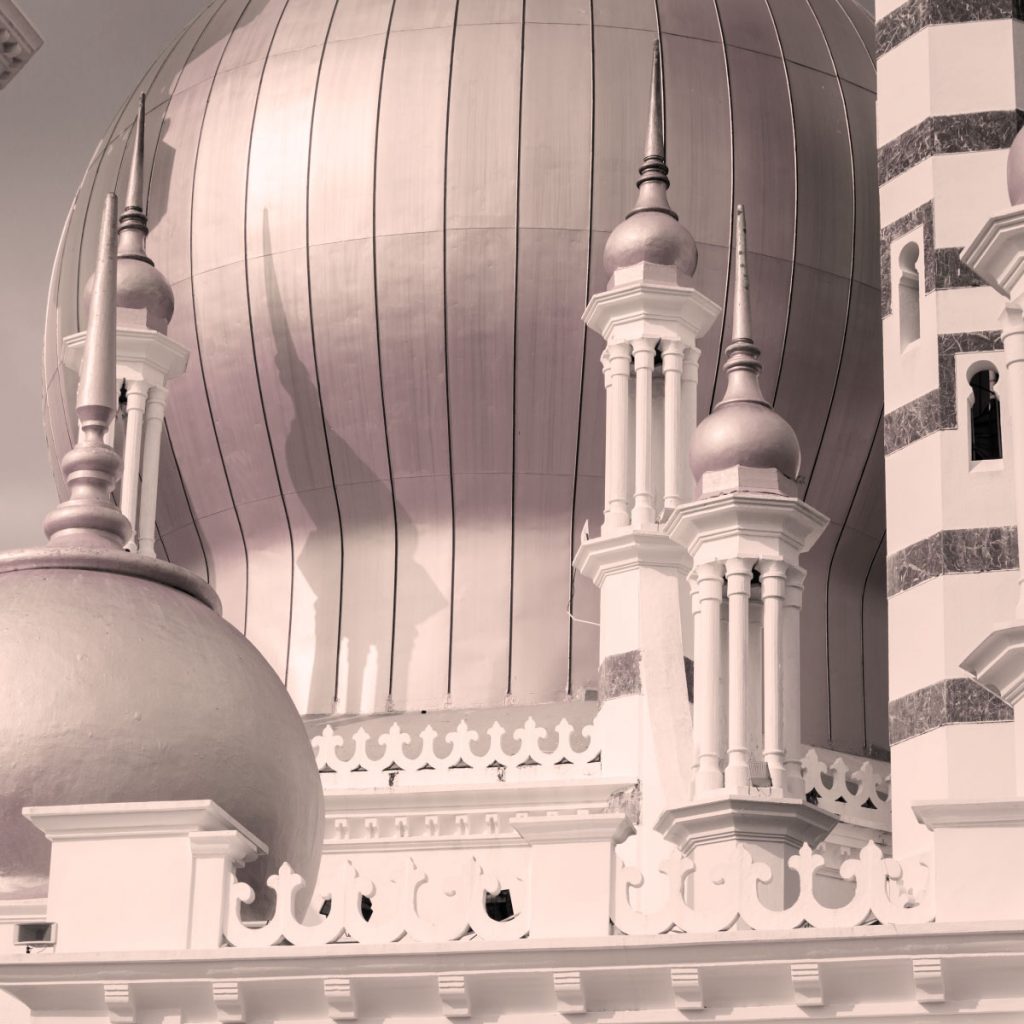
The Ubudiah Mosque is instantly recognisable for its magnificent golden bulbous dome, rising to a height of 140 feet (43 metres) above the prayer hall. Clad in gold-like yellow plating and crowned with a pointed pinnacle, the dome creates an undulating, almost liquid silhouette against the sky, visible from across the town and the surrounding hills. Flanking the main dome is a constellation of smaller golden domes and 16 turrets, giving the mosque its distinctive floating, layered appearance.
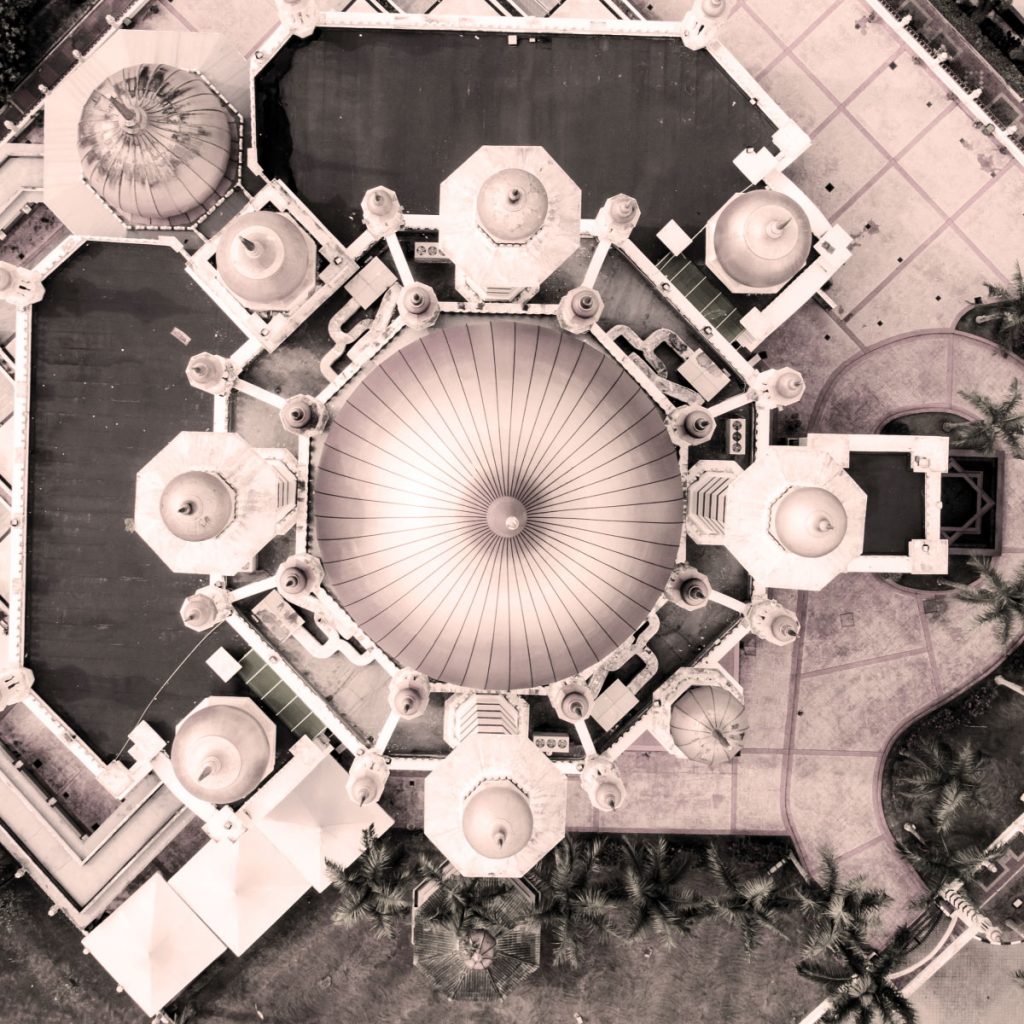
At the four corners stand four octagonal minarets, each 126 feet (38 metres) tall, topped with chattri-style balconies (a feature borrowed from Mughal Indian architecture) and their own onion-shaped domes. The minarets feature bold horizontal bands of dark marble against white, a decorative technique that gives the mosque its distinctive striped appearance and draws the eye upward.
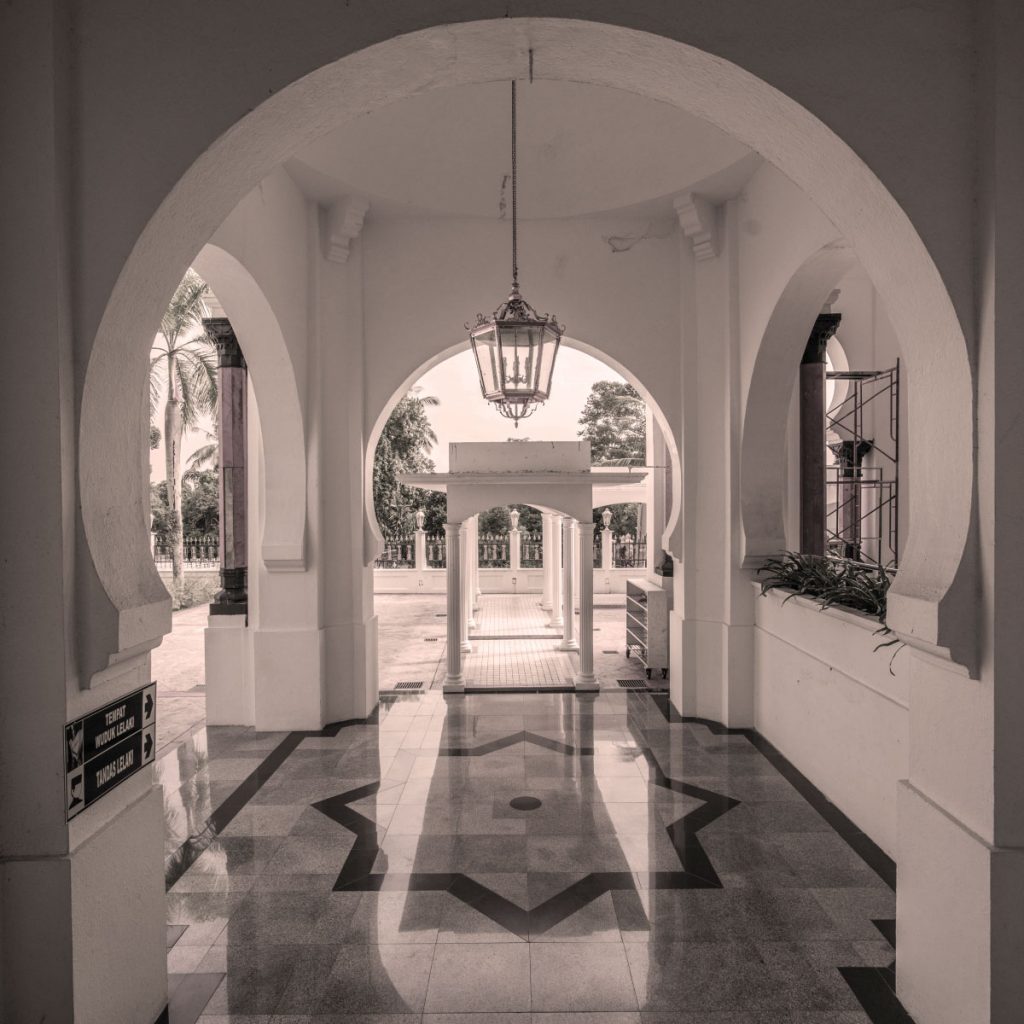
The exterior of the mosque uses white Italian marble with darker marble banding, while the wide verandah surrounding the prayer hall features Moorish horseshoe arches supported by Corinthian columns and pilasters, a perfect illustration of the Indo-Saracenic style’s ability to fuse Islamic, Indian, and European elements into a single coherent design. The architect Hubback described the mosque as an octagon with “a wide and imposing verandah all round”, and this verandah today serves as an overflow prayer area.
Designed by the same architect behind the KL Railway Station and the Jamek Mosque of Kuala Lumpur
The Interior: Red Marble and Persian Carpet
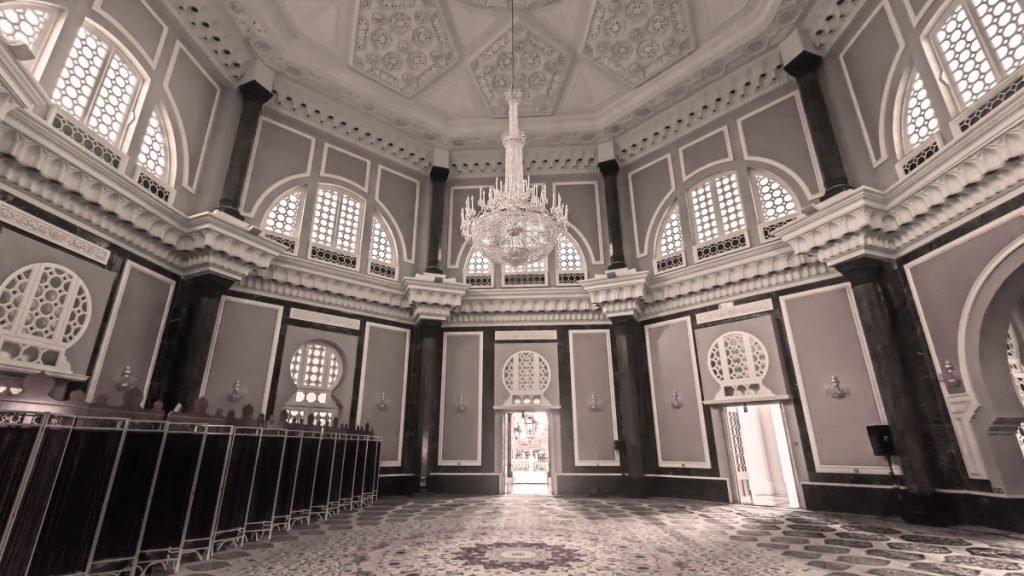
Inside, the Ubudiah Mosque is a study in refined beauty. The main prayer hall is surprisingly intimate, with the octagonal space measuring approximately 18 metres across. The recessed mihrab (prayer niche) is lined with naturally patterned red Italian marble, creating a warm, rich focal point on the qibla wall. A rounded horseshoe arch frames the mihrab, beside which stands an elevated timber minbar (pulpit). A fine wall-to-wall Persian carpet covers the floor, and a grand chandelier hangs from the intricately decorated ceiling.
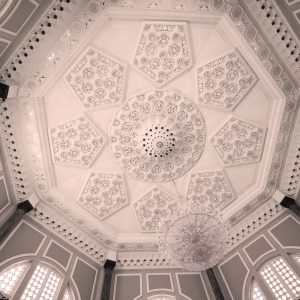
The ceiling itself is a masterwork of moulded cornice and plasterwork, while the walls feature a series of horseshoe-arched windows that fill the space with natural light. A carved wooden screen separates the women’s prayer area. The interior decoration blends Islamic geometric patterns with the softer, more ornamental approach of Mughal-Gothic design, creating a space that feels both grand and deeply peaceful.
The mihrab is lined with naturally patterned red Italian marble imported twice after elephants destroyed the first shipment
The History of the Ubudiah Mosque
A Sultan’s Vow and Two Fighting Elephants
In 1911, the 28th Sultan of Perak, Sultan Idris Murshidul’adzam Shah, returned from England, where he had attended the coronation of King George V, and fell gravely ill. While recovering in Port Dickson, he made a solemn vow: if Allah restored him to good health, he would build a mosque of great beauty in Bukit Chandan, the royal hill of Kuala Kangsar. When his health improved, the Sultan honoured his promise and instructed the government architect Arthur Benison Hubback to design the mosque.
The construction was interrupted not once but twice. The outbreak of the First World War in 1914 delayed the import of materials from Europe. But the most extraordinary interruption came when two royal elephants, one belonging to the Sultan’s family named Kulop Chandan and the other belonging to Raja Chulan named Kulop Gangga, broke free and fought on the construction site, destroying the building equipment and, most devastatingly, the entire shipment of expensive Italian marble that had to be ordered again from Italy.

A Sultan Who Never Saw His Mosque
Tragically, Sultan Idris Murshidul’adzam Shah passed away on 14th January 1916, before the mosque he had vowed to build was completed. The Ubudiah Mosque was finally finished in late 1917 and was officially opened by his son and successor, the 29th Sultan of Perak, Sultan Abdul Jalil Karamatullah Shah. The mosque that was born from a father’s prayer of gratitude was completed under a son’s care, and it has stood on Bukit Chandan ever since, for over a century, as a monument to a promise kept.
The Sultan’s Vow
Sultan Idris Murshidul’adzam Shah, the 28th Sultan of Perak, falls gravely ill after returning from King George V’s coronation in England. While convalescing in Port Dickson, he vows to build a mosque of great beauty in Bukit Chandan if Allah restores his health. When he recovers, he commissions government architect Arthur Benison Hubback to design the mosque.
The Foundation Stone Is Laid
Sultan Idris himself lays the foundation stone at a formal ceremony reported in The Straits Times. The mosque is to be an octagon of 60 feet in diameter, built with white Italian marble and crowned with a grand golden dome. The project budget is set at $200,000 Straits Dollars.
War, Elephants, and Delays
Construction is disrupted twice: first by the outbreak of the First World War, which delays the import of marble from Italy, and then by a spectacular fight between two royal elephants, Kulop Gangga and Kulop Chandan, who destroy the Italian marble on site. The marble has to be ordered again from Italy. The architect Hubback returns to England to serve in the war.
The Sultan Passes Away
Sultan Idris Murshidul’adzam Shah dies before his mosque is completed. He never sees the golden dome rise above Bukit Chandan. His son, Sultan Abdul Jalil Karamatullah Shah, the 29th Sultan of Perak, succeeds him and oversees the completion of the mosque.
The Mosque Is Completed
After four years of construction, the Ubudiah Mosque is completed at a total cost of $224,000 Straits Dollars. It is officially opened by Sultan Abdul Jalil. The mosque is immediately recognised as one of the most beautiful buildings in British Malaya, and it has remained virtually unchanged in appearance for over a century.
Renovation and Preservation
The mosque undergoes its first renovation, approved by the 34th Sultan of Perak, Sultan Azlan Muhibuddin Shah, on two conditions: not to demolish the original structure, and any additions must not be too prominent from the original design. Verandahs are added with red, black, and white marble floors to accommodate more worshippers while preserving the mosque’s historic character.
A Promise Kept in Gold
The Ubudiah Mosque is a mosque born from gratitude. A sultan fell ill, turned to Allah, and promised that if he was healed, he would build something beautiful for God. He was healed. And though he did not live to see the golden dome rise, his son completed the promise, and for over a century that dome has caught the light on Bukit Chandan, a shimmering reminder that the most beautiful things in this world are those built from thankfulness to the Creator.
Allah says in Surah Ibrahim of the Quran:
لَئِنۡ شَکَرۡتُمۡ لَاَزِیۡدَنَّکُمۡ
“If you are grateful, I will surely increase you in favour.”
The Ubudiah Mosque is the physical embodiment of this verse. Built as an act of shukr (gratitude), it has been rewarded with a beauty that has endured for over a hundred years, admired by millions, and cherished as the most beautiful mosque in Malaysia. It is proof that when a heart turns to Allah in sincere thankfulness, the result is something that lasts far beyond a single lifetime.
FAQ About the Ubudiah Mosque
The mosque is located on Bukit Chandan (Chandan Hill) on Jalan Istana in the royal town of Kuala Kangsar, Perak, Malaysia, approximately 3 kilometres from the town centre. It sits beside the Royal Mausoleum (Makam Al-Ghufran) and near the Istana Iskandariah (the royal palace of the Sultan of Perak). Visitors can reach it by taxi from Kuala Kangsar railway station or by bus.
The foundation stone was laid on 26th September 1913 and the mosque was completed in late 1917, after delays caused by the First World War and the famous elephant incident. The total cost was $224,000 Straits Dollars. The mosque has remained largely unchanged in appearance for over a century, with a renovation in 1991 to add verandahs for extra prayer space.
The mosque was commissioned by the 28th Sultan of Perak, Sultan Idris Murshidul’adzam Shah, as an act of thanksgiving to Allah for his recovery from a serious illness. While convalescing in Port Dickson, the Sultan vowed that if he recovered, he would build a mosque of “great beauty” in Bukit Chandan. Tragically, the Sultan passed away in January 1916 before the mosque was completed. It was finished and opened by his son, the 29th Sultan.
During construction, two royal elephants, Kulop Gangga (belonging to Raja Chulan) and Kulop Chandan (belonging to Sultan Abdul Jalil), fought on the building site and destroyed the entire shipment of Italian marble that had been imported for the mosque’s floors. The marble had to be ordered again from Italy, causing significant delays. Raja Chulan himself managed to calm his elephant single-handedly, an unusual feat as the elephant normally required two handlers.
Yes, visitors are admitted inside the mosque provided they are appropriately dressed (long sleeves and long trousers or skirts, with headscarves for women). The mosque is open outside of prayer times. The exterior, gardens, and nearby Royal Mausoleum can also be explored. Photography is generally permitted outside but visitors should be respectful inside the prayer hall.
The mosque was designed by Arthur Benison Hubback (known as A.B. Hubback), a British government architect who served in the Federated Malay States from 1895 to 1914. Hubback also designed the famous Kuala Lumpur Railway Station, the Ipoh Railway Station, and the Jamek Mosque of Kuala Lumpur. He designed the mosque in the Indo-Saracenic style, blending Mughal, Moorish, and European influences. Hubback returned to England during WWI and never returned to Malaya. He died in 1948.
A Prayer Answered in Gold
The Ubudiah Mosque is one of the most intimate and moving stories in the Islamic monuments series. It is not a mosque of empire or political ambition. It is a mosque born from one man’s private conversation with Allah, a whispered promise during illness, honoured with a building that has stood in beauty for over a hundred years. That it was designed by a British non-Muslim, built with Italian marble trampled by royal elephants, interrupted by a world war, and completed after its patron’s death only adds to the extraordinary richness of its story.
As Allah, Ash-Shakur (The Most Appreciative), rewards those who are grateful to Him, the Ubudiah Mosque stands as living proof that a sincere act of gratitude to God is never lost. It becomes gold on a hilltop, light in a prayer hall, and beauty that endures long after the one who was grateful has returned to his Lord.
May Allah preserve the mosques of this Ummah and bless those who build and maintain them. Ameen.