The Faisal Mosque
Faith without walls
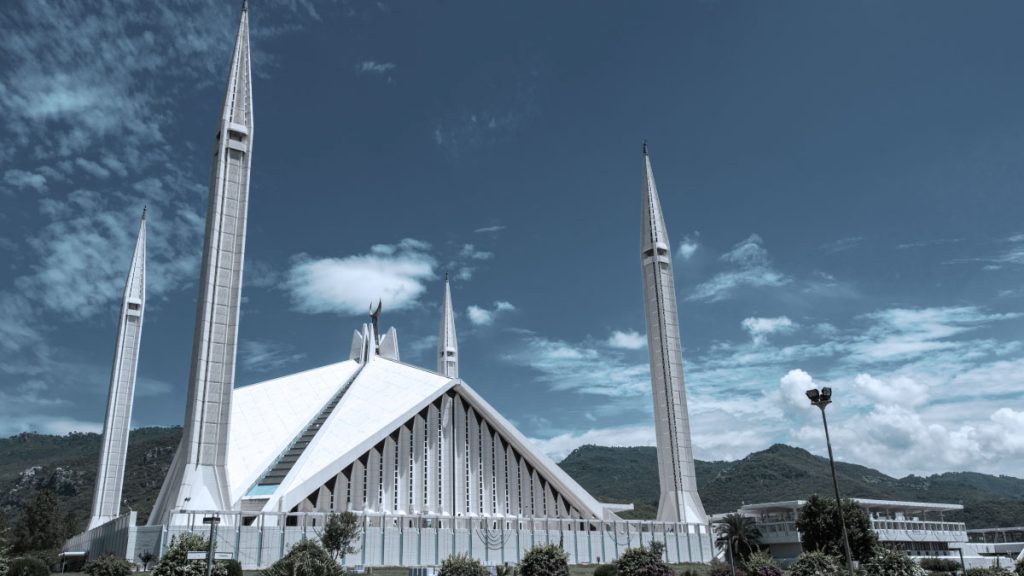
Rising like a desert tent pitched against the Himalayas, the Faisal Mosque (فیصل مسجد) in Islamabad, Pakistan is one of the most striking and unconventional mosques ever built. It has no dome. Instead, its eight-sided prayer hall is shaped like a Bedouin tent, its sloping white marble roof echoing both the peaks of the Margalla Hills behind it and the form of the Kaaba itself. Designed by the award-winning Turkish architect Vedat Dalokay and funded by King Faisal of Saudi Arabia, it was the largest mosque in the world from 1986 to 1993 and remains Pakistan’s national mosque and most iconic landmark.
In this article, we explore the history, architecture, and fascinating facts about the Faisal Mosque, a monument where a king’s generosity, an architect’s genius, and a nation’s faith come together at the foot of the mountains.
“I tried to capture the spirit, proportion, and geometry of the Kaaba in a purely abstract manner.”
What Is the Faisal Mosque?
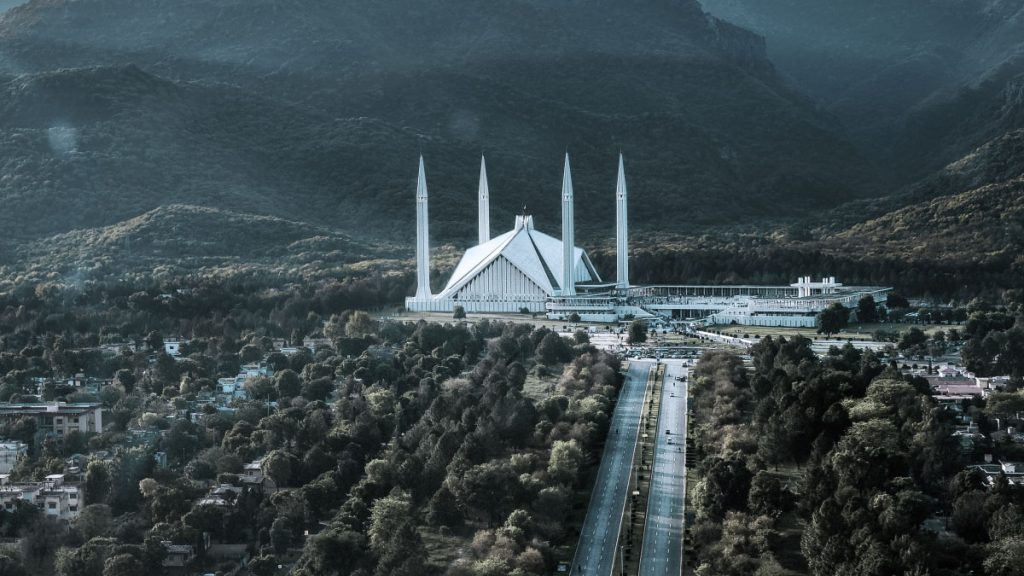
The Faisal Mosque is the largest mosque in Pakistan and the largest in South Asia. Located at the northern end of Faisal Avenue in Islamabad, at the foot of the Margalla Hills (the westernmost foothills of the Himalayas), the mosque and its surrounding grounds cover a total area of 33 acres (130,000 square metres). It can accommodate up to 100,000 worshippers when the prayer hall, courtyard, and porticoes are combined, with the main prayer hall alone holding 10,000.
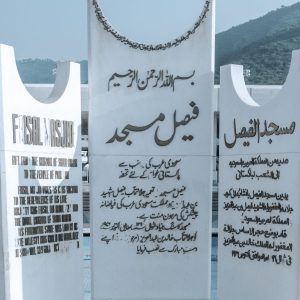
The mosque was the result of an international design competition held in 1969, in which architects from 17 countries submitted 43 proposals. The winning design was by the Turkish architect Vedat Dalokay, who had studied under the legendary Le Corbusier in Paris and later served as the mayor of Ankara. Construction began in 1976 and was completed in 1986, at a cost of approximately $120 million, funded by the government of Saudi Arabia. The mosque was named after King Faisal bin Abdul-Aziz, who was assassinated in 1975 before the project was completed, and the main avenue leading to the mosque also bears his name.
From 1986 to 1993 the Faisal Mosque was the largest mosque in the world
The Architecture: A Tent at the Foot of the Mountains
The Mosque Without a Dome
The Faisal Mosque breaks almost every expectation of what a mosque should look like. There is no dome, no traditional arch, and no ornamental tilework on the exterior. Instead, the architect Vedat Dalokay designed the main prayer hall as an eight-sided shell with sharply sloping white marble roofs, forming the shape of a Bedouin desert tent. Dalokay explained that his design fused two sacred forms: the cuboid shape of the Kaaba (the house of Allah to which all Muslims pray) and the peaked tent of the Arab Bedouin (the dwelling of the earliest Muslims). The resulting structure is an advanced hyperbolic paraboloid, a form rarely seen in religious architecture.
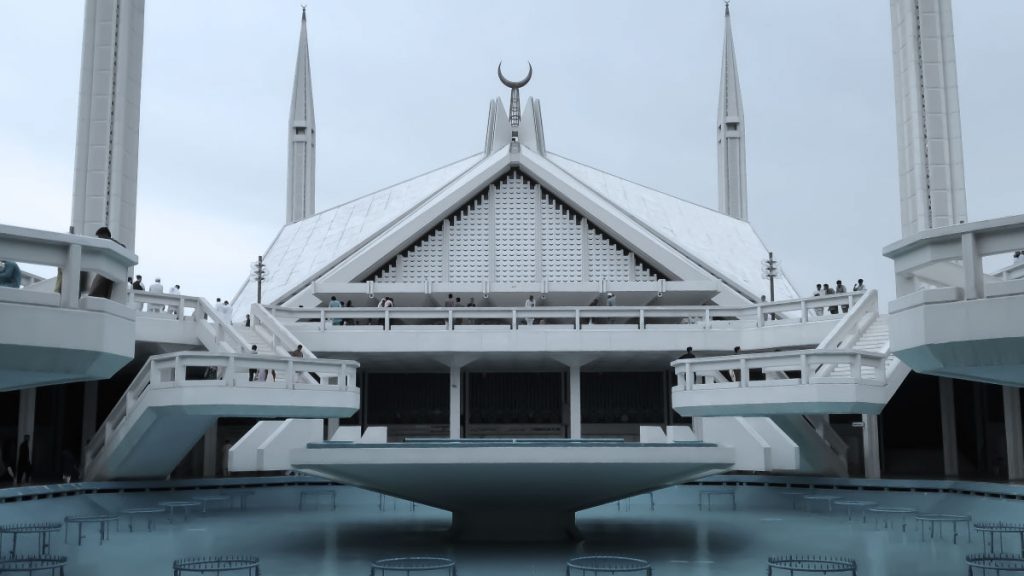
The white marble roof of the tent-shaped hall also mirrors the snow-capped peaks of the Margalla Hills directly behind it, creating a visual harmony between the mosque and the natural landscape. From a distance, the mosque appears to grow out of the mountains themselves, as if faith and nature are one.
For this extraordinary design, Dalokay received the prestigious Aga Khan Award for Architecture, recognising the Faisal Mosque as one of the finest examples of contemporary Islamic architecture in the world. The mosque was also ranked among the 50 most beautiful buildings in the world using the ancient Greek Golden Ratio methodology, confirming the mathematical precision of its proportions.
The design fuses the shape of the Kaaba and a Bedouin tent with no dome, no arch and no traditional ornament
The Tallest Minarets in South Asia
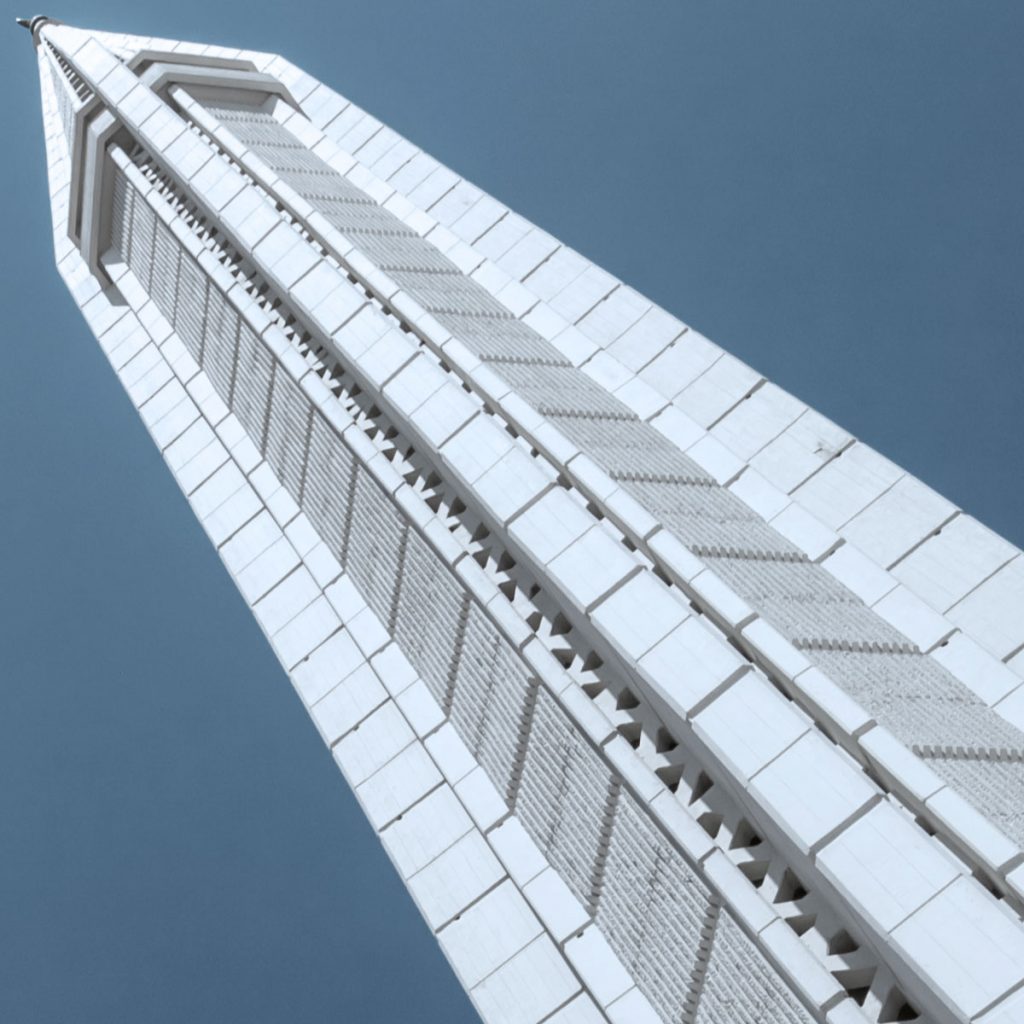
At the four corners of the prayer hall stand four minarets, each rising to a height of 90 metres (300 feet), making them the tallest minarets in South Asia. Their design is inspired by Turkish architecture but rendered in an abstract, modernist style: slender, pointed, and formed from the intersection of two planes rising from a square base. They appear almost like pencils or spears reaching towards the sky, completing the tent-like silhouette of the mosque with a sense of upward motion that draws the eye from earth to heaven.
The four minarets rise to 90 metres (300 feet) making them the tallest in all of South Asia
The Interior: Calligraphy by a Master
Inside, the tent-shaped prayer hall is lined with white marble and illuminated by a spectacular Turkish-style chandelier that hangs from the apex of the roof. The walls are adorned with mosaics and calligraphy by the renowned Pakistani artist Sadequain, one of the most celebrated calligraphers and painters in the country’s history. His work includes a mosaic on the west wall featuring the Kalima (the declaration of faith) written in early Kufic script and repeated in a mirror-image pattern. A remarkable sculpture of the Holy Quran is also situated within the main hall.
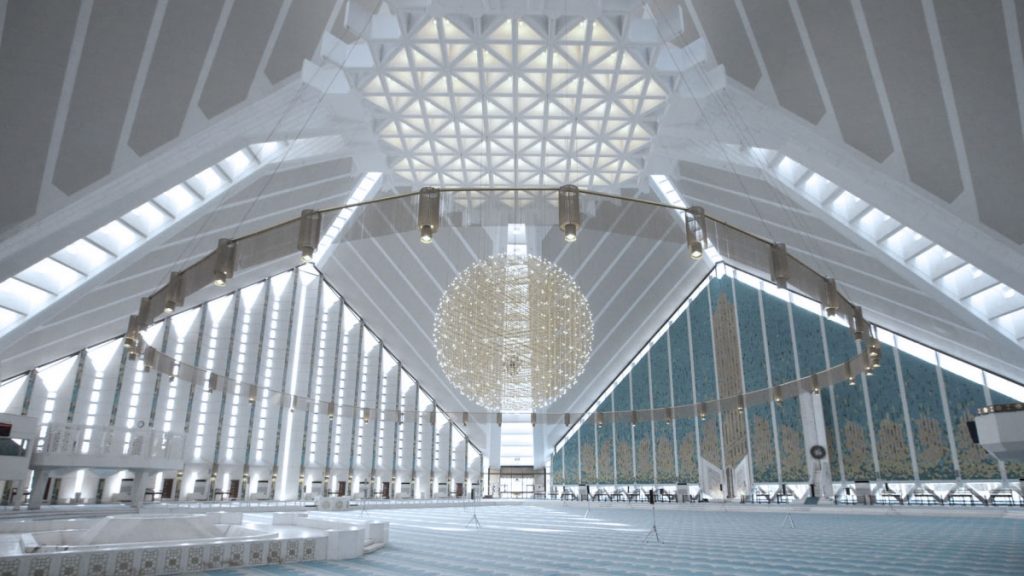
The Qibla wall is covered with stunning blue and white calligraphic tiles designed by the Turkish artist Mengu Ertel, creating a visual focal point that guides the eye and the heart towards the direction of Makkah. The overall interior blends Turkish and Pakistani decorative traditions, creating a space that feels both contemporary and deeply rooted in Islamic art.
More Than a Mosque
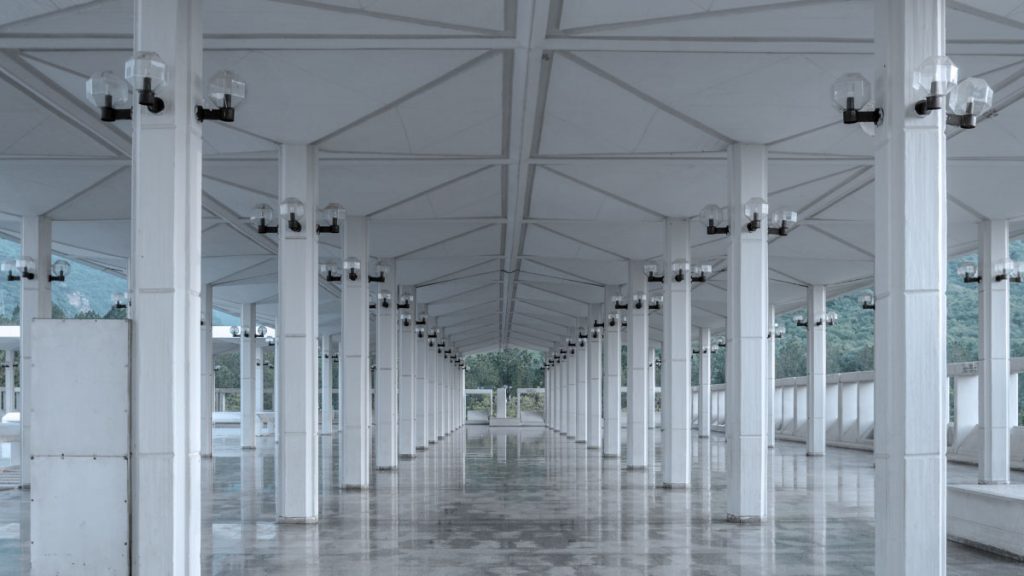
The Faisal Mosque complex is far more than a prayer hall. It includes a library, a lecture hall, a museum, and a cafe. The International Islamic University was originally housed beneath the main courtyard before relocating to its own campus. Unlike most historic mosques, the Faisal Mosque has no boundary wall; instead, it sits on an elevated concrete platform, open to the landscape on all sides, symbolising an Islam that is accessible, open, and welcoming.
43 designs from 17 countries competed for this mosque the winning architect studied under Le Corbusier in Paris
The History of the Faisal Mosque

A King’s Gift to a Nation
The story of the Faisal Mosque begins in 1966, when King Faisal bin Abdul-Aziz of Saudi Arabia made an official visit to Pakistan. During the visit, he expressed his support for the Pakistani government’s ambition to build a national mosque in the newly planned capital city of Islamabad. King Faisal pledged a generous grant of $120 million to fund the project, transforming the dream into reality.
Three years later, in 1969, the international design competition was held. Vedat Dalokay’s radical proposal, with its tent-shaped hall and absence of a dome, was a bold and controversial choice, unlike anything the Muslim world had seen. But it won the hearts of the jury and the Pakistani leadership, who saw in it a vision of Islam that was both deeply traditional and daringly modern. King Faisal was assassinated in 1975, one year before construction began, but his successor King Khalid laid the foundation stone in October 1976 and signed the construction agreement in 1978, ensuring that the late king’s vision would be honoured.
King Faisal’s Visit
King Faisal bin Abdul-Aziz of Saudi Arabia visits Pakistan and pledges his support and funding for the construction of a national mosque in the new capital city of Islamabad. His grant of $120 million will make the project possible.
The Design Competition
An international competition is held, attracting 43 proposals from architects in 17 countries. The winning design by Turkish architect Vedat Dalokay breaks all conventions with its tent-shaped prayer hall, absence of a dome, and four abstract minarets. It is hailed as a masterpiece of contemporary Islamic architecture.
Construction Begins
Construction begins under the supervision of National Construction Limited of Pakistan, led by engineer Azim Khan. King Khalid, successor to the assassinated King Faisal, lays the foundation stone in October 1976. The mosque is named after the late King Faisal in honour of his generosity and vision.
The World’s Largest Mosque
After ten years of construction, the Faisal Mosque is completed. With its capacity for 100,000 worshippers, it becomes the largest mosque in the world, a title it holds until 1993. Its tent-shaped silhouette immediately becomes the defining image of Islamabad and one of the most iconic landmarks in the Muslim world.
The First Prayer and a Historic Funeral
The first prayer is held at the Faisal Mosque on 18th June 1988. That same year, following the death of President General Zia-ul-Haq, his funeral prayers are held at the mosque in what becomes the largest funeral congregation in the history of Pakistan. A mausoleum dedicated to him is later constructed adjacent to the mosque.
Recognised Worldwide
Architect Vedat Dalokay receives the Aga Khan Award for Architecture for the Faisal Mosque’s extraordinary design. In 2021, the mosque is ranked among the 50 most beautiful buildings in the world using the ancient Golden Ratio methodology. It remains the national mosque of Pakistan and one of the most visited landmarks in the country.
Faith Without Walls
The Faisal Mosque is a mosque that defied expectation and rewrote the rules of Islamic architecture. It has no dome, no arches, no boundary wall. And yet, from the moment it was completed, it became the most recognisable symbol of Pakistan and a source of deep pride for Muslims around the world. Its architect understood something profound: that Islam does not belong to any single architectural form. The tent of the Bedouin, the cube of the Kaaba, and the peaks of the Himalayas can all become expressions of tawhid, the oneness of Allah.
Allah says in Surah Al-Jinn of the Quran:
وَّاَنَّ الۡمَسٰجِدَ لِلّٰہِ فَلَا تَدۡعُوۡا مَعَ اللّٰہِ اَحَدًا ﴿ۙ۱۸﴾
“The mosques are for Allah alone, so do not invoke anyone alongside Allah.”
The Faisal Mosque strips away everything unnecessary and leaves only the essential: a vast, open space pointed towards Makkah, open to the sky, open to the mountains, and open to all who come to worship. It is a reminder that the house of Allah does not need walls to contain His presence, because His presence is everywhere.
FAQ About the Faisal Mosque
The Faisal Mosque is located at the northern end of Faisal Avenue in Sector E-8, Islamabad, Pakistan, at the foot of the Margalla Hills. It is situated on an elevated piece of land backed by the green mountain ranges of the Margalla Hills National Park, and it dominates the skyline of the capital city. The main highway leading to it, Faisal Avenue, is one of Islamabad’s most important roads.
The mosque is named after King Faisal bin Abdul-Aziz of Saudi Arabia, who pledged $120 million to fund its construction during a visit to Pakistan in 1966. King Faisal was assassinated in 1975, one year before construction began. Both the mosque and the avenue leading to it were named in his honour, and his successor King Khalid laid the foundation stone in 1976.
The architect Vedat Dalokay deliberately departed from the traditional dome form. He explained that his design combined the cuboid shape of the Kaaba with the peaked tent of the Arab Bedouin, the dwelling of the earliest Muslims. The result is a hyperbolic paraboloid roof covered in white marble, whose sloping lines also echo the peaks of the Margalla Hills behind the mosque. The design won the Aga Khan Award for Architecture.
The Faisal Mosque can accommodate up to 100,000 worshippers when the main prayer hall, courtyard, and porticoes are combined. The main prayer hall alone holds 10,000. The mosque and its grounds cover a total area of 33 acres (130,000 square metres), making it the largest mosque in Pakistan and South Asia.
The mosque was designed by the Turkish architect Vedat Dalokay (1927-1991), who graduated from Istanbul Technical University and later studied at the Sorbonne in Paris, where he worked under the legendary architects Auguste Perret and Le Corbusier. Dalokay also served as the mayor of Ankara from 1973 to 1977. The interior calligraphy was created by the famous Pakistani artist Sadequain, while the Qibla wall tiles were designed by Turkish artist Mengu Ertel.
Beyond the prayer hall, the Faisal Mosque complex includes a library, a lecture hall, a museum, and a cafe. The International Islamic University was originally housed beneath the main courtyard before relocating to a new campus. Adjacent to the mosque is the mausoleum of President General Zia-ul-Haq, whose funeral prayers in 1988 were the largest funeral congregation in Pakistan’s history.
A Tent Pitched for Eternity
The Faisal Mosque is a bold and beautiful answer to the question: what does a mosque look like in the modern age? It proves that a mosque can be shaped like a tent and still be the largest in the world, that it can have no dome and still win the most prestigious award in Islamic architecture, and that it can stand without walls and still shelter a hundred thousand worshippers beneath its roof. It is a mosque built from the generosity of a king, the genius of a Turkish architect, the craftsmanship of Pakistani builders, and the faith of an entire nation.
As Allah, Al-Wahid (The One), is worshipped by all creation in forms beyond counting, the Faisal Mosque stands as a reminder that there is no single shape for devotion, only a single direction: towards Him.
May Allah preserve the mosques of this Ummah and bless those who build and maintain them. Ameen.