The Prophet’s Mosque
Where it all began
In the heart of the city of Medina, Saudi Arabia, stands the Prophet’s Mosque (المسجد النبوي, Al-Masjid an-Nabawi), the second holiest site in all of Islam after the Masjid al-Haram in Makkah. This is not simply a grand mosque. This is the mosque that the Prophet Muhammad (pbuh) built with his own hands in 622 CE, the year he arrived in Medina. Beneath its iconic Green Dome lies the resting place of the Prophet (pbuh) himself, alongside his closest companions Abu Bakr and Umar (may Allah be pleased with them). From a simple open-air enclosure of palm trunks and mud walls, it has grown over fourteen centuries into one of the largest mosques in the world, capable of hosting over one million worshippers.
In this article, we explore the history, architecture, and profound significance of the Prophet’s Mosque, the mosque where every prayer is worth a thousand prayers offered anywhere else.
“One prayer in my mosque is better than a thousand prayers elsewhere except al-Masjid al-Haram.”
What Is the Prophet’s Mosque?
The Prophet’s Mosque was founded by the Prophet Muhammad (pbuh) in 622 CE after his migration (Hijrah) from Makkah to Medina. The land on which it was built belonged to two young orphans, Sahl and Suhayl, who offered it as a gift. The Prophet (pbuh) insisted on paying for the land because they were orphaned children, and the price was paid by his host, Abu Ayyub al-Ansari (may Allah be pleased with him). The Prophet (pbuh) himself participated in the construction alongside his companions, laying bricks and carrying palm trunks. The original mosque was a simple open-air enclosure, approximately 35 metres by 30 metres, with walls of mud and stone, a roof of palm leaves, and a floor of pebbles.
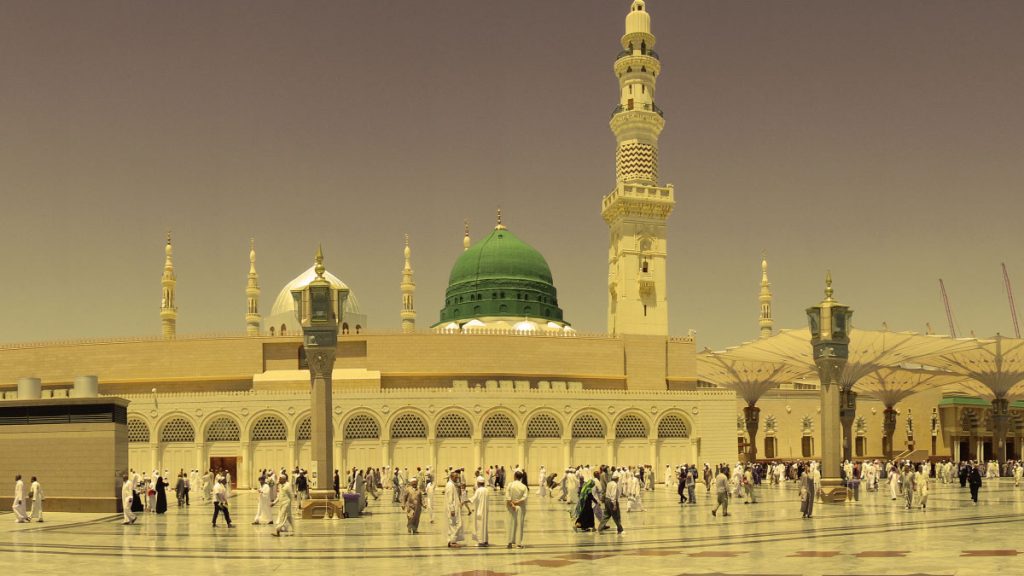
From the beginning, the mosque was far more than a place of prayer. It served as the community centre of the first Muslim society, a court of law, a school, a town hall, and a place for receiving delegations. The raised platform known as the Suffah became the first Islamic school, where companions who had no homes lived and studied under the Prophet (pbuh) himself. Today, the mosque covers approximately 59 acres, with ten minarets standing at 105 metres (344 feet) each, and a capacity of over one million worshippers during Hajj and Ramadan. It is always open, day and night, throughout the year.
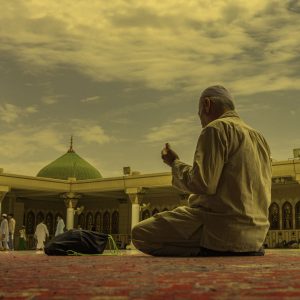
The Prophet (pbuh) insisted on paying for the land because the owners were orphaned children
The Architecture: From Palm Trunks to a Million Worshippers
The Green Dome
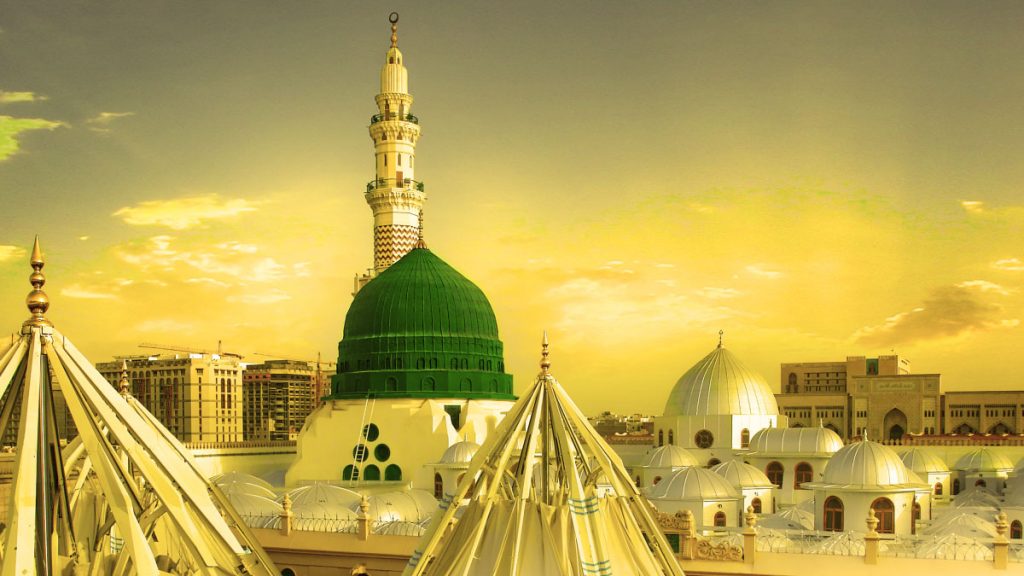
The most iconic feature of the Prophet’s Mosque is the Green Dome (القبة الخضراء), the most recognisable symbol of Medina, situated in the south-eastern corner of the mosque. Beneath this dome lies the tomb of the Prophet Muhammad (pbuh), alongside his beloved companions Abu Bakr as-Siddiq and Umar ibn al-Khattab (may Allah be pleased with them both). The graves are enclosed within the room that was once the chamber of Aisha (may Allah be pleased with her), the Prophet’s wife, and are surrounded by a five-sided wall without doors or windows, built deliberately in an irregular pentagon shape to prevent it from being mistaken for the Kaaba.
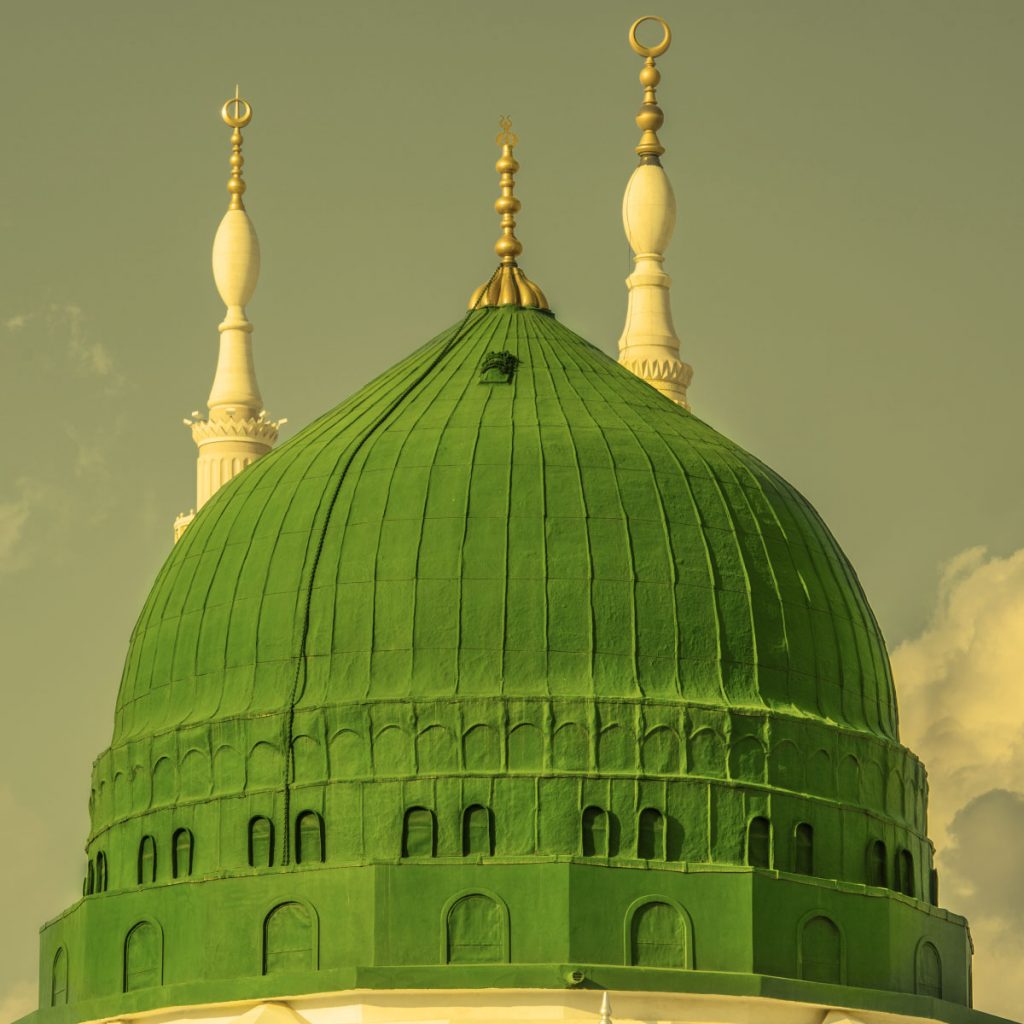
The dome was first built as an unpainted wooden cupola in 1279 CE during the Mamluk era. It was later rebuilt by Sultan Qaitbay in the 15th century after a fire struck the mosque, and the current dome was added in 1818 by Ottoman Sultan Mahmud II. It was first painted green in 1837, and has been known as the Green Dome ever since. Before that, it was white, and before that, purplish-blue, a colour favoured by the Arabs of the Hejaz at the time.
Many pilgrims describe standing near the Prophet’s (pbuh) tomb as one of the most emotional moments of their lives, a place where gratitude, love, and longing flow naturally in silent prayer. The tomb cannot be seen directly; only the outer southern wall, draped in green cloth, is visible through the grilles. The enclosure has been inaccessible since Sultan Qaitbay’s reconstruction in 1481.
The Green Dome was not always green it was white, then purplish-blue before being painted green in 1837
Riyad ul-Jannah: A Garden of Paradise
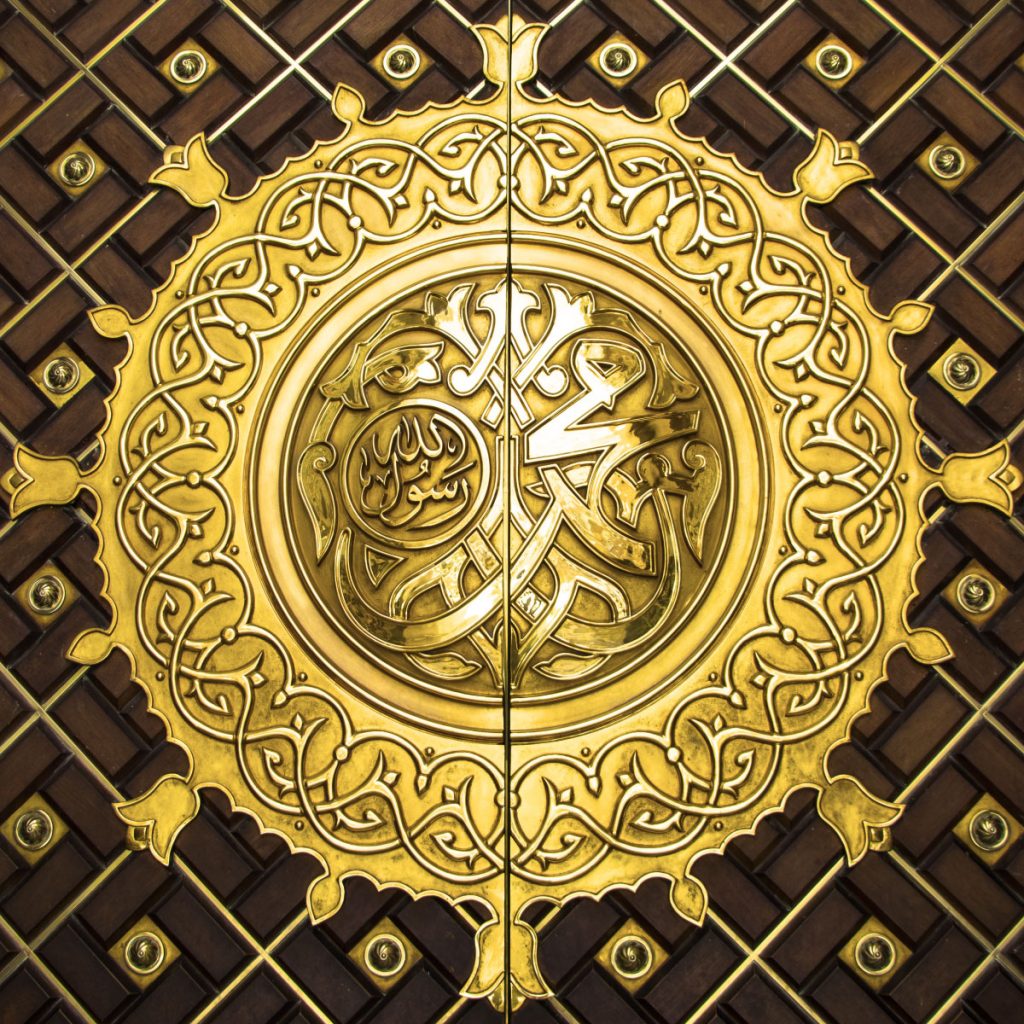
Between the minbar (pulpit) of the Prophet (pbuh) and his tomb lies a small rectangular area known as Riyad ul-Jannah (“The Garden of Paradise”). The Prophet (pbuh) said: “Between my house and my pulpit is a garden from the gardens of Paradise.” (Sahih al-Bukhari) This sacred area is distinguished by its green carpet, in contrast to the red carpet used in the rest of the mosque. It is one of the most sought-after places for prayer in the entire Islamic world, and pilgrims often wait hours for the opportunity to pray within it. Access is managed through the official Nusuk app.
“Between my house and my pulpit is a garden from the gardens of Paradise”
The Umbrellas of Medina
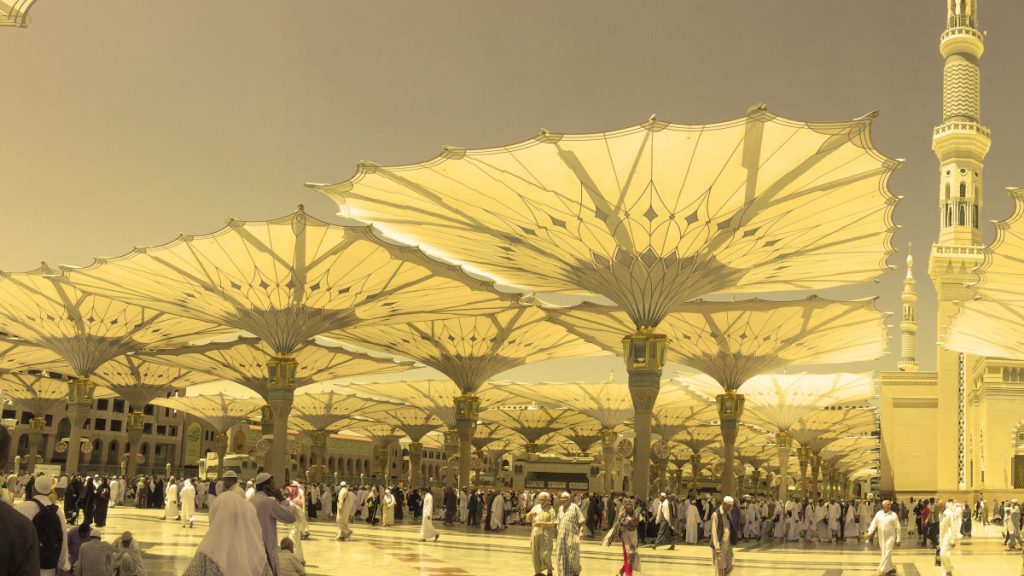
One of the most striking modern features of the Prophet’s Mosque is the array of giant retractable umbrellas that cover the vast piazzas surrounding the mosque. Standing approximately 26 metres high, these German-engineered umbrellas open each morning to protect worshippers from the harsh Medinan sun and close after the Isha prayer at night. Their shadow covers over 143,000 square metres, providing shade for tens of thousands of worshippers who pray in the open courtyards. The polished marble floors beneath them are designed to stay cool by reflecting sunlight, and the umbrella pillars are equipped with fans and water misters to keep pilgrims comfortable.
The sliding domes above the prayer hall, designed by the architect Kamal Ismael, can also open to adjust the internal climate of the mosque, decorated with Islamic geometric patterns in blue. Inside, the marble floors, imported from Greece and Italy, remain cool even under the desert sun. Golden calligraphy of Quranic verses adorns the arches, and ornate chandeliers illuminate the vast prayer halls with soft light. The Qibla wall, dating from the Ottoman renovation under Sultan Abdulmecid I, is adorned with 185 names of the Prophet Muhammad (pbuh) in exquisite calligraphy.
The giant umbrellas shade 143,000 square metres protecting worshippers from the Medinan sun
The History of the Prophet’s Mosque
The Mosque the Prophet Built
When the Prophet Muhammad (pbuh) arrived in Medina in 622 CE after the Hijrah, one of his first acts was to build a mosque. Mounted on his camel Qaswa, he let the animal walk freely through the city until it stopped and knelt at a piece of land that was used as a date-drying yard. This was the site chosen for the mosque. The Prophet (pbuh) purchased the land from the two orphans who owned it, and construction began immediately. He worked alongside his companions, carrying bricks and reciting poetry as they built. The mosque took seven months to complete.
The original structure was humble: walls of mud brick and stone, columns of palm trunks, a roof of palm leaves, and a floor of pebbles and earth. It was accessed through three doors. Initially, the prayer direction (qibla) faced Jerusalem; after approximately 16 months, following the revelation of verses in Surah Al-Baqara, the qibla was changed to face the Kaaba in Makkah. Seven years later, the mosque was doubled in size to accommodate the growing Muslim community. After the Prophet (pbuh) passed away in 632 CE, he was buried in the chamber of his wife Aisha (may Allah be pleased with her), which was adjacent to the mosque.
The mosque today covers 100 times the area of the original mosque built by the Prophet (pbuh) himself
The Prophet Builds His Mosque
After the Hijrah from Makkah to Medina, the Prophet Muhammad (pbuh) builds a mosque on land purchased from two orphans. The simple structure of mud walls, palm trunk columns, and a palm-leaf roof takes seven months to complete. It serves as a mosque, community centre, school, and court of law. The Prophet (pbuh) himself carries bricks alongside his companions.
The Prophet Is Buried Beside the Mosque
Following the death of the Prophet Muhammad (pbuh) on 12th Rabi ul-Awwal 11 AH, he is buried in the chamber of his wife Aisha (may Allah be pleased with her), adjacent to the mosque. Abu Bakr (may Allah be pleased with him) and later Umar (may Allah be pleased with him) are buried beside him. Their resting place remains beneath the Green Dome to this day.
The Great Umayyad Expansion
Umayyad Caliph al-Walid I orders a major expansion under the governorship of Umar ibn Abd al-Aziz. The mosque is significantly enlarged, the tomb of the Prophet is incorporated within the new structure, and the walls are decorated with mosaics by Coptic and Greek craftsmen. Stone columns replace the original palm trunks, and four minarets are added.
The Dome Over the Tomb
In 1279 CE, Mamluk Sultan al-Mansur Qalawun builds the first wooden dome over the Prophet’s tomb. After a devastating fire in 1481, Sultan Qaitbay rebuilds the dome with a brick base. The current dome is added in 1818 by Ottoman Sultan Mahmud II. In 1837, it is painted green for the first time, becoming the Green Dome known and loved across the Muslim world.
The Ottoman Renovation
Ottoman Sultan Abdulmecid I remodels the entire site, expanding the prayer hall, paving the floors in marble and red stone, adding a fifth minaret, and adorning the Qibla wall with glazed tiles featuring 185 names of the Prophet (pbuh) in calligraphy. The domes are decorated with Quranic verses and lines from al-Busiri’s famous poem Qasidat al-Burdah.
The Saudi Expansions
Beginning in 1951 under King Abdulaziz Al Saud, the mosque undergoes multiple expansions that transform it into one of the largest in the world. The latest expansion in the 1990s adds sliding domes, giant retractable umbrellas, air conditioning, marble floors from Greece and Italy, and ten minarets at 105 metres each. The mosque now covers 59 acres and can accommodate over one million worshippers.
The Mosque Where Every Prayer Counts a Thousandfold
The Prophet Muhammad (pbuh) said: “One prayer in my mosque is better than a thousand prayers elsewhere, except al-Masjid al-Haram.” (Sahih al-Bukhari) This hadith has drawn believers from every corner of the world to Medina for fourteen centuries, each one seeking the closeness of the Prophet (pbuh) and the tranquillity that fills his blessed mosque. Many pilgrims who perform the Hajj also travel to Medina to visit the mosque, to stand near the Green Dome, to pray in the Riyad ul-Jannah, and to send salutations (salawat) upon the beloved Messenger of Allah (pbuh).
Allah says in Surah At-Tawba of the Quran, “A mosque founded on righteousness from the first day is more worthy for you to stand in.” (Quran 9:108)
ؕ لَمَسۡجِدٌ اُسِّسَ عَلَی التَّقۡوٰی مِنۡ اَوَّلِ یَوۡمٍ اَحَقُّ اَنۡ تَقُوۡمَ فِیۡہِ
“A mosque founded on righteousness from the first day is more worthy for you to stand in.”
There is no mosque on earth more founded on righteousness than the one built by the Prophet (pbuh) himself, with his own hands, on land he paid for fairly, in a city that welcomed him when no other would. From a simple rectangle of palm trunks and pebbles, it has grown into a shimmering expanse of marble, gold, and light, yet its essence has never changed: it is, and has always been, the house of the Prophet (pbuh), where the faithful come to pray, to learn, and to be near the one who brought them the message of Allah.
FAQ About the Prophet’s Mosque
The Prophet’s Mosque is located in the heart of Medina (also spelled Madinah), in the western Hejaz region of Saudi Arabia. It was originally situated at the edge of the city but now forms the centre of modern Medina. The mosque is under the control of the Custodian of the Two Holy Mosques (the King of Saudi Arabia) and is a major site of pilgrimage for Muslims from around the world.
The dome over the Prophet’s (pbuh) tomb has not always been green. It was first built as an unpainted wooden cupola in 1279 CE. Over the centuries, it was painted white, then purplish-blue (a colour favoured by the Arabs of Hejaz). The current dome was added in 1818 by Ottoman Sultan Mahmud II and was first painted green in 1837. Green is traditionally associated with Islam and the Prophet (pbuh), and the colour has remained ever since.
Riyad ul-Jannah (“The Garden of Paradise”) is a small rectangular area between the Prophet’s (pbuh) pulpit (minbar) and his tomb. The Prophet (pbuh) said: “Between my house and my pulpit is a garden from the gardens of Paradise.” (Sahih al-Bukhari) It is distinguished by its green carpet, in contrast to the red carpet in the rest of the mosque. Pilgrims often wait hours for the opportunity to pray within this blessed area. Access is now managed through the Nusuk app.
The Prophet’s Mosque can accommodate over one million worshippers during peak seasons such as Hajj and Ramadan. The mosque covers approximately 59 acres, which is 100 times the size of the original mosque built by the Prophet (pbuh). It has ten minarets, each standing 105 metres (344 feet) tall. The mosque is always open, day and night, throughout the year.
Unlike the Masjid al-Haram in Makkah, which is restricted to Muslims, the Prophet’s Mosque in Medina is open to visitors of all faiths. Non-Muslims are welcome to visit the mosque and its courtyards, though access to certain areas such as the Riyad ul-Jannah may be restricted during prayer times. Visitors should dress modestly and observe the customs of the mosque.
The giant retractable umbrellas on the piazzas surrounding the Prophet’s Mosque are designed to protect worshippers from the sun and rain. Standing approximately 26 metres high and manufactured in Germany, they cover over 143,000 square metres of shade. Each umbrella pillar is fitted with fans and water misters to help keep the area cool. They open in the morning and close after the Isha prayer each night.
The Mosque That Started It All
Every great mosque in this series, from the Blue Mosque to the Faisal Mosque, from the Taj Mahal to the Crystal Mosque, exists because of this one. The Prophet’s Mosque in Medina is where Islamic architecture began: a rectangle of palm trunks and mud, built by the hands of the Prophet (pbuh) and his companions, where the Quran was taught, justice was dispensed, and the first Muslim community learned how to live, pray, and build together. Fourteen centuries later, it has grown beyond recognition, yet its heart has never moved. The Green Dome still marks the place where the most beloved human being in Islamic history rests, beside the companions who gave everything for the faith he brought.
As Allah, As-Salam (The Source of Peace), fills the hearts of the faithful with tranquillity, the Prophet’s Mosque remains the place on earth where that peace is felt most deeply. It is not just a monument. It is home.
May Allah preserve the mosques of this Ummah and bless those who build and maintain them. Ameen.