
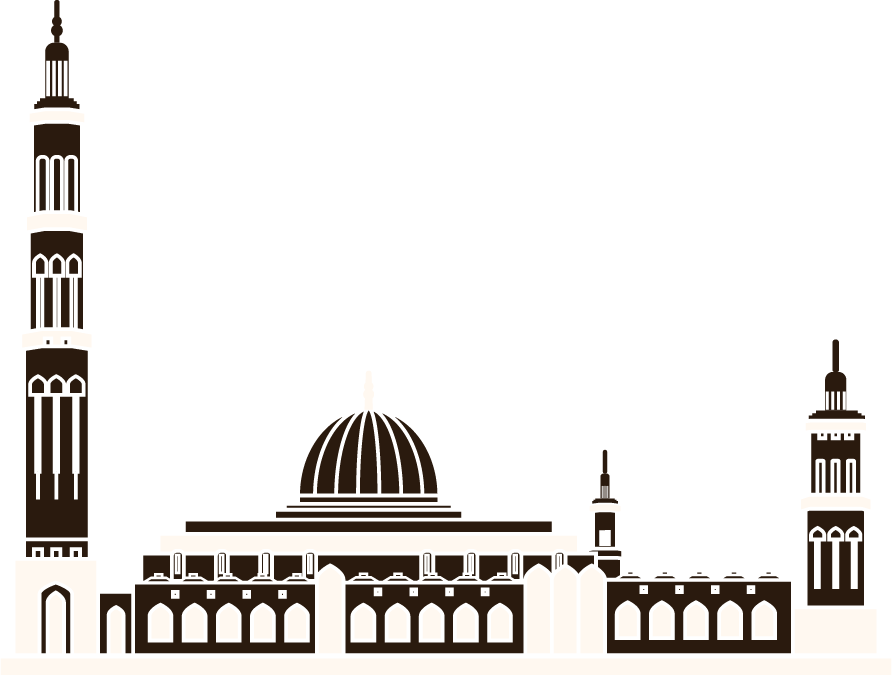
The Sultan Qaboos Grand Mosque
A Sultan’s gift in sandstone
Gleaming in Indian sandstone beneath the Arabian sun, the Sultan Qaboos Grand Mosque (جَامِع ٱلسُّلْطَان قَابُوْس ٱلْأَكْبَر) in Muscat, Oman is a monument to the vision of one man and the faith of an entire nation. Commissioned by Sultan Qaboos bin Said Al Said to mark the 30th anniversary of his reign, it is the largest mosque in Oman and one of the most breathtaking in the Muslim world.
Inside its walls, the world’s second-largest hand-woven carpet covers the prayer hall floor, a Swarovski crystal chandelier hangs from the dome, and the decorative arts of Persia, Ottoman Turkey, Mughal India, and traditional Oman come together in one harmonious masterpiece.
In this article, we explore the history, architecture, and fascinating facts about the Sultan Qaboos Grand Mosque, a gift from a beloved Sultan to his people and a beacon of Oman’s unique place in the Islamic world.
“A radiant lighthouse attracting its visitors to interact with the spirit of Islam as a religion, science, and civilisation.”
What Is the Sultan Qaboos Grand Mosque?
The Sultan Qaboos Grand Mosque is situated in the Al-Ghubra district of Bawshar, along the main road between Muscat and Seeb. Built on a vast site of 416,000 square metres (102 acres), with the complex itself covering 40,000 square metres, it was constructed from 300,000 tonnes of Indian sandstone over six years and seven months.
The mosque was inaugurated on 4th May 2001 by Sultan Qaboos himself, exactly thirty years after he came to power.
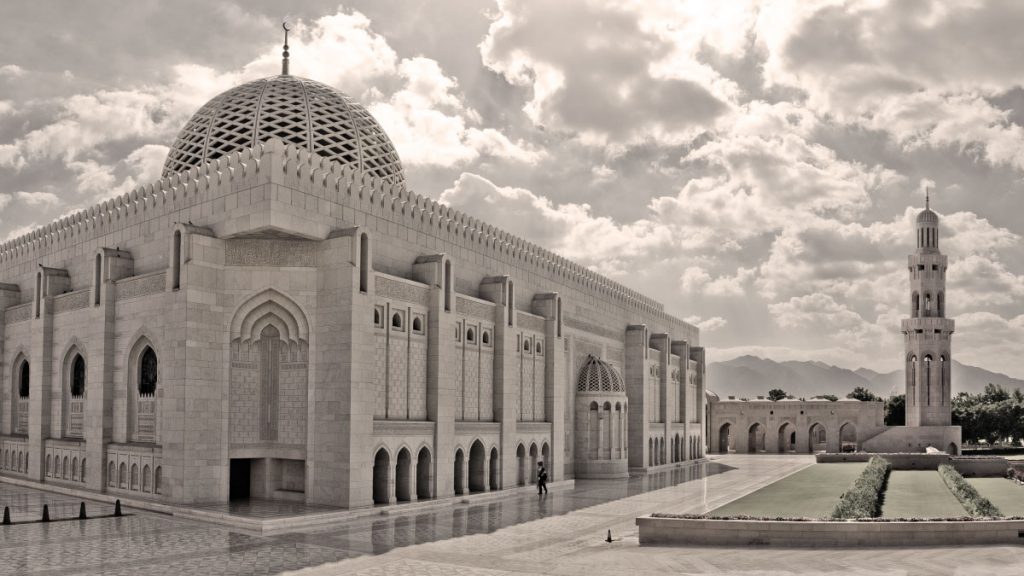
The mosque can accommodate up to 20,000 worshippers: the main prayer hall holds 6,500, the women’s prayer hall 750, and the exterior paved grounds, courtyards, and corridors provide space for a further 8,000 or more.
The mosque is not only the largest in Oman but also the country’s tallest building, thanks to its main minaret rising to 91.5 metres. It is also a centre for the dissemination of Islam, particularly the Ibadhi tradition, which holds special significance in Oman as the country’s predominant school of Islamic jurisprudence.
Built from 300,000 tonnes of Indian sandstone on a site covering 102 acres
The Architecture: Where Every Tradition Meets
The Dome and the Five Pillars
The Sultan Qaboos Grand Mosque is a contemporary Islamic building that draws from an extraordinary range of architectural traditions: Ottoman, Persian, Mughal Indian, Egyptian, and traditional Omani. The result is a mosque that feels universal, as if the entire Islamic world contributed to its creation.
The main prayer hall is square in shape, crowned by a magnificent central dome rising to a total height of 50 metres above the floor, with a diameter of 50 metres. The dome is constructed from 14,000 tonnes of marble and composed of spherical triangles supported by marble columns and pointed arches.
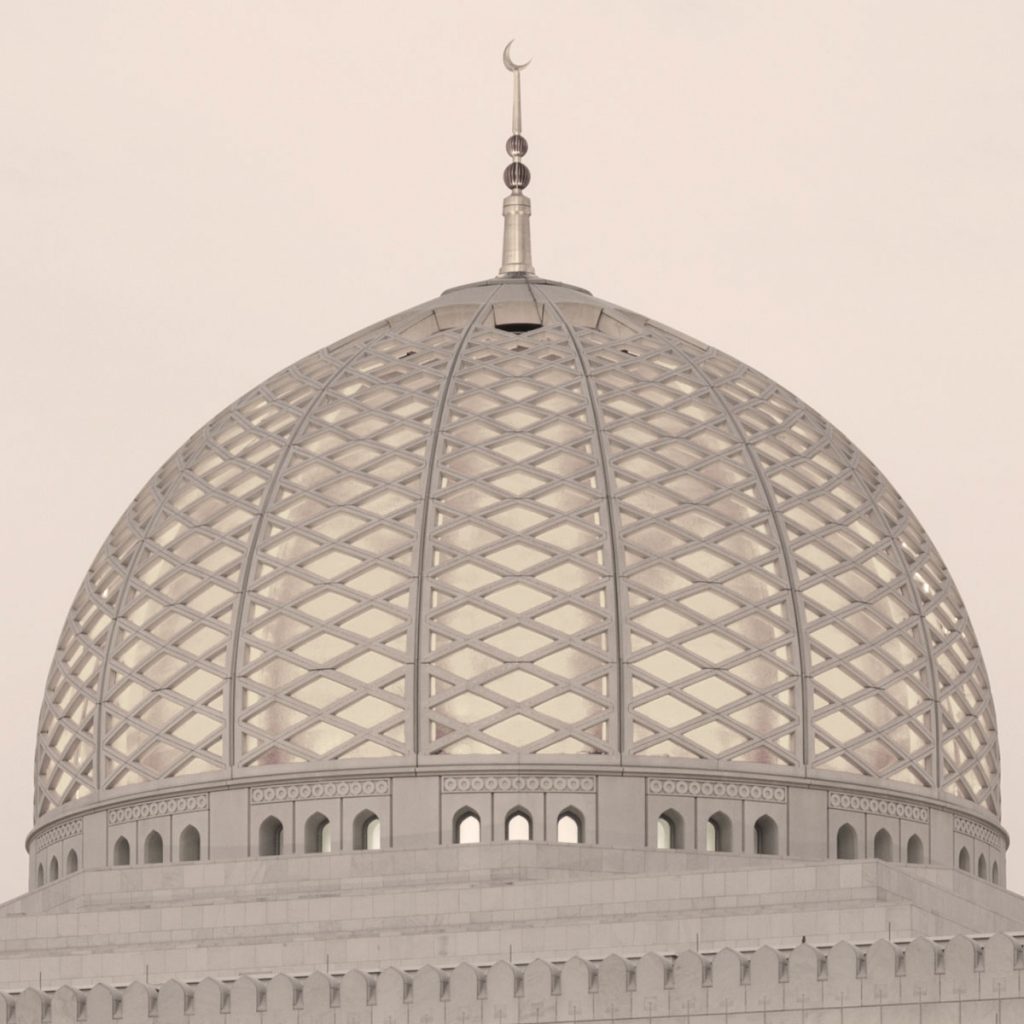
The mosque has five minarets that define the limits of the site, deliberately symbolising the five pillars of Islam: the profession of faith, prayer, giving of alms, fasting, and pilgrimage. The main minaret stands at 91.5 metres, making it the tallest building in Oman.
While the other four reach 45 metres each, the minarets are designed in a style inspired by traditional Egyptian architecture, while the decorative programme throughout the mosque draws on Omani and Persian influences.
The mosque’s exterior is clad in luminous white and red-brown marble, and is approached from the east through spacious gardens bisected by water channels, a design that recalls the traditional Islamic paradise garden.
Two long corridors, each 240 metres in length, run along the north and south sides, divided into halls each decorated in the style of a different Islamic culture.
The corridors are crowned with a canopy of small domes inspired by the historic Bilad Bani Bu Ali mosque in Oman’s eastern Sharqiyah region, connecting the contemporary architecture to the country’s own heritage.
The five minarets symbolise the five pillars of Islam the tallest rising to 91.5 metres above the city
The Prayer Carpet: 600 Women, Four Years, 1.7 Million Knots
The most celebrated feature of the mosque’s interior is the hand-woven prayer carpet that covers the entire floor of the main prayer hall. Measuring approximately 70 x 60 metres (4,343 square metres), it weighs 21 tonnes and contains 1.7 million knots. It took over 600 Iranian women four years to weave, and it was produced by the Iran Carpet Company at the order of the Diwan of the Royal Court. The design brings together the classical Persian carpet traditions of Tabriz, Kashan, and Isfahan, using 28 colours in varying shades, the majority obtained from traditional vegetable dyes. When the mosque opened, it was the largest single-piece carpet in the world.
The prayer carpet weighs 21 tonnes and was hand-woven by 600 women over four years
The Sultan Qaboos Grand Mosque is more than a building. It is a statement about what Islam means to Oman: a faith of knowledge, beauty, openness, and peace. Sultan Qaboos designed his mosque to welcome visitors of all faiths.
It houses a library alongside its prayer hall and celebrates the artistic traditions of every corner of the Islamic world within its corridors. In a region often associated with division, this mosque stands as a monument to unity, tolerance, and the pursuit of beauty in the service of Allah.
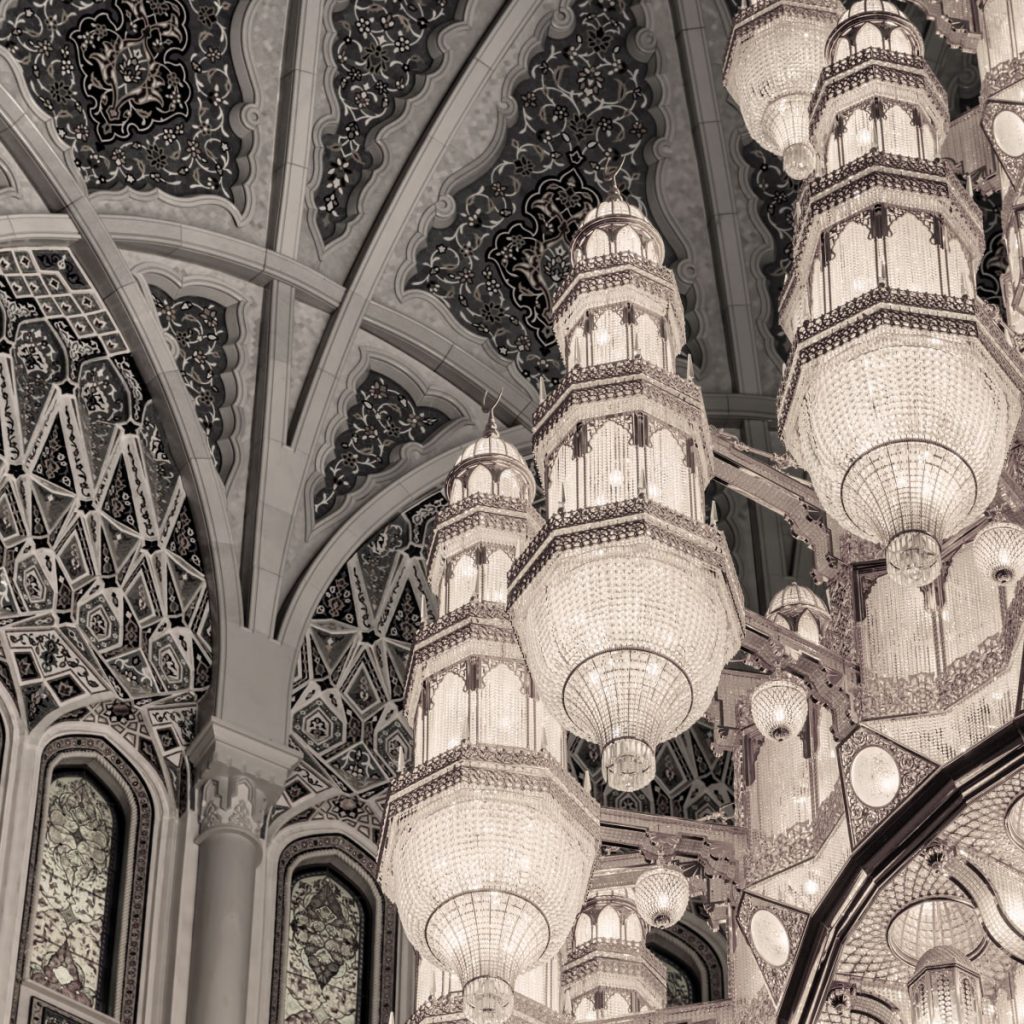
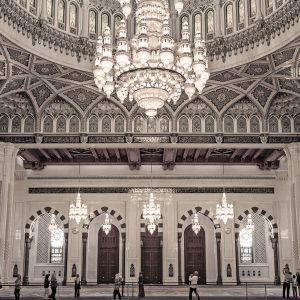
Hanging from the centre of the main dome is one of the largest chandeliers in any mosque in the world. Measuring 14 metres in height and weighing 8,500 kilograms, it holds approximately 600,000 Swarovski crystals with 24-carat gold plating. The chandelier took over four years to complete. When the mosque opened in 2001, it was the largest chandelier in any mosque in the world. Together with the hand-woven carpet beneath it, it creates a space where light falls from above onto a sea of colour below, a breathtaking experience for every worshipper who enters.
The chandelier holds 600,000 Swarovski crystals with 24-carat gold plating and weighs 8,500 kilograms
The Interiors: A Gallery of Islamic Civilisation
The interior decorative programme of the Sultan Qaboos Grand Mosque is a deliberate celebration of the diversity and unity of Islamic art. The dome is decorated with porcelain panels and timber panelling that reflects the architectural development of traditional Omani ceilings.
The doors are inscribed with Islamic embellishments topped by Quranic verses in the Thuluth script, while others feature stained glass panels.
Connecting the top of the walls and the courtyard is a bar inscribed with verses from the Quran in Thuluth calligraphy, with Islamic geometric frameworks filling the corridor archways.
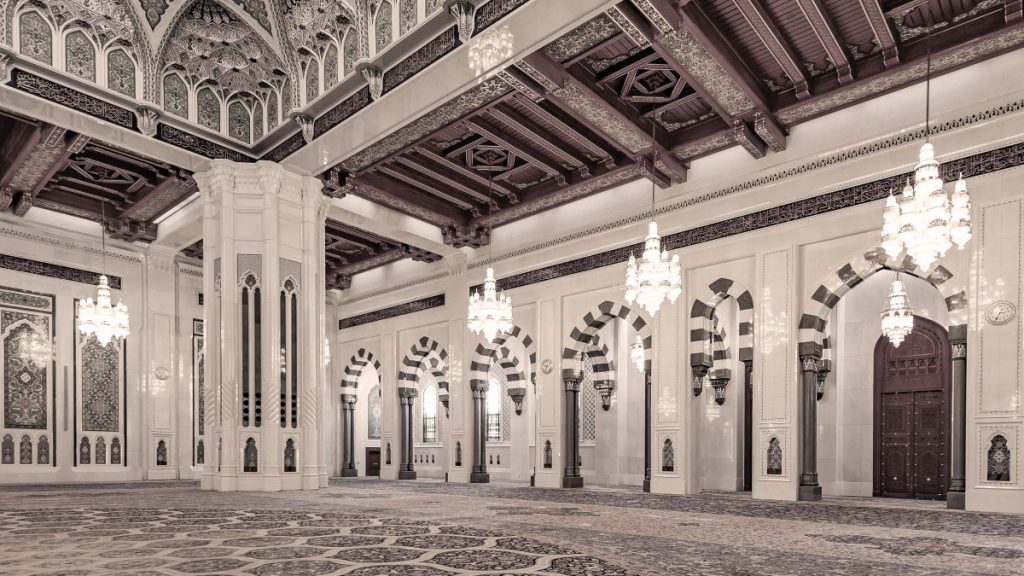
Each corridor hall showcases a different Islamic culture from Andalusia to China in a gallery of civilisation
The History of the Sultan Qaboos Grand Mosque

A Sultan’s Gift to His Nation
Sultan Qaboos bin Said Al Said (1940-2020) came to power in 1970 and spent the next fifty years transforming Oman from one of the most isolated countries in the world into a modern, educated, and prosperous nation. He built schools, hospitals, roads, and universities, and he invested heavily in preserving Oman’s Islamic heritage and culture. In 1992, he directed that Oman should have a Grand Mosque worthy of the nation, and in 1993 a design competition was held. The winning design was a collaborative effort between the Iraqi architect Mohammed Saleh Makiya and the design firm Quad Design, with interior design by Edgard Bali.
Sultan Qaboos was known for his extraordinary religious tolerance. During his reign, he did not only build over 50 mosques but also commissioned the construction of Catholic and Protestant churches and Hindu temples for Oman’s diverse expatriate communities, earning him deep respect across faiths. The Grand Mosque was his crowning achievement, a building he intended not only as a place of worship but as a centre for Islamic learning and culture, housing a library of over 20,000 volumes and an Institute of Islamic Sciences for young students.
The Sultan’s Vision
Sultan Qaboos bin Said Al Said directs that Oman should have a Grand Mosque befitting the nation’s Islamic heritage and its place in the modern world. A design competition is announced the following year, attracting proposals from architects across the Islamic world.
Construction Begins
After a site is chosen at Bawshar, along the main road between Muscat and Seeb, construction begins under the contract awarded to Carillion Alawi LLC. The project will require 300,000 tonnes of Indian sandstone and involve artisans from across the Islamic world, including 600 Iranian women who will weave the prayer hall carpet over four years.
Inaugurated by the Sultan
After six years and seven months of construction, the Sultan Qaboos Grand Mosque is inaugurated by Sultan Qaboos himself, exactly 30 years after he came to power. When it opens, it holds two world records: the largest single-piece hand-woven carpet and the largest chandelier in any mosque. It immediately becomes Oman’s most iconic landmark.
Among the World’s Most Beautiful
The Sultan Qaboos Grand Mosque is featured by The Telegraph (UK) as one of the 25 most beautiful mosques in the world. The mosque continues to draw visitors of all faiths from around the globe and serves as a centre for Islamic learning through its library of over 20,000 volumes and its Institute of Islamic Sciences.
The Sultan’s Legacy
Sultan Qaboos bin Said Al Said passes away on 10th January 2020 after nearly 50 years in power. His Grand Mosque remains his most visible legacy, a gift to the people of Oman that embodies his vision of Islam as a faith of beauty, knowledge, tolerance, and unity. He is succeeded by Sultan Haitham bin Tariq.
A Sultan’s Prayer for His People
The Sultan Qaboos Grand Mosque is more than a building. It is a statement about what Islam means to Oman: a faith of knowledge, beauty, openness, and peace. Sultan Qaboos designed his mosque to welcome visitors of all faiths, to house a library alongside its prayer hall, and to celebrate the artistic traditions of every corner of the Islamic world within its corridors. In a region often associated with division, this mosque stands as a monument to unity, tolerance, and the pursuit of beauty in the service of Allah.
Allah says in Surah Az-Zumar of the Quran:
اَمَّنۡ ہُوَ قَانِتٌ اٰنَآءَ الَّیۡلِ سَاجِدًا وَّقَآئِمًا یَّحۡذَرُ الۡاٰخِرَۃَ وَیَرۡجُوۡا رَحۡمَۃَ رَبِّہٖ
“Is one who worships devoutly during the hours of the night, prostrating and standing, fearing the Hereafter and hoping for the mercy of his Lord, equal to one who does not?”
The Sultan Qaboos Grand Mosque was built for those who stand in the night, those who prostrate at dawn, and those who seek knowledge in the afternoon. Every thread of its carpet, every crystal of its chandelier, and every verse inscribed on its walls exists for a single purpose: to bring the worshipper closer to Allah.
FAQ About the Sultan Qaboos Grand Mosque
The mosque is located in the Al-Ghubra district of Bawshar, along the main road between Muscat and Seeb in the Muscat Capital Area, Oman. It occupies a vast 416,000 square metre site and is easily accessible from across the capital. Its main minaret, at 91.5 metres, makes it the tallest building in Oman and visible from a great distance.
Construction began in December 1994 and took six years and seven months. The mosque was inaugurated on 4th May 2001 by Sultan Qaboos to celebrate the 30th anniversary of his reign. It was built using 300,000 tonnes of Indian sandstone.
Yes. The Sultan Qaboos Grand Mosque is the only mosque in Oman open to non-Muslim visitors. It is open Saturday to Thursday, from 8:30am to 11:00am. Admission is free. Visitors are asked to dress modestly, covering arms and legs. Women must cover their hair. Abayas and scarves can be rented at the entrance. Children under ten are not permitted in the prayer halls. The mosque is closed to visitors on Fridays.
Ibadhi Islam (also spelled Ibadi) is the predominant school of Islamic jurisprudence in Oman and is distinct from both Sunni and Shia traditions. It is one of the oldest branches of Islam, known for its emphasis on tolerance, moderation, and the importance of the community. The Sultan Qaboos Grand Mosque serves as a centre for the dissemination of the Ibadhi tradition, which has shaped Oman’s culture of religious coexistence and mutual respect.
The hand-woven carpet measures approximately 70 x 60 metres (4,343 square metres), weighs 21 tonnes, and contains 1.7 million knots. It was woven by over 600 Iranian women over four years and uses 28 colours in varying shades, most from traditional vegetable dyes. Its design combines the classical Persian carpet traditions of Tabriz, Kashan, and Isfahan. When the mosque opened in 2001, it was the largest single-piece carpet in the world (now the second largest).
The architectural design was a collaboration between Iraqi architect Mohammed Saleh Makiya and the design firm Quad Design, with interior design by Edgard Bali. The design was selected through a competition held in 1993 and draws from Ottoman, Persian, Mughal Indian, Egyptian, and traditional Omani architectural traditions. The building contract was carried out by Carillion Alawi LLC.
A Gift Woven in Light and Stone
The Sultan Qaboos Grand Mosque is a mosque that was born from love: the love of a Sultan for his people, and the love of a people for their faith. In a country that prides itself on quiet dignity rather than loud spectacle, it is a building of extraordinary beauty and restraint, where the finest artisans of the Islamic world were brought together to create a space that honours every tradition while belonging unmistakably to Oman. Every carpet knot, every crystal, every verse of calligraphy is a prayer made visible.
As Allah, Al-Kareem (The Most Generous), is the source of all generosity, the Sultan Qaboos Grand Mosque stands as a reminder that the most beautiful gifts are those given not for oneself but for the worship of the One who gave us everything.
May Allah preserve the mosques of this Ummah and bless those who build and maintain them. Ameen.