The Badshahi Mosque
The last great Mughal mosque
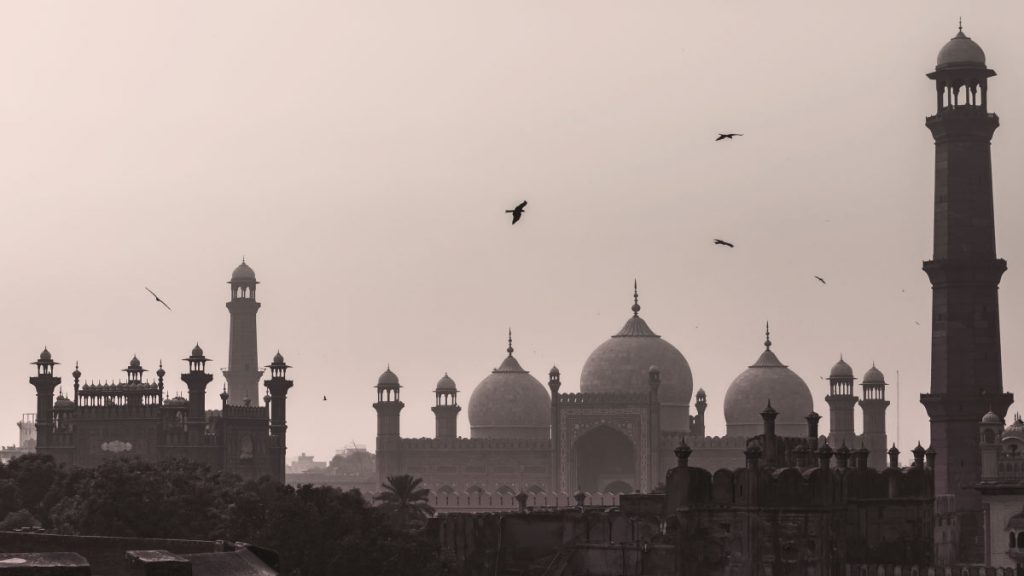
Standing in magnificent defiance of time on the outskirts of the Walled City of Lahore, Pakistan, the Badshahi Mosque (بادشاہی مسجد) is the last great imperial mosque of the Mughal Empire and one of the most iconic landmarks in the Islamic world. Commissioned in 1671 by the sixth Mughal emperor, Aurangzeb Alamgir, and completed in just two years, this colossal structure of red sandstone and white marble was the largest mosque in the world at the time of its opening. Today, it remains the second largest in Pakistan and a powerful symbol of Mughal grandeur, faith, and resilience.
In this article, we explore the history, architecture, and fascinating facts about the Badshahi Mosque, a monument that survived desecration and neglect to rise again as the beating heart of Lahore.
“The mosque is the school of sacrifice and devotion.”
What Is the Badshahi Mosque?
The Badshahi Mosque (meaning “Emperor’s Mosque”) was built between 1671 and 1673 under the supervision of Muzaffar Hussain (also known as Fidai Khan Koka), Aurangzeb’s foster brother and the governor of Lahore. It stands directly opposite the Lahore Fort, separated by the beautiful Hazuri Bagh gardens, creating a deliberate visual dialogue between imperial power and devotion to Allah. The mosque is situated next to the Roshnai Gate, one of the thirteen original gates of the Walled City of Lahore.
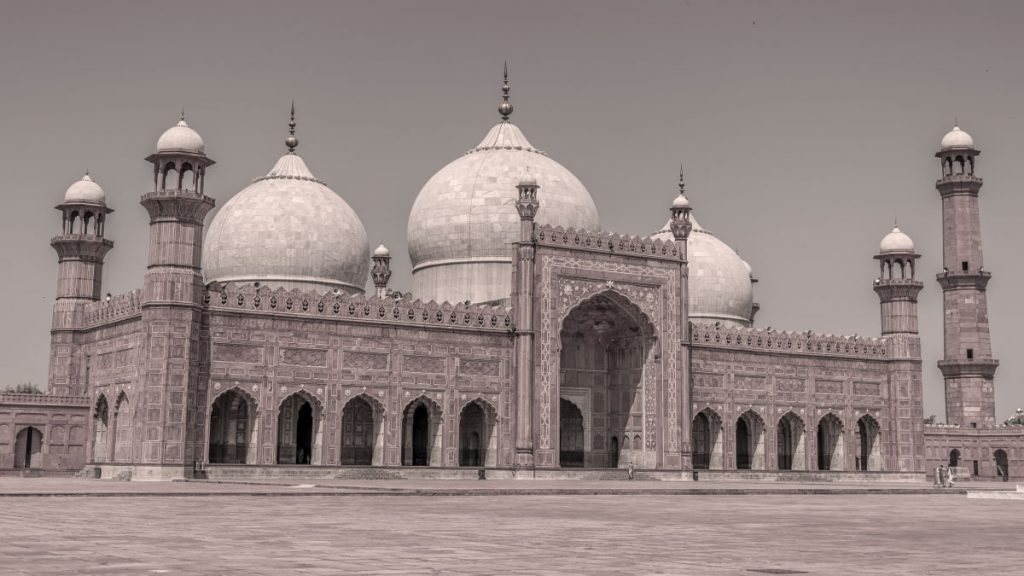
Aurangzeb chose an architectural plan modelled on his father Shah Jahan’s Jama Masjid in Delhi, but built the Badshahi Mosque on a much grander scale. Both mosques share the distinctive combination of red sandstone with white marble inlay, a departure from the intricate tilework (kashi kari) that was typical of Lahore’s earlier mosques. The mosque can accommodate over 55,000 worshippers in its prayer hall and vast courtyard combined, with the prayer hall alone holding 10,000. It has been on the UNESCO World Heritage Site tentative list since 1993.
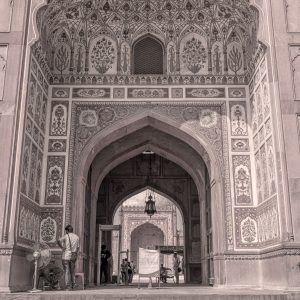
The Architecture: The Emperor’s Final Masterpiece
Domes, Minarets, and Red Sandstone
The Badshahi Mosque is crowned by three grand bulbous domes clad in white marble, the central one slightly larger than the flanking pair. Rising at the four corners of the vast courtyard are four octagonal minarets, each standing 60 metres (196 feet) tall with an outer circumference of 20 metres, each topped by a marble canopy. A further four smaller octagonal minarets are attached to the corners of the prayer hall itself, giving the mosque a total of eight minarets.
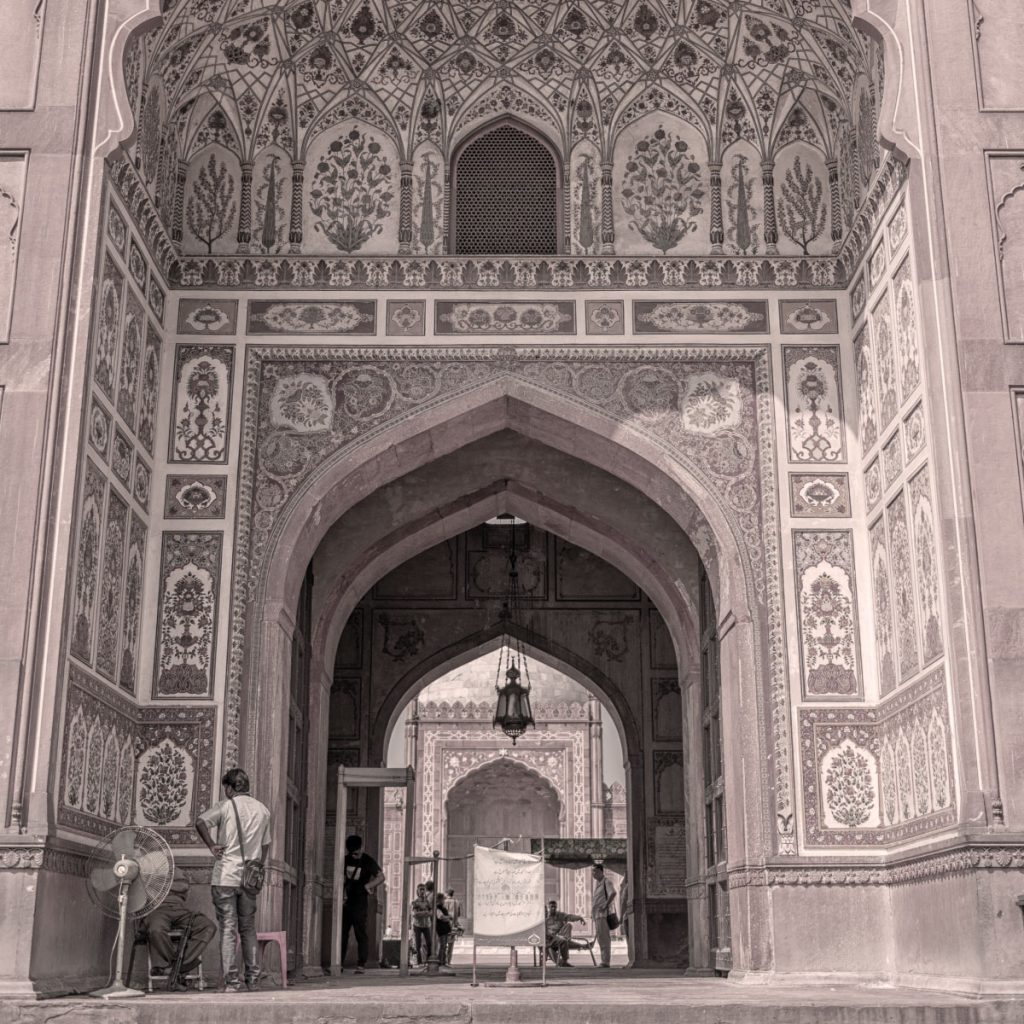
The entire complex is raised upon a high stone platform, approached from the east by a magnificent flight of 22 steps leading to a two-storey entrance gateway decorated with elaborately carved and framed panels on every facade. This gateway also introduces a feature from Middle Eastern architecture: muqarnas (honeycomb vaulting), making the Badshahi Mosque one of the first buildings in Lahore to incorporate this element.
Unlike the richly decorated mosques of Shah Jahan’s era, Aurangzeb’s Badshahi Mosque embraces a philosophy of disciplined restraint. The exterior walls of red sandstone stretch wide and unbroken, interrupted only by arches, cornices, and subtle patterns in white marble inlay. This minimalism makes proportion, scale, and light the true decoration. In an empire where architectural excess was common, the Badshahi Mosque expressed power through austerity, a reflection of Aurangzeb’s own character as a ruler known for his personal piety and simplicity.
When it was completed in 1673 the Badshahi Mosque was the largest mosque in the world
The Prayer Hall
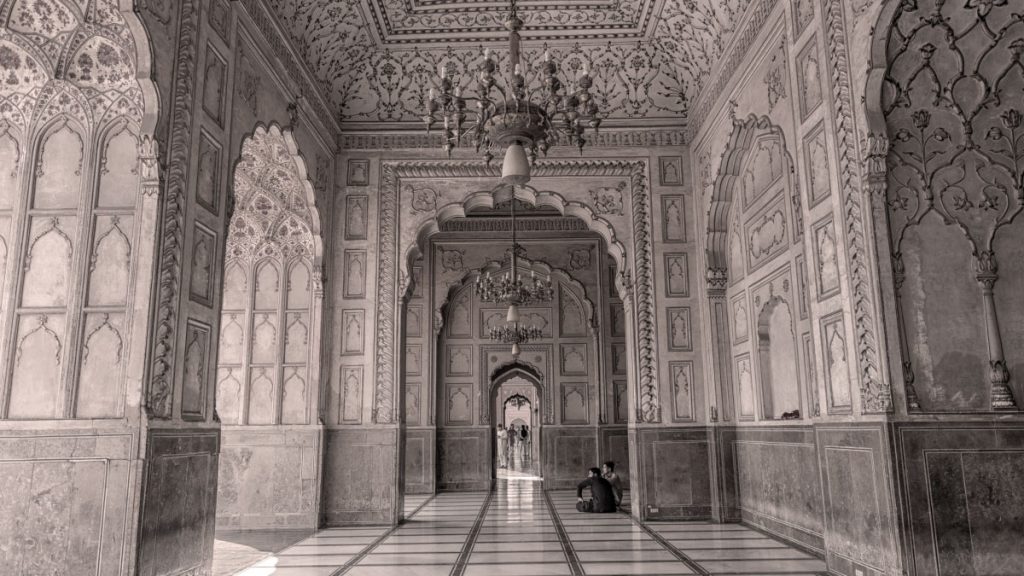
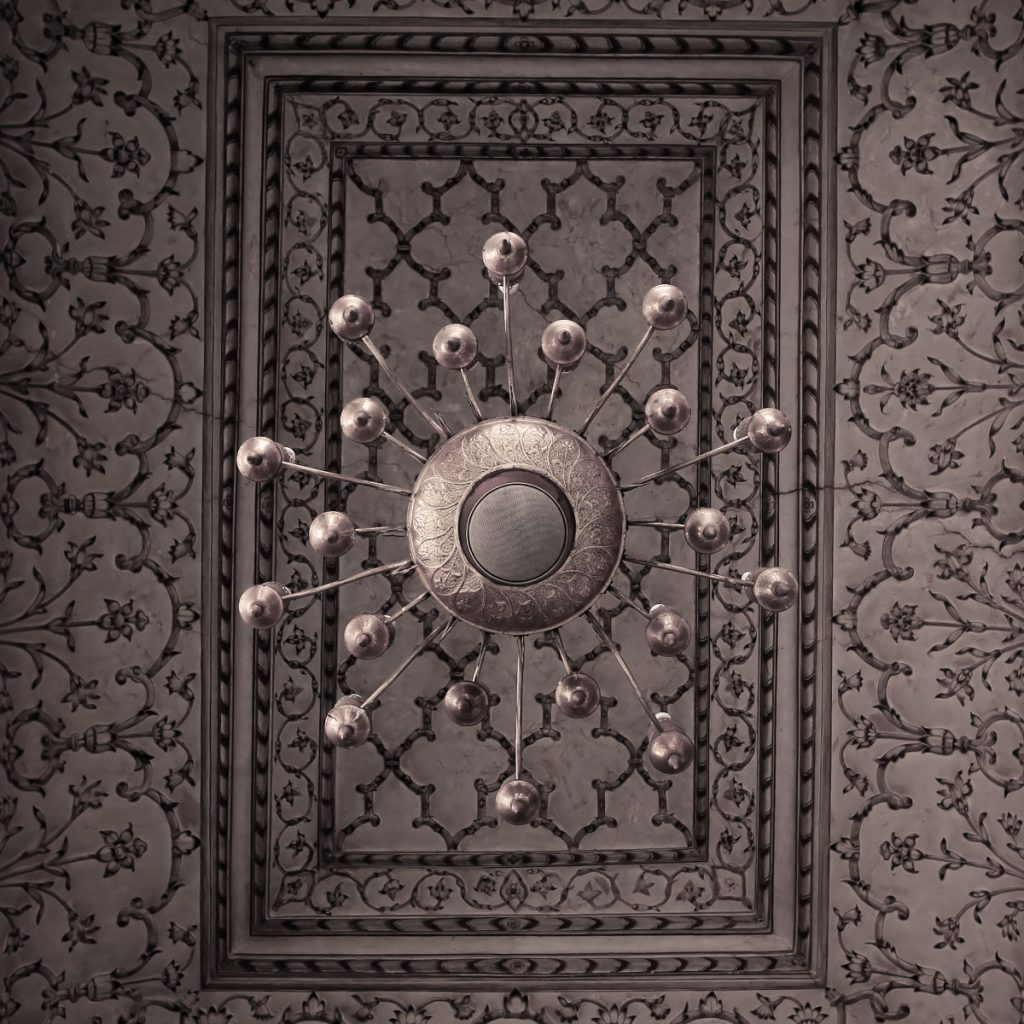
The interior of the prayer hall is a masterpiece of Mughal decorative art. The walls and ceilings are adorned with intricate floral motifs carved in stucco relief, fresco paintings, and white marble inlay work. Verses from the Quran are inscribed across the walls, while delicate Zanjira interlacing patterns (interlocking geometric designs) and floral tendrils in bold relief are considered unsurpassed works of Mughal craftsmanship. The prayer hall is divided into seven compartments separated by richly carved arches supported by heavy columns, with chambers on either side that were originally used for religious instruction.
Sacred Relics of the Prophet
One of the most spiritually significant features of the Badshahi Mosque is a small gallery on the upper floor of the main entrance that houses sacred relics attributed to the Prophet Muhammad (pbuh), as well as relics associated with Ali (may Allah be pleased with him), Fatima (may Allah be pleased with her), Imam Hassan, and Imam Hussain (may Allah be pleased with them). This collection makes the Badshahi Mosque not only a place of prayer but a site of deep reverence and pilgrimage for Muslims from around the world.
The mosque houses relics of the Prophet Muhammad (pbuh) and members of the Prophet’s blessed family
The History of the Badshahi Mosque
An Emperor’s Statement of Faith
Aurangzeb Alamgir (1618-1707) was unlike his predecessors. While his father Shah Jahan was the greatest builder in Mughal history, and his grandfather Akbar was famous for his religious tolerance, Aurangzeb was known above all for his personal piety and devotion to Islam. He spent much of his reign on military campaigns rather than architectural projects, but when he chose to build, he built on a monumental scale. The Badshahi Mosque was commissioned to commemorate his military campaigns in the south, and he chose Lahore as its location because of its strategic importance as the gateway to Persia, Afghanistan, and Central Asia.
To connect the mosque to the Lahore Fort, Aurangzeb ordered the construction of the Alamgiri Gate (named after himself), which faces directly towards the mosque’s entrance across the Hazuri Bagh. The gate has become one of the most photographed and iconic features of the fort, inseparable from the mosque it was built to honour.

A Mosque That Survived Desecration
After the fall of the Mughal Empire, the Badshahi Mosque endured one of the darkest chapters in the history of any Islamic monument. Under the Sikh Empire (from 1799), the vast courtyard was converted into horse stables, the surrounding rooms were used as military barracks, and the marble, rubies, gold, and other treasures were stripped from the building. Muslims were forbidden from entering the mosque to worship.
An earthquake in 1840 destroyed the canopies atop the minarets. The British, who took control in 1849, initially continued to use the mosque for military purposes before returning it to the Muslim community. A full restoration did not begin until 1939 and continued for two decades, led by Sir Sikander Hayat Khan and later by the newly independent state of Pakistan, bringing the Badshahi Mosque back to its original glory.
Construction Begins
Mughal Emperor Aurangzeb Alamgir commissions the construction of an imperial mosque opposite the Lahore Fort. His foster brother Muzaffar Hussain (Fidai Khan Koka), the governor of Lahore, supervises the project. The Alamgiri Gate is simultaneously built at the fort to face the mosque’s entrance.
The World’s Largest Mosque
After just two years of construction, the Badshahi Mosque is completed and opened for worship. With its vast courtyard, eight minarets, three marble domes, and capacity for over 55,000 worshippers, it becomes the largest mosque in the world, a title it will hold for centuries.
Desecration Under the Sikh Empire
Maharaja Ranjit Singh captures Lahore and the Badshahi Mosque is converted into horse stables and military barracks. Marble, rubies, gold, and other precious materials are stripped from the building. Minaret canopies are removed and their marble repurposed. Muslims are forbidden from entering to worship, and a small area outside is all that is permitted for prayer.
British Control and Return
The British take control of Lahore and initially continue to use the mosque for military purposes. They eventually return it to the Muslim community as a functioning mosque, but the building remains badly damaged, with its treasures looted and its minarets stripped of their domes.
The Great Restoration
A comprehensive restoration programme is launched under Sir Sikander Hayat Khan, the premier of Punjab, and continues after Pakistan’s independence in 1947. The minaret domes are replaced, the marble inlay is repaired, and the mosque is restored to its original grandeur. Red sandstone for the courtyard is later imported from the original Mughal source near Jaipur, India.
39 Muslim Heads of State Pray Together
During the 2nd Islamic Summit held in Lahore, thirty-nine heads of Muslim states offer their Friday prayers together at the Badshahi Mosque. Among them are Zulfiqar Ali Bhutto of Pakistan, King Faisal of Saudi Arabia, Muammar Gaddafi of Libya, Yasser Arafat of Palestine, and dignitaries from across the Muslim world. It is one of the most historic gatherings ever held in any mosque.
The Emperor’s Mosque Endures
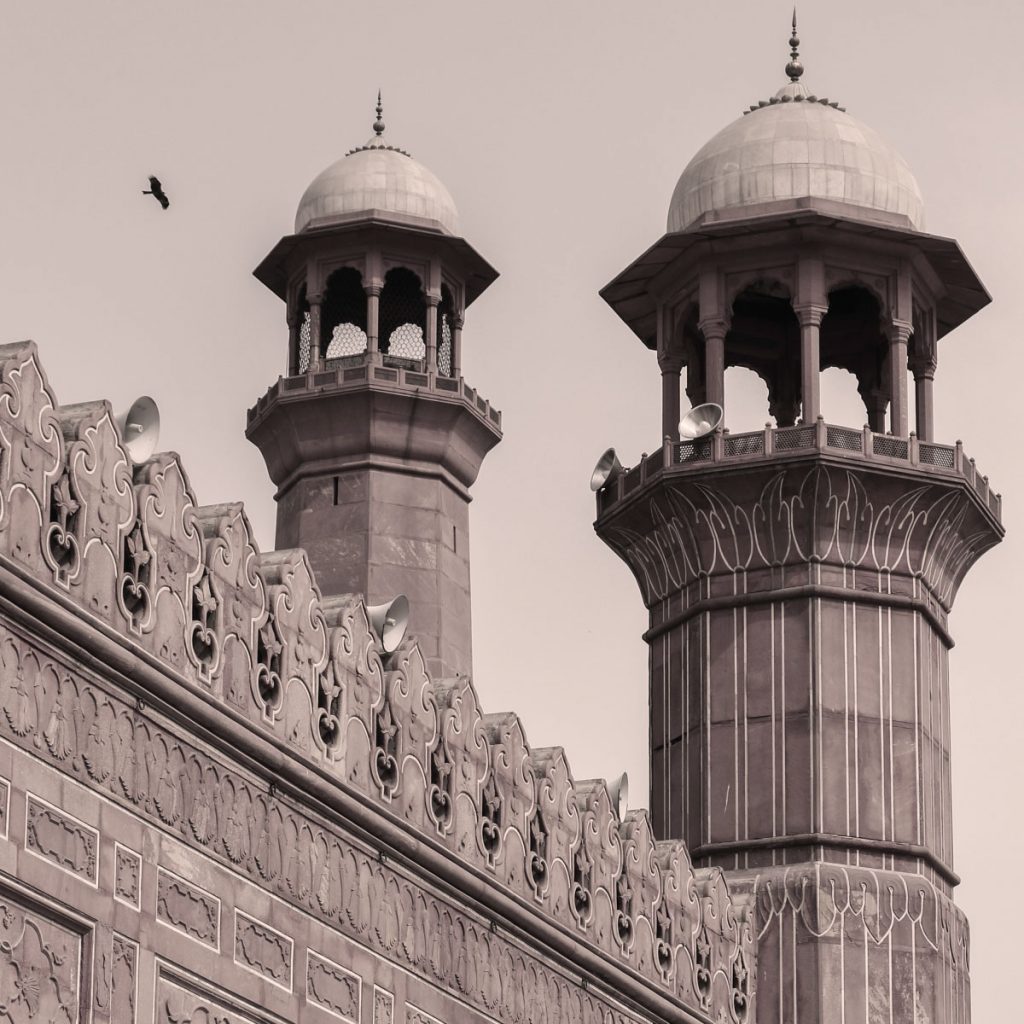
The Badshahi Mosque has witnessed the rise and fall of empires, survived desecration and neglect, weathered earthquakes and wars, and emerged from it all as one of the most beloved and iconic mosques in the Muslim world. Near its entrance lies the tomb of Allama Muhammad Iqbal, the poet and philosopher widely regarded as the spiritual founder of Pakistan, whose vision of a homeland for the Muslims of South Asia was realised just decades after the mosque was restored to its glory. The legendary Quran reciter Qari Abdul Basit is among those who have recited the Quran within its walls.
Allah says in Surah Al-Hajj of the Quran:
لِکُلِّ اُمَّۃٍ جَعَلۡنَا مَنۡسَکًا ہُمۡ نَاسِکُوۡہُ فَلَا یُنَازِعُنَّکَ فِی الۡاَمۡرِ وَادۡعُ اِلٰی رَبِّکَ
“For each community We have appointed a rite of worship which they observe. So do not let them dispute with you over this matter. And call the people to your Lord.”
The Badshahi Mosque stands as proof that no force on earth can silence the call to prayer forever. Even after its darkest years, when its courtyard held horses instead of worshippers, the mosque was returned to its purpose, restored to its beauty, and filled once again with the voices of the faithful. It is not just a monument to the Mughal Empire; it is a monument to the resilience of faith itself.
FAQ About the Badshahi Mosque
The Badshahi Mosque is located in Lahore, Punjab, Pakistan, on the outskirts of the historic Walled City. It stands directly opposite the Lahore Fort, separated by the Hazuri Bagh gardens, and is situated next to the Roshnai Gate, one of the thirteen original gates of old Lahore. Nearby landmarks include Minar-e-Pakistan and the tomb of Allama Iqbal.
The mosque was built between 1671 and 1673 during the reign of the sixth Mughal emperor, Aurangzeb Alamgir. Construction took just two years under the supervision of Muzaffar Hussain (Fidai Khan Koka), the governor of Lahore. At the time of its completion, it was the largest mosque in the world.
The Badshahi Mosque can accommodate over 55,000 worshippers in its prayer hall and courtyard combined, with the prayer hall alone holding 10,000. The four main minarets stand at 60 metres (196 feet) tall. The mosque features three white marble domes, eight minarets in total (four large and four small), and a vast courtyard accessed by a grand flight of 22 steps. It is currently the second largest mosque in Pakistan after the Faisal Mosque in Islamabad.
After Maharaja Ranjit Singh captured Lahore in 1799, the Badshahi Mosque was converted into horse stables and military barracks. Marble, gold, rubies, and other precious materials were stripped from the building. The domes atop the minarets were removed and repurposed. Muslims were forbidden from entering the mosque to worship. The mosque was later further damaged when Sikh factions fought amongst themselves after Ranjit Singh’s death. It was not fully restored until between 1939 and 1960.
A small gallery on the upper floor of the main entrance houses sacred relics attributed to the Prophet Muhammad (pbuh), as well as relics associated with Ali, Fatima, Imam Hassan, and Imam Hussain (may Allah be pleased with them all). Emperor Aurangzeb originally commissioned the mosque in part to house these precious relics, making it a site of pilgrimage and deep reverence for Muslims.
“Badshahi” means “Emperor’s” or “Imperial” in Urdu. The mosque’s full official name is “Masjid Abul Zafar Muhy-ud-Din Mohammad Alamgir Badshah Ghazi”, which is inscribed in white marble above the vaulted entrance. It was named after its patron, Emperor Aurangzeb Alamgir, the sixth and last of the great Mughal emperors, who commissioned it as a statement of both imperial power and personal devotion to Allah.
The Last Great Mughal Mosque
The Badshahi Mosque is the final chapter of Mughal mosque architecture, the culmination of a tradition that began with Babur and reached its artistic peak under Shah Jahan. It is a mosque that has known both the glory of empires and the agony of occupation, and has survived it all. Its design went on to inspire mosques across the world, including the Sheikh Zayed Grand Mosque in Abu Dhabi, whose dome layout and floor plan were directly influenced by this Lahore masterpiece.
As Allah, Al-Aziz (The Almighty), grants honour and strength to whom He wills, the Badshahi Mosque stands as a reminder that the houses of Allah endure long after the empires that built them have passed away.
May Allah preserve the mosques of this Ummah and bless those who build and maintain them. Ameen.