
The Taj Mahal
Love written in marble
Rising in luminous white marble on the banks of the Yamuna River in Agra, India, the Taj Mahal (تاج محل) is universally regarded as one of the most beautiful buildings ever created by human hands. Commissioned in 1631 by the fifth Mughal emperor, Shah Jahan, as a mausoleum for his beloved wife Mumtaz Mahal, it is described by UNESCO as “the jewel of Muslim art in India and one of the universally admired masterpieces of the world’s heritage.” More than a monument to love, the Taj Mahal is the finest expression of Indo-Islamic architecture, a building where Persian, Islamic, and Indian traditions come together in perfect harmony.
In this article, we explore the history, architecture, and fascinating facts about the Taj Mahal, a monument where love, loss, and devotion are written in marble, calligraphy, and light.
It makes the sun and the moon shed tears from their eyes
What Is the Taj Mahal?
The Taj Mahal (meaning “Crown of the Palace”) is an ivory-white marble mausoleum situated on the right bank of the Yamuna River in Agra, Uttar Pradesh, India. The tomb is the centrepiece of a vast 17-hectare (42-acre) complex that includes a mosque, a guest house, formal gardens, and a monumental gateway of red sandstone. Construction of the mausoleum began in 1632 and was substantially complete by 1648, with the entire complex finished by 1653, at an estimated cost equivalent to over $800 million in modern terms.
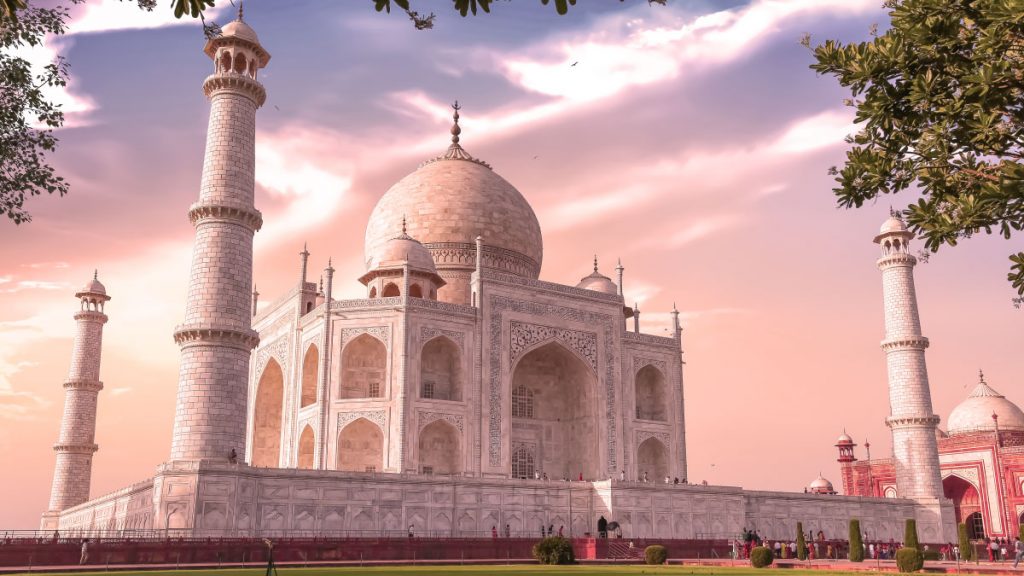
The building was designed and executed by an international team of architects and artisans, led by the emperor’s court architect Ustad Ahmad Lahori. The team included an Ottoman dome designer, Persian architects, a chief calligrapher from Shiraz, sculptors from Bukhara, stone cutters from Baluchistan, and inlay specialists from southern India. In all, over 20,000 workers and 1,000 elephants were employed to transport materials from across Asia, including white marble from Rajasthan, jade and crystal from China, turquoise from Tibet, lapis lazuli from Afghanistan, and sapphire from Sri Lanka.
The Architecture: A Paradise on Earth
The Dome and the Minarets
The most iconic feature of the Taj Mahal is its bulbous central dome, rising to a height of 73 metres (240 feet) and surrounded by four smaller domes. The dome is topped with a gilded finial that originally combined traditional Islamic and Hindu decorative elements, including a crescent moon, a motif common to Islamic architecture. Together, the finial and the dome’s lotus design create a unified point that draws the eye heavenward.
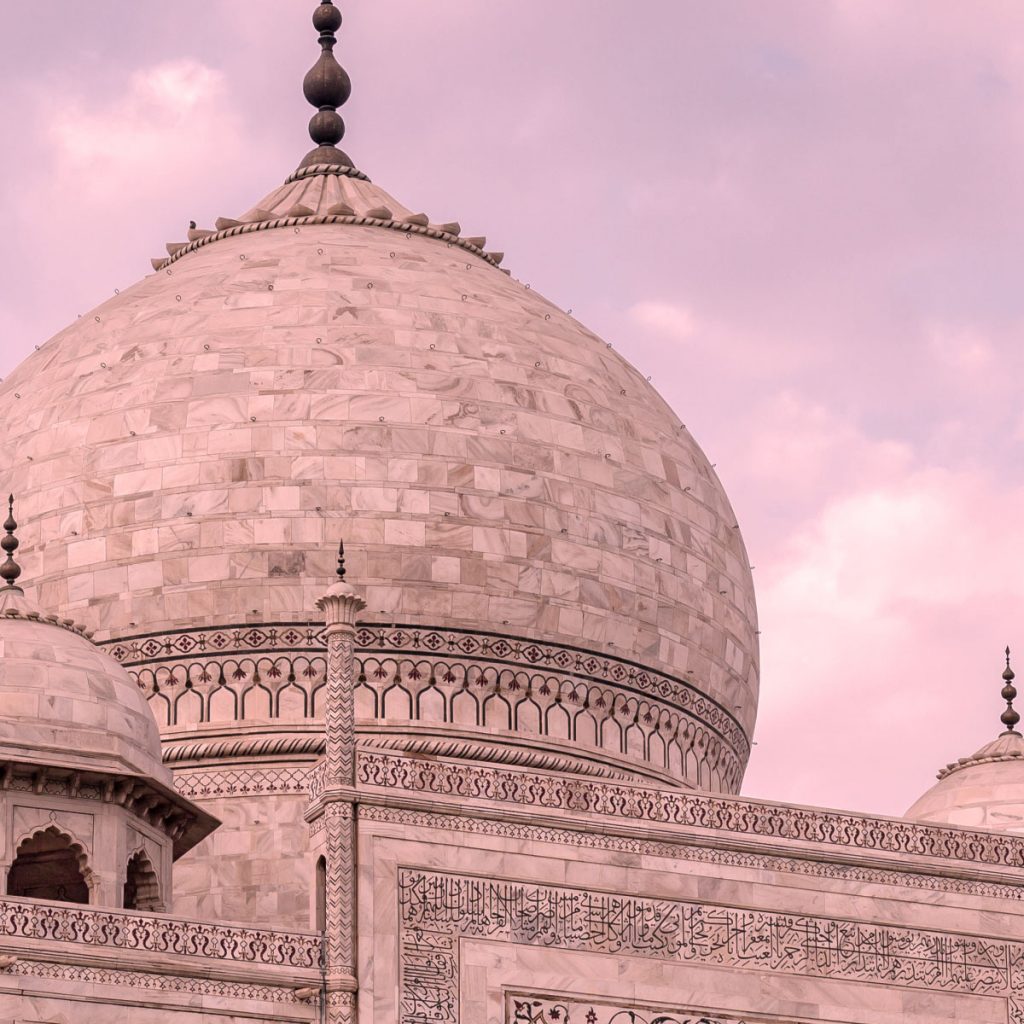
At the four corners of the raised platform stand four free-standing minarets, each approximately 40 metres (130 feet) tall. Unlike the minarets of most mosques, these are purely decorative rather than functional, designed to frame the mausoleum and give it a three-dimensional presence from every angle. Each minaret is slightly tilted outward, an ingenious engineering decision that ensures that if they were ever to collapse, they would fall away from the tomb rather than onto it.
The white marble that gives the Taj Mahal its ethereal glow is famous for appearing to change colour throughout the day: pinkish in the morning, dazzling white at noon, and golden under the moon. This is not an accident but a property of the translucent Makrana marble from Rajasthan, chosen specifically for this effect. The marble is inlaid with 28 types of precious and semi-precious stones using the pietra dura technique, creating intricate floral patterns of astonishing detail.
The four minarets tilt slightly outward so that if they ever fell they would fall away from the tomb
The Quranic Calligraphy
Across the arched entrances and walls of the Taj Mahal, verses from the Quran are inscribed in magnificent calligraphy by the master calligrapher Amanat Khan al-Shirazi. The inscriptions include passages from Surah Ya-Sin, Surah Al-Fajr, and other chapters, carefully selected to speak of the Day of Judgement, paradise, and divine mercy. One of the most significant inscriptions, found on the great gateway, is from Surah Al-Fajr (89:28-30), which invites the faithful soul to “Enter among My servants. Enter My Paradise.”
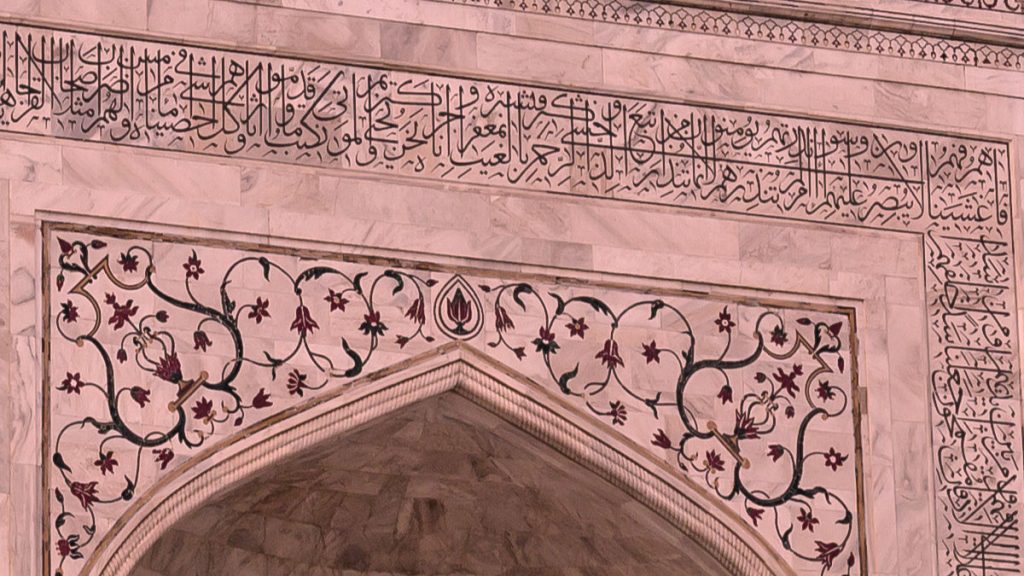
In a remarkable display of optical precision, the calligraphy increases in size as it rises higher on the building, so that from the viewer’s vantage point on the ground, every line appears to be the same size. This technique ensures that the Word of Allah is always legible, no matter where the eye falls. Amanat Khan was so proud of his work that he became the only craftsman to sign his name on the Taj Mahal.
The jewel of Muslim art in India
The Gardens of Paradise
The Taj Mahal is set within a monumental Charbagh (four-part) garden, a design rooted in the Islamic concept of Jannah (paradise). The garden is divided into four equal sections by raised marble walkways and long reflecting pools that mirror the mausoleum. The plan follows the hasht-behesht (eight paradises) principle, with eight divisions reflecting the eight levels of paradise described in Islamic tradition. The complex also includes a functioning mosque built of red sandstone to the west of the mausoleum, facing Makkah, which remains in use for Friday prayers to this day.
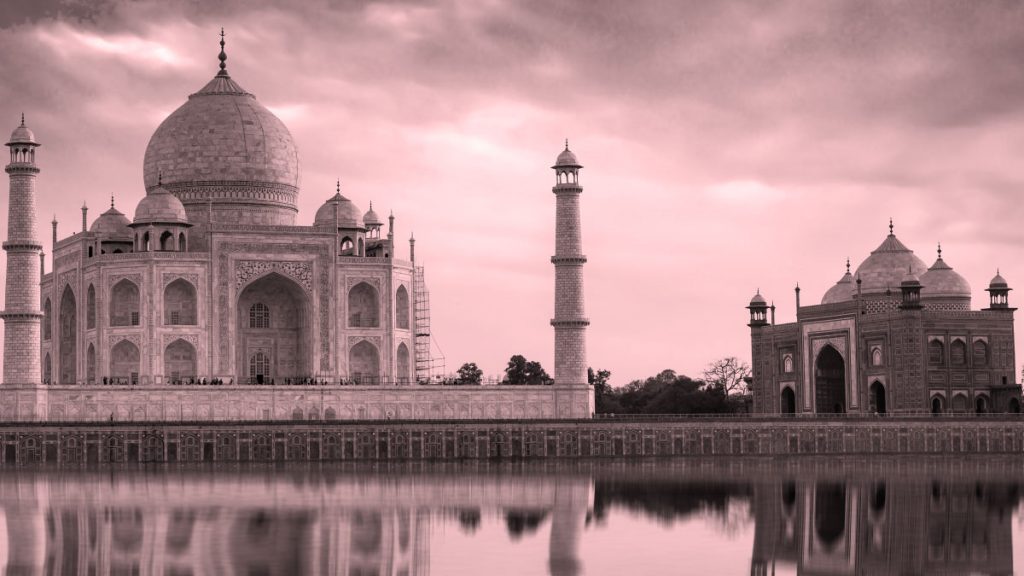
Over 20,000 workers and 1,000 elephants transported materials from across Asia over 22 years of construction
The History of the Taj Mahal
A Love That Built an Empire’s Greatest Monument
Shah Jahan married Arjumand Banu Begum in 1612. He gave her the title Mumtaz Mahal (“Chosen One of the Palace”), and she became his inseparable companion, travelling with him even on military campaigns. She was his trusted adviser, his confidante, and the love of his life. When Mumtaz Mahal died in 1631 during the birth of their fourteenth child, the emperor was said to have been so consumed by grief that his hair turned grey and he wept for weeks.
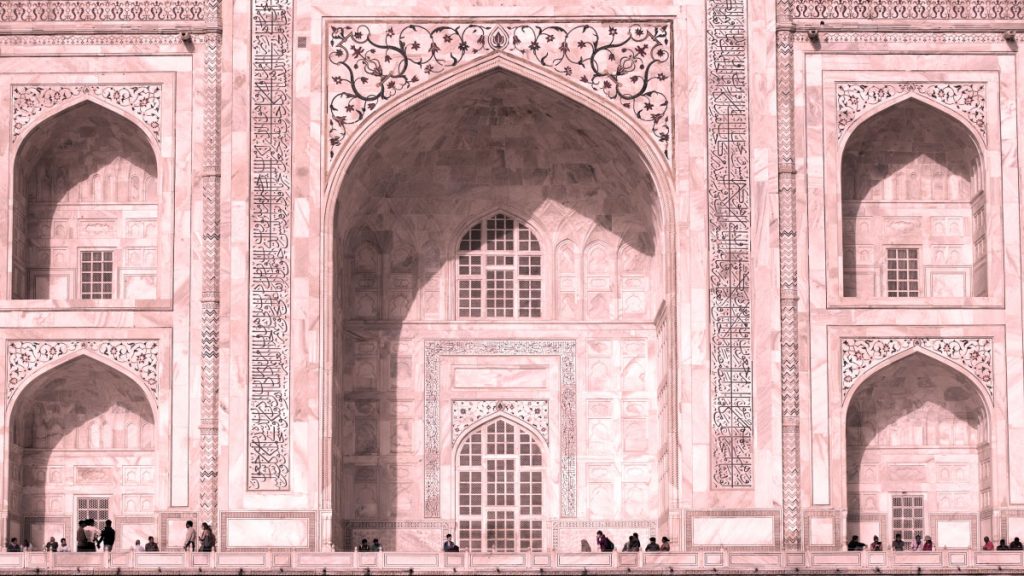
Determined to create a monument worthy of their love, Shah Jahan commissioned a mausoleum that would be the most beautiful building the world had ever seen. The result, twenty-two years later, was the Taj Mahal. When Shah Jahan himself died in 1666, after spending the last years of his life under house arrest in the Red Fort of Agra, gazing at the Taj Mahal from his window, he was buried beside Mumtaz Mahal in the same tomb chamber, reunited in death as they had been inseparable in life.
The Death of Mumtaz Mahal
Mumtaz Mahal dies on 17th June 1631 during the birth of her fourteenth child. Shah Jahan is said to have been inconsolable. He vows to build the most magnificent tomb the world has ever seen in her memory, commissioning the project that same year.
Construction Begins
Work begins on the south bank of the Yamuna River in Agra. Over 20,000 workers are recruited from across northern India, and a multinational team of architects, calligraphers, and artisans is assembled, including specialists from Persia, the Ottoman Empire, Bukhara, and southern India. More than 1,000 elephants are used to transport marble and stone.
The First Ceremony
On 6th February 1643, Shah Jahan holds the first formal ceremony at the mausoleum, marking the 12th anniversary of Mumtaz Mahal’s death. Though the tomb is largely complete, work continues on the surrounding complex for another decade.
The Complex Is Completed
After 22 years and a cost equivalent to over $800 million in modern terms, the Taj Mahal complex is complete. It includes the white marble mausoleum, a red sandstone mosque, a guest house, monumental gateway, Charbagh gardens, and reflecting pools. The complex is the crowning achievement of Mughal architecture.
Shah Jahan Is Buried Beside His Wife
Shah Jahan dies on 22nd January 1666, having spent his final years under house arrest in the Red Fort of Agra, from where he could see the Taj Mahal from his window. He is buried beside Mumtaz Mahal in the mausoleum’s tomb chamber, reunited with his beloved wife after 35 years apart.
UNESCO World Heritage Site
The Taj Mahal is designated a UNESCO World Heritage Site, described as “the jewel of Islamic art in India and one of the universally admired masterpieces of the world’s heritage.” Today, it attracts approximately 3 million visitors each year and remains one of the most photographed buildings on earth.
An Invitation to Paradise
The Taj Mahal is not merely a tomb. It is an architectural representation of the Islamic vision of Jannah (paradise). The gardens are modelled on the Quranic description of paradise, the octagonal floor plan represents the eight levels of heaven, and the Quranic verses inscribed across the building culminate in a direct invitation from Allah to the righteous soul: “Enter My Paradise.”
Allah says in Surah Al-Fajr of the Quran:
یٰۤاَیَّتُہَا النَّفۡسُ الۡمُطۡمَئِنَّۃُ ﴿٭ۖ۲۷﴾ ارۡجِعِیۡۤ اِلٰی رَبِّکِ رَاضِیَۃً مَّرۡضِیَّۃً ﴿ۚ۲۸﴾ فَادۡخُلِیۡ فِیۡ عِبٰدِیۡ ﴿ۙ۲۹﴾ وَادۡخُلِیۡ جَنَّتِیۡ ﴿٪۳۰﴾
“O soul at peace, return to your Lord, well pleased and well pleasing. Enter among My servants. Enter My Paradise.”
These are the very words inscribed on the great gateway of the Taj Mahal, greeting every visitor who enters. Shah Jahan chose them not as decoration, but as a prayer: that his beloved Mumtaz Mahal would be among those whom Allah welcomes into eternal peace. Nearly four centuries later, those words still echo through the marble arches, a reminder that behind every stone of this monument lies not just love, but faith.
FAQ About the Taj Mahal
The Taj Mahal is located on the right bank of the Yamuna River in Agra, Uttar Pradesh, India. It sits within a vast 17-hectare complex that includes formal gardens, a mosque, a guest house, and a monumental gateway. Agra is approximately 200 kilometres south of Delhi.
The Taj Mahal was commissioned by the Mughal emperor Shah Jahan in 1631 to serve as a mausoleum for his beloved wife, Mumtaz Mahal, who died during childbirth. Devastated by her loss, Shah Jahan vowed to build the most magnificent tomb the world had ever seen. When he died in 1666, he was buried beside her in the same tomb chamber.
The mausoleum itself was substantially complete by 1648, but work on the wider complex continued until 1653, a total of approximately 22 years. Over 20,000 workers and artisans from across India and the Islamic world were involved, along with 1,000 elephants used to transport materials. The total cost was equivalent to over $800 million in modern terms.
The Taj Mahal itself is a mausoleum (tomb), not a mosque. However, the complex includes a functioning mosque built of red sandstone, situated to the west of the mausoleum and facing the direction of Makkah. This mosque remains in active use for Friday prayers to this day. A mirror-image building on the east side, sometimes called the “jawab” (answer), was built purely for architectural symmetry.
Verses from the Quran are inscribed across the arched entrances and walls of the Taj Mahal in exquisite calligraphy by the master calligrapher Amanat Khan al-Shirazi. The inscriptions include passages from Surah Ya-Sin, Surah Al-Fajr, and other chapters, speaking of paradise, the Day of Judgement, and divine mercy. The most famous inscription, on the great gateway, invites the soul to “Enter My Paradise” (Quran 89:30). The calligraphy increases in size as it rises higher so that it appears uniform from ground level.
The Taj Mahal is built from translucent Makrana marble from Rajasthan, which has the natural property of reflecting and absorbing light differently throughout the day. At dawn, the marble appears soft pink; at midday, it glows a brilliant white; and under moonlight, it takes on a silvery golden hue. This effect was known to the Mughal builders and is one of the reasons Makrana marble was chosen.
The Jewel of Muslim Art
The Taj Mahal is more than a monument to love. It is the crowning achievement of Islamic art in India, a building where the Quran is inscribed on the walls, paradise is mapped into the gardens, and every surface testifies to the skill and devotion of the Muslim artisans who created it. Nearly four centuries after its completion, it remains one of the most visited, most photographed, and most universally admired structures on earth, a gift from the Mughal world to all of humanity.
As Allah, Al-Wadud (The Most Loving), is the source of all love, the Taj Mahal stands as a reminder that the deepest human love is itself a reflection of the divine, and that the most beautiful things we build in this world are but shadows of the beauty that awaits in the next.
May Allah preserve the mosques and monuments of this Ummah and bless those who build and maintain them. Ameen.